




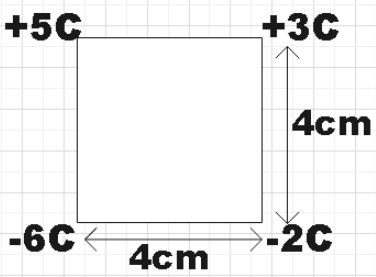
At the centre of the square
A. E=0, V=0
B. $E\ne 0$, V=0
C. E=0,$V\ne 0$
D. $E\ne 0,V\ne 0$
Answer
 Verified
598.8k+ views
Hint: As a first step, you could think of the differences between the two given quantities. Also, give a brief description about both. Now find the net potential and electric field due to these charges by considering the direction and sign as per requirement. Thus, determine which among the given options is true.
Formula used:
Electric field,
$E=\dfrac{kQ}{{{r}^{2}}}$
Electric potential,
$V=\dfrac{kQ}{r}$
Complete Step by step solution:
In the question, we are given four charges that are kept at the four corners of the square. The charges are +5C, +3C, -6C and -2C. The side of the square is given as 4cm. By using this information, we are supposed to find which among conditions given in the options is correct.
In order to find the answer to the question, we have to first understand what exactly electric potential and electric fields are. The electric field E due to some charge Q is given by,
$E=\dfrac{kQ}{{{r}^{2}}}$
The electric field is a vector quantity and thus for a system of charges, the net field would be the vector sum of these electric fields. The field due to positive charge would be directed away from it and that due to negative charge will be directed towards it.
Clearly, by doing the vector sum of the fields due to the given charges, we will get a non zero value.
Hence, $E\ne 0$
Now the potential is given by,
$V=\dfrac{kQ}{r}$
Electric potential being a scalar, net potential can be given by the sum of the potentials due to individual charges.
${{V}_{net}}=\dfrac{5k}{{{\left( 4\sqrt{2} \right)}^{2}}}+\dfrac{3k}{{{\left( 4\sqrt{2} \right)}^{2}}}-\dfrac{6k}{{{\left( 4\sqrt{2} \right)}^{2}}}-\dfrac{2k}{{{\left( 4\sqrt{2} \right)}^{2}}}$
$\therefore {{V}_{net}}=0$
Therefore, we found option B to be the correct answer.
Note:
You may have noted the constant k that we repeatedly used in every equation in the solution. This constant is known to have the value,
$k=\dfrac{1}{4\pi {{\varepsilon }_{0}}}=9\times {{10}^{9}}N{{m}^{2}}{{C}^{-2}}$
The electric potential can be defined as the work done to move unit electric charge from one point to the other. Electric field can be described as the gradient of electrostatic potential.
Formula used:
Electric field,
$E=\dfrac{kQ}{{{r}^{2}}}$
Electric potential,
$V=\dfrac{kQ}{r}$
Complete Step by step solution:
In the question, we are given four charges that are kept at the four corners of the square. The charges are +5C, +3C, -6C and -2C. The side of the square is given as 4cm. By using this information, we are supposed to find which among conditions given in the options is correct.
In order to find the answer to the question, we have to first understand what exactly electric potential and electric fields are. The electric field E due to some charge Q is given by,
$E=\dfrac{kQ}{{{r}^{2}}}$
The electric field is a vector quantity and thus for a system of charges, the net field would be the vector sum of these electric fields. The field due to positive charge would be directed away from it and that due to negative charge will be directed towards it.
Clearly, by doing the vector sum of the fields due to the given charges, we will get a non zero value.
Hence, $E\ne 0$
Now the potential is given by,
$V=\dfrac{kQ}{r}$
Electric potential being a scalar, net potential can be given by the sum of the potentials due to individual charges.
${{V}_{net}}=\dfrac{5k}{{{\left( 4\sqrt{2} \right)}^{2}}}+\dfrac{3k}{{{\left( 4\sqrt{2} \right)}^{2}}}-\dfrac{6k}{{{\left( 4\sqrt{2} \right)}^{2}}}-\dfrac{2k}{{{\left( 4\sqrt{2} \right)}^{2}}}$
$\therefore {{V}_{net}}=0$
Therefore, we found option B to be the correct answer.
Note:
You may have noted the constant k that we repeatedly used in every equation in the solution. This constant is known to have the value,
$k=\dfrac{1}{4\pi {{\varepsilon }_{0}}}=9\times {{10}^{9}}N{{m}^{2}}{{C}^{-2}}$
The electric potential can be defined as the work done to move unit electric charge from one point to the other. Electric field can be described as the gradient of electrostatic potential.
Recently Updated Pages
Master Class 9 General Knowledge: Engaging Questions & Answers for Success

Master Class 9 Maths: Engaging Questions & Answers for Success
Master Class 9 Science: Engaging Questions & Answers for Success
Master Class 9 English: Engaging Questions & Answers for Success
Master Class 9 Social Science: Engaging Questions & Answers for Success
Class 9 Question and Answer - Your Ultimate Solutions Guide
Trending doubts
Which are the Top 10 Largest Countries of the World?
The total number of vertebrae in man is a30 b31 c32 class 12 biology CBSE
Draw a labelled sketch of the human eye class 12 physics CBSE
The number of cranial nerves in a frog is A 10 pairs class 12 biology CBSE
Differentiate between homogeneous and heterogeneous class 12 chemistry CBSE
Differentiate between Pyramid of energy and pyramid class 12 biology CBSE