



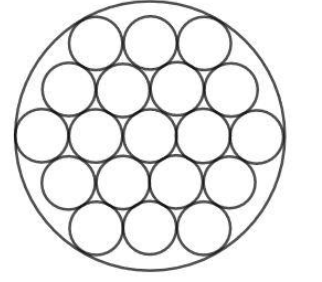
At the beginning of a carrom game, the coins are arranged in the central circle of the board as shown. What is the area in (square inches in nearest integer) of the central circle not occupied by the coins if the radius of each coin is $\dfrac{1}{2}$ inch.
Answer
 Verified
606.3k+ views
Hint: We will first find the area of the center circle using the formula, $\pi {{r}^{2}}$ and then we will find the area of a single coin using the same formula. We will multiply the area of a coin with the total number of coins and then we will subtract the obtained area of all coins from the area of the center to get the area of the central circle which is not occupied by the coins.
Complete step-by-step answer:
It is given in the question that, at the beginning of a carrom game, the coins are arranged in the central circle of the board. Also, the radius of each coin is $\dfrac{1}{2}$ inch. And we have to find the area of the center circle which is not filled by coins. So, we know that the radius of each coin is $\dfrac{1}{2}$ inch.
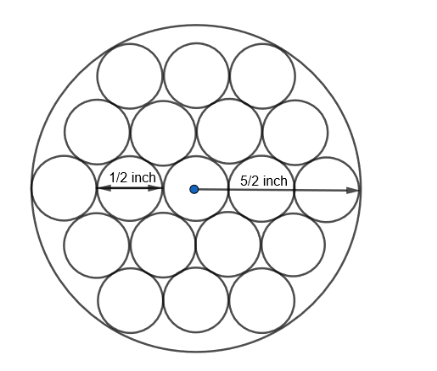
From the figure given above, we can say that the radius of the center circle is equal to 5 times the radius of each coin. So, we can write,
Radius of the central circle = $\left( 5\times \dfrac{1}{2} \right)$ inch = $\dfrac{5}{2}$ inch.
Now, we will count the total number of coins arranged in the central circle. We get to know that we have 19 coins in the center of the circle. We know that the area of a circle is given by the formula, $\pi {{r}^{2}}$ where, $\pi =3.14$ and r is the radius of the coin.
So, we get the area of the circle occupied by 19 coins as 19 $\times $ area of one coin.
$\begin{align}
& =19\left( \pi {{r}^{2}} \right) \\
& =19\times \pi \times {{\left( \dfrac{1}{2} \right)}^{2}} \\
\end{align}$
$=\dfrac{19\pi }{4}$ sq. inches.
Now, the total area of the central circle with the radius $\dfrac{5}{2}=\pi {{\left( \dfrac{5}{2} \right)}^{2}}=\dfrac{25\pi }{4}$.
Now, the area of the central circle not occupied by the coins = area of the central circle – area of 19 coins.
$\begin{align}
& =\dfrac{25\pi }{4}-\dfrac{19\pi }{4} \\
& =\dfrac{25\pi -19\pi }{4} \\
& =\dfrac{6\pi }{4} \\
\end{align}$
Taking, $\pi =3.14$, we get,
\[\begin{align}
& =\dfrac{6\times 3.14}{4} \\
& =\dfrac{18.84}{4} \\
\end{align}\]
= 4.71 sq. inches
Hence, we get the value of the area of the central circle not occupied by the coins as 4.71 sq. inches.
Note: It is to be noted that some students miss to calculate the total number of coins arranged in the center of the board. Hence, mistakes in this step will affect the value of the area of the coins and thus they will get the wrong answer. Also, it is to be noted in this question that the unit of area is in sq. inches and not in inches. So, the students must do the calculations carefully.
Complete step-by-step answer:
It is given in the question that, at the beginning of a carrom game, the coins are arranged in the central circle of the board. Also, the radius of each coin is $\dfrac{1}{2}$ inch. And we have to find the area of the center circle which is not filled by coins. So, we know that the radius of each coin is $\dfrac{1}{2}$ inch.
From the figure given above, we can say that the radius of the center circle is equal to 5 times the radius of each coin. So, we can write,
Radius of the central circle = $\left( 5\times \dfrac{1}{2} \right)$ inch = $\dfrac{5}{2}$ inch.
Now, we will count the total number of coins arranged in the central circle. We get to know that we have 19 coins in the center of the circle. We know that the area of a circle is given by the formula, $\pi {{r}^{2}}$ where, $\pi =3.14$ and r is the radius of the coin.
So, we get the area of the circle occupied by 19 coins as 19 $\times $ area of one coin.
$\begin{align}
& =19\left( \pi {{r}^{2}} \right) \\
& =19\times \pi \times {{\left( \dfrac{1}{2} \right)}^{2}} \\
\end{align}$
$=\dfrac{19\pi }{4}$ sq. inches.
Now, the total area of the central circle with the radius $\dfrac{5}{2}=\pi {{\left( \dfrac{5}{2} \right)}^{2}}=\dfrac{25\pi }{4}$.
Now, the area of the central circle not occupied by the coins = area of the central circle – area of 19 coins.
$\begin{align}
& =\dfrac{25\pi }{4}-\dfrac{19\pi }{4} \\
& =\dfrac{25\pi -19\pi }{4} \\
& =\dfrac{6\pi }{4} \\
\end{align}$
Taking, $\pi =3.14$, we get,
\[\begin{align}
& =\dfrac{6\times 3.14}{4} \\
& =\dfrac{18.84}{4} \\
\end{align}\]
= 4.71 sq. inches
Hence, we get the value of the area of the central circle not occupied by the coins as 4.71 sq. inches.
Note: It is to be noted that some students miss to calculate the total number of coins arranged in the center of the board. Hence, mistakes in this step will affect the value of the area of the coins and thus they will get the wrong answer. Also, it is to be noted in this question that the unit of area is in sq. inches and not in inches. So, the students must do the calculations carefully.
Recently Updated Pages
Master Class 9 General Knowledge: Engaging Questions & Answers for Success

Master Class 9 Social Science: Engaging Questions & Answers for Success
Master Class 9 English: Engaging Questions & Answers for Success
Master Class 9 Maths: Engaging Questions & Answers for Success
Master Class 9 Science: Engaging Questions & Answers for Success
Class 9 Question and Answer - Your Ultimate Solutions Guide
Trending doubts
Difference Between Plant Cell and Animal Cell
Fill the blanks with the suitable prepositions 1 The class 9 english CBSE
Who is eligible for RTE class 9 social science CBSE
Which places in India experience sunrise first and class 9 social science CBSE
What is pollution? How many types of pollution? Define it
Name 10 Living and Non living things class 9 biology CBSE