




At constant pressure, density of a gas is:
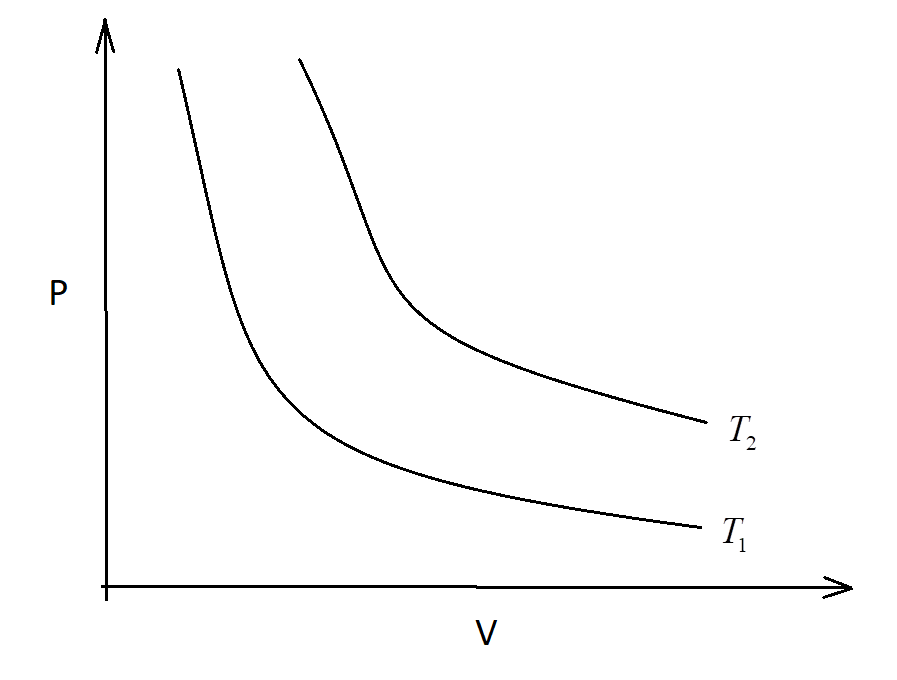
A. directly proportional to absolute temperature
B. inversely proportional to absolute temperature
C. independent of temperature
D. directly proportional to square root of absolute temperature
Answer
 Verified
573.9k+ views
Hint: Before we solve this question, it is important to understand the mathematical definition of the quantity density. It is the ratio of mass of the body to its volume.
Density, $\rho = \dfrac{m}{V}$
where m = mass of the body and V = volume of the body.
Complete step-by-step solution:
For any gas, the state of the gas at any instant of time, is defined by four basic quantities : pressure P, volume V, temperature T and quantity of substance (or number of moles, n).
There are 4 laws known as Gas laws, that establish the relationship between these four state variables. They are: i) Boyle’s law: $P \propto \dfrac{1}{V}$ ii) Charles’s law: $V \propto \dfrac{1}{T}$ iii) Gay-Lussac’s law: $P \propto T$ iv) Avogadro’s law: $V \propto n$
By combining these 4 individual gas laws, we obtain an important equation known as the Ideal Gas Equation.
Ideal gas equation:
$PV \propto nT$
By removing the proportionality, we get –
$PV = nRT$
where R = universal gas constant.
The number of moles of a gas is equal to the mass of the gas per unit molar mass (or mass of 1 mole of the gas) of the gas. Hence,
$n = \dfrac{m}{M}$
where m = mass of the gas, M = molar mass or mass of 1 mole of the gas
Substituting in the ideal gas equation,
$PV = \dfrac{m}{M}RT$
By rearranging the equation,
$P = \dfrac{m}{V}\dfrac{R}{M}T$
The density of the gas is the mass per unit volume of the gas.
Hence, $\rho = \dfrac{m}{V}$
Also, we have –
$R' = \dfrac{R}{M}$
where $R'$ is called a specific gas constant for the gas and is equal to the universal gas constant divided by the molar mass of the gas.
Thus, we have –
$P = \rho R'T$
Given, that the pressure is constant, we get –
$\rho = \dfrac{P}{{R'T}}$
$\therefore \rho \propto \dfrac{1}{T}$
Hence, the density of the gas is inversely proportional to the absolute temperature.
Hence, the correct option is Option B.
Note: The students should exercise caution while substituting the values of temperature in problems related to this equation. The temperature should be compulsorily converted to kelvin scale and cross-checked before substituting because here, it is given as absolute temperature, which is the temperature in the kelvin scale.
Density, $\rho = \dfrac{m}{V}$
where m = mass of the body and V = volume of the body.
Complete step-by-step solution:
For any gas, the state of the gas at any instant of time, is defined by four basic quantities : pressure P, volume V, temperature T and quantity of substance (or number of moles, n).
There are 4 laws known as Gas laws, that establish the relationship between these four state variables. They are: i) Boyle’s law: $P \propto \dfrac{1}{V}$ ii) Charles’s law: $V \propto \dfrac{1}{T}$ iii) Gay-Lussac’s law: $P \propto T$ iv) Avogadro’s law: $V \propto n$
By combining these 4 individual gas laws, we obtain an important equation known as the Ideal Gas Equation.
Ideal gas equation:
$PV \propto nT$
By removing the proportionality, we get –
$PV = nRT$
where R = universal gas constant.
The number of moles of a gas is equal to the mass of the gas per unit molar mass (or mass of 1 mole of the gas) of the gas. Hence,
$n = \dfrac{m}{M}$
where m = mass of the gas, M = molar mass or mass of 1 mole of the gas
Substituting in the ideal gas equation,
$PV = \dfrac{m}{M}RT$
By rearranging the equation,
$P = \dfrac{m}{V}\dfrac{R}{M}T$
The density of the gas is the mass per unit volume of the gas.
Hence, $\rho = \dfrac{m}{V}$
Also, we have –
$R' = \dfrac{R}{M}$
where $R'$ is called a specific gas constant for the gas and is equal to the universal gas constant divided by the molar mass of the gas.
Thus, we have –
$P = \rho R'T$
Given, that the pressure is constant, we get –
$\rho = \dfrac{P}{{R'T}}$
$\therefore \rho \propto \dfrac{1}{T}$
Hence, the density of the gas is inversely proportional to the absolute temperature.
Hence, the correct option is Option B.
Note: The students should exercise caution while substituting the values of temperature in problems related to this equation. The temperature should be compulsorily converted to kelvin scale and cross-checked before substituting because here, it is given as absolute temperature, which is the temperature in the kelvin scale.
Recently Updated Pages
Master Class 11 Computer Science: Engaging Questions & Answers for Success

Master Class 11 Business Studies: Engaging Questions & Answers for Success
Master Class 11 Economics: Engaging Questions & Answers for Success
Master Class 11 English: Engaging Questions & Answers for Success
Master Class 11 Maths: Engaging Questions & Answers for Success
Master Class 11 Biology: Engaging Questions & Answers for Success
Trending doubts
One Metric ton is equal to kg A 10000 B 1000 C 100 class 11 physics CBSE
There are 720 permutations of the digits 1 2 3 4 5 class 11 maths CBSE
Discuss the various forms of bacteria class 11 biology CBSE
Draw a diagram of a plant cell and label at least eight class 11 biology CBSE
State the laws of reflection of light
Explain zero factorial class 11 maths CBSE