




At a point A, 20 meters above the level of water in a lake, then the angle of elevation of a cloud is $ {{30}^{o}} $ . The angle of depression of the reflection of the cloud in the lake at A is $ {{60}^{o}} $ . Find the distance of the cloud from sea level and also from A.
(a) Distance from $ A=20\sqrt{3}m $ , distance from sea level = 40m.
(b) Distance from A = 40m, distance from sea level = 40m.
(c) Distance from A=20m, distance from sea level = 40m.
(d) Distance from \[A=40\sqrt{3}m\], distance from sea level = 40m.
Answer
 Verified
672k+ views
Hint: we use the given information and draw figure to get a better view of the figure. Once we draw a figure, we use trigonometric functions to get the relation between distance from A and distance from sea-level. Using these relations we solve for the required results.
Complete step-by-step answer:
Given that we have a point A, which is 20 meters above the level of water in the lake. There is a cloud in the sky and the angle of elevation of the cloud $ {{30}^{o}} $ with respect to point A.
We can see a reflection of the cloud in the lake which has an angle of depression $ {{60}^{o}} $ with respect to point A.
We need to find the horizontal distance between point A and cloud and also the vertical distance of cloud from sea level.
Let us assume the distance between point A and cloud be ‘x’ m and the vertical distance of cloud from point ‘A’ be ‘h’ m.
Let us draw all these so that we can have a detailed view of the information.
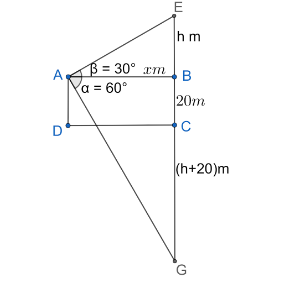
Since, the cloud is ‘h+20’m above the water level of the lake the reflection of cloud lies ‘(h+20)’m below the surface DC.
We know that in a right-angled triangle with an angle $ \theta $ (other than the right angle). $ \tan \theta =\dfrac{\text{opposite side length}}{\text{adjacent side length}} $
From $ \Delta ABE $ of the figure, we get
$ \tan \alpha =\dfrac{h}{x} $
$ \tan {{30}^{o}}=\dfrac{h}{x} $
$ \dfrac{1}{\sqrt{3}}=\dfrac{h}{x} $
$ x=h\sqrt{3}.......(1) $
From $ \Delta ABG $ of the figure, we get
$ \tan \beta =\dfrac{\left( h+20 \right)+20}{x} $
$ \tan {{60}^{o}}=\dfrac{h+40}{x} $
$ \sqrt{3}=\dfrac{h+40}{x} $
$ x\sqrt{3}=h+40 $
From equation (1), we have $ x=h\sqrt{3} $ . Substituting it we get,
$ \left( h\sqrt{3} \right)\sqrt{3}=h+40 $
$ 3h=h+40 $
\[3h-h=40\]
$ 2h=40 $
$ h=\dfrac{40}{2} $
$ h=20m $
The cloud is (h+20) m above the water level of lake. So, cloud is at a distance of (20+20) = 40m from sea level
From equation (1),
$ x=20\sqrt{3} $
∴ The cloud is at a distance of $ 20\sqrt{3}m $ from the point A.
So, the correct answer is “Option A”.
Note: We take horizontal and vertical distance unless it is stated otherwise. Whenever we get a problem involving angle of elevation and depression, draw a figure representing the information and try to solve the problem. Use all the information provided for us in the problem. On the problem side DC is considered as a surface and the portion below it is considered as a lake.
Complete step-by-step answer:
Given that we have a point A, which is 20 meters above the level of water in the lake. There is a cloud in the sky and the angle of elevation of the cloud $ {{30}^{o}} $ with respect to point A.
We can see a reflection of the cloud in the lake which has an angle of depression $ {{60}^{o}} $ with respect to point A.
We need to find the horizontal distance between point A and cloud and also the vertical distance of cloud from sea level.
Let us assume the distance between point A and cloud be ‘x’ m and the vertical distance of cloud from point ‘A’ be ‘h’ m.
Let us draw all these so that we can have a detailed view of the information.
Since, the cloud is ‘h+20’m above the water level of the lake the reflection of cloud lies ‘(h+20)’m below the surface DC.
We know that in a right-angled triangle with an angle $ \theta $ (other than the right angle). $ \tan \theta =\dfrac{\text{opposite side length}}{\text{adjacent side length}} $
From $ \Delta ABE $ of the figure, we get
$ \tan \alpha =\dfrac{h}{x} $
$ \tan {{30}^{o}}=\dfrac{h}{x} $
$ \dfrac{1}{\sqrt{3}}=\dfrac{h}{x} $
$ x=h\sqrt{3}.......(1) $
From $ \Delta ABG $ of the figure, we get
$ \tan \beta =\dfrac{\left( h+20 \right)+20}{x} $
$ \tan {{60}^{o}}=\dfrac{h+40}{x} $
$ \sqrt{3}=\dfrac{h+40}{x} $
$ x\sqrt{3}=h+40 $
From equation (1), we have $ x=h\sqrt{3} $ . Substituting it we get,
$ \left( h\sqrt{3} \right)\sqrt{3}=h+40 $
$ 3h=h+40 $
\[3h-h=40\]
$ 2h=40 $
$ h=\dfrac{40}{2} $
$ h=20m $
The cloud is (h+20) m above the water level of lake. So, cloud is at a distance of (20+20) = 40m from sea level
From equation (1),
$ x=20\sqrt{3} $
∴ The cloud is at a distance of $ 20\sqrt{3}m $ from the point A.
So, the correct answer is “Option A”.
Note: We take horizontal and vertical distance unless it is stated otherwise. Whenever we get a problem involving angle of elevation and depression, draw a figure representing the information and try to solve the problem. Use all the information provided for us in the problem. On the problem side DC is considered as a surface and the portion below it is considered as a lake.
Recently Updated Pages
Which will be the least stable resonating structure class 11 chemistry CBSE

How many 5 digit telephone numbers can be construc-class-11-maths-CBSE
How do you find the angle of the resultant vector class 11 physics CBSE
Draw labelled diagram of the following i Gram seed class 11 biology CBSE
1 Quintal is equal to a 110 kg b 10 kg c 100kg d 1000 class 11 physics CBSE
What is the need and importance of classification class 11 biology CBSE
Trending doubts
Find the value of the expression given below sin 30circ class 11 maths CBSE
One Metric ton is equal to kg A 10000 B 1000 C 100 class 11 physics CBSE
10 examples of friction in our daily life
Draw a diagram of a plant cell and label at least eight class 11 biology CBSE
Difference between physical and chemical change class 11 chemistry CBSE
Proton was discovered by A Thomson B Rutherford C Chadwick class 11 chemistry CBSE