




At a certain place, the horizontal component of the earth's magnetic field is Bo and the angle of dip is ${45^0}$. The total intensity of the field at that place will be
A. ${B_0}$
B. $\sqrt 2 {B_0}$
C. $2{B_0}$
D. ${B_0}2$
Answer
 Verified
636.3k+ views
Hint: According to modern earth’s magnetism theory, Earth has both geographic poles and magnetic poles. These poles of the earth’s magnet produce magnetic fields surrounding the earth. Just like the magnetic field produced around a permanent magnet has different magnetic intensities at different points, total magnetic intensity at different locations of earth also varies from place to place. Total magnetic intensity (B) has two components. One is the vertical component$({B_V})$ and the other is horizontal component$({B_H})$.
Complete answer:
The angle between the resultant total magnetic field(B) vector at a particular location and its horizontal component $({B_H})$ vector is called a dip at a particular location.
Let dip angle be $\theta $
According to formula
${B_H} = B\cos (\theta )$
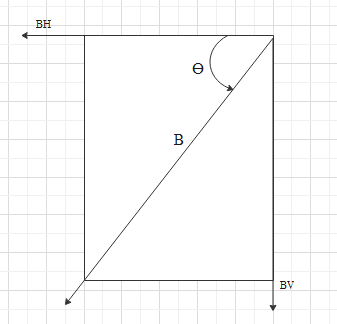
From the given question
$\eqalign{
& {B_H} = {B_0}And\theta = {45^0} \cr
& \cr
& hence\cos (\theta ) = \cos ({45^0}) = \dfrac{1}{{\sqrt 2 }} \cr} $
$B = \dfrac{{{B_H}}}{{\cos (\theta )}} = \dfrac{{{B_0}}}{{(\dfrac{1}{{\sqrt 2 }})}} = \sqrt 2 {B_0}$
Hence answer would be option B
Dip at a particular place is measured by the dip circle
Additional information:
There is a device called a magnetic compass. Actually the compass needle aligns along the direction of earth’s magnetic north and south poles. This should not be confused with geographic north and south poles. The angle between the planes passing through geographical poles(geographic meridian) and magnetic poles(magnetic meridian) at a certain place is called declination. Since magnetic poles are closer to geographical poles we consider both are the same but actually not.
Note:
Magnetic compass shows us the geographic directions whereas there is a dip circle which aligns itself along the direction of resultant earth’s magnetic field at that particular direction. I.e magnetic needle aligns along ${B_H}$ while dip needle aligns along resultant of ${B_V}and{B_H}$ at a particular place. If we have a horizontal component or vertical component and dip angle we can get a resultant magnetic field at a place.
Complete answer:
The angle between the resultant total magnetic field(B) vector at a particular location and its horizontal component $({B_H})$ vector is called a dip at a particular location.
Let dip angle be $\theta $
According to formula
${B_H} = B\cos (\theta )$
From the given question
$\eqalign{
& {B_H} = {B_0}And\theta = {45^0} \cr
& \cr
& hence\cos (\theta ) = \cos ({45^0}) = \dfrac{1}{{\sqrt 2 }} \cr} $
$B = \dfrac{{{B_H}}}{{\cos (\theta )}} = \dfrac{{{B_0}}}{{(\dfrac{1}{{\sqrt 2 }})}} = \sqrt 2 {B_0}$
Hence answer would be option B
Dip at a particular place is measured by the dip circle
Additional information:
There is a device called a magnetic compass. Actually the compass needle aligns along the direction of earth’s magnetic north and south poles. This should not be confused with geographic north and south poles. The angle between the planes passing through geographical poles(geographic meridian) and magnetic poles(magnetic meridian) at a certain place is called declination. Since magnetic poles are closer to geographical poles we consider both are the same but actually not.
Note:
Magnetic compass shows us the geographic directions whereas there is a dip circle which aligns itself along the direction of resultant earth’s magnetic field at that particular direction. I.e magnetic needle aligns along ${B_H}$ while dip needle aligns along resultant of ${B_V}and{B_H}$ at a particular place. If we have a horizontal component or vertical component and dip angle we can get a resultant magnetic field at a place.
Recently Updated Pages
Basicity of sulphurous acid and sulphuric acid are

Master Class 12 Economics: Engaging Questions & Answers for Success
Master Class 12 Biology: Engaging Questions & Answers for Success
Master Class 11 English: Engaging Questions & Answers for Success
Master Class 11 Physics: Engaging Questions & Answers for Success
Master Class 11 Computer Science: Engaging Questions & Answers for Success
Trending doubts
Draw a labelled sketch of the human eye class 12 physics CBSE
The chemical formula of tear gas is A CO Cl 2 B C 10 class 12 chemistry CBSE
Draw ray diagrams each showing i myopic eye and ii class 12 physics CBSE
Which are the Top 10 Largest Countries of the World?
Differentiate between homogeneous and heterogeneous class 12 chemistry CBSE
Which is the correct genotypic ratio of mendel dihybrid class 12 biology CBSE