




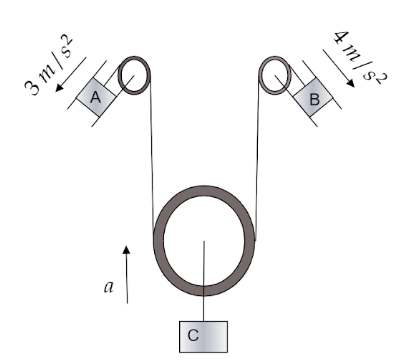
Assuming all the surfaces to be frictionless, acceleration of the block C, shown in the figure is _____ $\dfrac{m}{{{s^2}}}$.
Answer
 Verified
535.5k+ views
Hint: In this question above we have to find the acceleration of block C and the value of acceleration of block A and B are given. We will consider the distances that block A, B and C may cover due to tension of the string. Then, the double derivative of the equation will give the result.
Complete step by step answer:
Let us consider that the two bodies are suspended by a string. Forces are acting on them.The surfaces given here are also frictionless.Let us now consider that the block A having acceleration of $3{\text{ }}\dfrac{m}{{{s^2}}}$ moves by a distance $x$ as it is acted upon forces or tension of the string.Now, let us assume that block B which is moving with a velocity of ${\text{4 }}\dfrac{m}{{{s^2}}}$ moves by a distance $y$ as it is also acted upon forces or tension of the string.
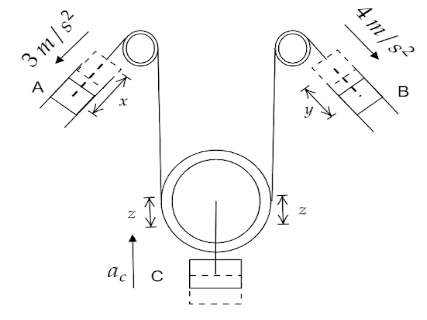
The block is also acted upon tension and its weight and lets it cover a distance of $z$. So, we can easily say that the distance moved by block C is equal to the distance moved by block A and C combined. As the block C is connected with two strings, we have
$z = x$ and $z = y$.
Thus, we now sum these two and get,
$2z = x + y$
$ \Rightarrow z = \dfrac{{x + y}}{2}$
Double derivative of the equation with respect to $t$, we get,
$\dfrac{{{d^2}z}}{{d{t^2}}} = \dfrac{1}{2}\left( {\dfrac{{{d^2}y}}{{d{t^2}}} + \dfrac{{{d^{}}y}}{{d{t^2}}}} \right)$
Double derivative of distance with respect to time gives acceleration,
${a_c} = \dfrac{{{a_a} + {a_b}}}{2}$
Substituting the values of acceleration of block A and C we get,
$\therefore {a_c} = \dfrac{{3 + 4}}{2} = 3.5$
Therefore, the acceleration of block C is $3.5{\text{ }}\dfrac{m}{{{s^2}}}$.
Note:It must be noted that the first derivative of distance with respect to time gives velocity whereas the second derivative of distance with respect to time gives acceleration. As there is no friction there isn’t any opposition in forces, if there was friction between the surfaces, we have to use the tension formula. Also the Block A and B have the same angle of inclination with respect to C.
Complete step by step answer:
Let us consider that the two bodies are suspended by a string. Forces are acting on them.The surfaces given here are also frictionless.Let us now consider that the block A having acceleration of $3{\text{ }}\dfrac{m}{{{s^2}}}$ moves by a distance $x$ as it is acted upon forces or tension of the string.Now, let us assume that block B which is moving with a velocity of ${\text{4 }}\dfrac{m}{{{s^2}}}$ moves by a distance $y$ as it is also acted upon forces or tension of the string.
The block is also acted upon tension and its weight and lets it cover a distance of $z$. So, we can easily say that the distance moved by block C is equal to the distance moved by block A and C combined. As the block C is connected with two strings, we have
$z = x$ and $z = y$.
Thus, we now sum these two and get,
$2z = x + y$
$ \Rightarrow z = \dfrac{{x + y}}{2}$
Double derivative of the equation with respect to $t$, we get,
$\dfrac{{{d^2}z}}{{d{t^2}}} = \dfrac{1}{2}\left( {\dfrac{{{d^2}y}}{{d{t^2}}} + \dfrac{{{d^{}}y}}{{d{t^2}}}} \right)$
Double derivative of distance with respect to time gives acceleration,
${a_c} = \dfrac{{{a_a} + {a_b}}}{2}$
Substituting the values of acceleration of block A and C we get,
$\therefore {a_c} = \dfrac{{3 + 4}}{2} = 3.5$
Therefore, the acceleration of block C is $3.5{\text{ }}\dfrac{m}{{{s^2}}}$.
Note:It must be noted that the first derivative of distance with respect to time gives velocity whereas the second derivative of distance with respect to time gives acceleration. As there is no friction there isn’t any opposition in forces, if there was friction between the surfaces, we have to use the tension formula. Also the Block A and B have the same angle of inclination with respect to C.
Recently Updated Pages
Master Class 12 Economics: Engaging Questions & Answers for Success

Master Class 12 English: Engaging Questions & Answers for Success
Master Class 12 Social Science: Engaging Questions & Answers for Success
Master Class 12 Maths: Engaging Questions & Answers for Success
Master Class 12 Physics: Engaging Questions & Answers for Success
Master Class 11 Social Science: Engaging Questions & Answers for Success
Trending doubts
Find the value of the expression given below sin 30circ class 11 maths CBSE
Draw a diagram of a plant cell and label at least eight class 11 biology CBSE
Name the Largest and the Smallest Cell in the Human Body ?
Draw a diagram showing the external features of fish class 11 biology CBSE
What organs are located on the left side of your body class 11 biology CBSE
Difference between physical and chemical change class 11 chemistry CBSE