




Assume that the distance of the earth from the moon to be 38,400 km and the angle subtended by the moon at the eye of the person on the earth to be ${31^{'}}$ ,find the diameter of the moon?
a.The diameter of the moon is $3464\dfrac{8}{{63}}km$
b. The diameter of the moon is $3564\dfrac{8}{{63}}km$
c.The diameter of the moon is $346\dfrac{8}{{63}}km$
d.The diameter of the moon is $3664\dfrac{8}{{63}}km$
Answer
 Verified
623.4k+ views
Hint: Let AB be the diameter of the moon and O be the observer and the diameter of the moon is nothing but the length of the arc of the circle with the centre as the observer and radius as the distance between the moon and earth . We use the formula $\theta = \dfrac{l}{r}$
Complete step-by-step answer:
Let AB be the diameter of the moon and O be the observer
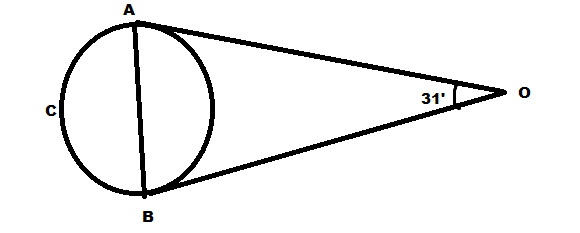
We are given that $\angle AOB = {31^{'}}$
We can convert this into degree by dividing it by 60 and multiplying it by $\dfrac{\pi }{{180}}$
From this we get $\theta = \dfrac{{31}}{{60}}*\dfrac{\pi }{{180}}$ ………(1)
Since the angle subtended by the moon is very small
Its diameter will be equal to the small arc of the circle whose centre is the eye of the observer and radius is the distance of the earth from the moon
And the moon also subtends an angle of 31’ at the centre of this circle
Therefore it is given by the formula
$ \Rightarrow \theta = \dfrac{l}{r}$
Here l = diameter of the moon and r = distance of the earth from the moon
$
\Rightarrow \dfrac{{31}}{{60}}*\dfrac{\pi }{{180}} = \dfrac{{AB}}{{384400}} \\
\Rightarrow \dfrac{{31}}{{60}}*\dfrac{{22}}{7}*\dfrac{{384400}}{{180}} = AB \\
\Rightarrow \dfrac{{31}}{6}*\dfrac{{22}}{7}*\dfrac{{3844}}{{18}} = AB \\
\Rightarrow \dfrac{{31}}{3}*\dfrac{{11}}{7}*\dfrac{{1922}}{9} = AB \\
\Rightarrow 3464\dfrac{8}{{63}}km = AB \\
$
The diameter of the moon is $3464\dfrac{8}{{63}}km$
The correct option is a.
Note: The distance along the arc (part of the circumference of a circle, or of any curve). For a circle: Arc Length = θ × r. (when θ is in radians) Arc Length = (θ × π/180) × r.
Arc length is the distance between two points along a section of a curve. Determining the length of an irregular arc segment is also called rectification of a curve
Complete step-by-step answer:
Let AB be the diameter of the moon and O be the observer
We are given that $\angle AOB = {31^{'}}$
We can convert this into degree by dividing it by 60 and multiplying it by $\dfrac{\pi }{{180}}$
From this we get $\theta = \dfrac{{31}}{{60}}*\dfrac{\pi }{{180}}$ ………(1)
Since the angle subtended by the moon is very small
Its diameter will be equal to the small arc of the circle whose centre is the eye of the observer and radius is the distance of the earth from the moon
And the moon also subtends an angle of 31’ at the centre of this circle
Therefore it is given by the formula
$ \Rightarrow \theta = \dfrac{l}{r}$
Here l = diameter of the moon and r = distance of the earth from the moon
$
\Rightarrow \dfrac{{31}}{{60}}*\dfrac{\pi }{{180}} = \dfrac{{AB}}{{384400}} \\
\Rightarrow \dfrac{{31}}{{60}}*\dfrac{{22}}{7}*\dfrac{{384400}}{{180}} = AB \\
\Rightarrow \dfrac{{31}}{6}*\dfrac{{22}}{7}*\dfrac{{3844}}{{18}} = AB \\
\Rightarrow \dfrac{{31}}{3}*\dfrac{{11}}{7}*\dfrac{{1922}}{9} = AB \\
\Rightarrow 3464\dfrac{8}{{63}}km = AB \\
$
The diameter of the moon is $3464\dfrac{8}{{63}}km$
The correct option is a.
Note: The distance along the arc (part of the circumference of a circle, or of any curve). For a circle: Arc Length = θ × r. (when θ is in radians) Arc Length = (θ × π/180) × r.
Arc length is the distance between two points along a section of a curve. Determining the length of an irregular arc segment is also called rectification of a curve
Recently Updated Pages
Master Class 12 Economics: Engaging Questions & Answers for Success

Master Class 12 English: Engaging Questions & Answers for Success
Master Class 12 Social Science: Engaging Questions & Answers for Success
Master Class 12 Maths: Engaging Questions & Answers for Success
Master Class 12 Physics: Engaging Questions & Answers for Success
Master Class 9 General Knowledge: Engaging Questions & Answers for Success
Trending doubts
One Metric ton is equal to kg A 10000 B 1000 C 100 class 11 physics CBSE
Difference Between Prokaryotic Cells and Eukaryotic Cells
Find the value of the expression given below sin 30circ class 11 maths CBSE
Two of the body parts which do not appear in MRI are class 11 biology CBSE
1 ton equals to A 100 kg B 1000 kg C 10 kg D 10000 class 11 physics CBSE
Draw a diagram of nephron and explain its structur class 11 biology CBSE