




Assertion: The velocity of a fall of a man jumping with a parachute first increases and then becomes constant.
Reason: The constant velocity of fall of man is called terminal velocity.
A. Assertion is true but the reason is false.
B. Assertion is false but the reason is true.
C. Both assertion and reason are true but reason is not the correct explanation of assertion.
D. Both assertion and reason are true and reason is the correct explanation of assertion.
Answer
 Verified
507.6k+ views
Hint:The maximum velocity that a body attains when in a free fall or in a liquid. This happens due to the resistive forces of the air and liquid respectively. The resistive force of the air is often termed as air drag and the resistive force of a liquid is termed as viscosity of that particular liquid. Terminal velocity is attained when resistance forces and gravitational force become equal.
Complete step by step answer:
When a man initially falls from a height it is acted upon by the gravitational force due to the earth which is equal to the weight $W = mg$ where m is the mass of the person and g is the acceleration due to gravity.
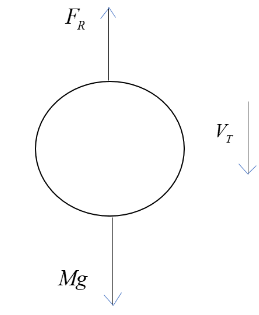
When the resistive force becomes equal to the weight of the person the body stops to accelerate as there are no other forces acting on it. So it starts to move with a constant velocity and we term this velocity as terminal velocity. It is represented by ${V_T}$. So both assertion and reason are correct and reason is the correct explanation of assertion.
Therefore, option D is correct.
Note:The terminal velocity can be visualized by dropping a coin in water. For this first take a transparent glass and fill it with water. Now drop a coin in the water. You will notice that the coin will initially fall with an acceleration and you will see that the velocity of the coin will increase initially and slowly you will notice that it becomes constant when it reaches the end.
Complete step by step answer:
When a man initially falls from a height it is acted upon by the gravitational force due to the earth which is equal to the weight $W = mg$ where m is the mass of the person and g is the acceleration due to gravity.
When the resistive force becomes equal to the weight of the person the body stops to accelerate as there are no other forces acting on it. So it starts to move with a constant velocity and we term this velocity as terminal velocity. It is represented by ${V_T}$. So both assertion and reason are correct and reason is the correct explanation of assertion.
Therefore, option D is correct.
Note:The terminal velocity can be visualized by dropping a coin in water. For this first take a transparent glass and fill it with water. Now drop a coin in the water. You will notice that the coin will initially fall with an acceleration and you will see that the velocity of the coin will increase initially and slowly you will notice that it becomes constant when it reaches the end.
Recently Updated Pages
Master Class 11 Computer Science: Engaging Questions & Answers for Success

Master Class 11 Business Studies: Engaging Questions & Answers for Success
Master Class 11 Economics: Engaging Questions & Answers for Success
Master Class 11 English: Engaging Questions & Answers for Success
Master Class 11 Maths: Engaging Questions & Answers for Success
Master Class 11 Biology: Engaging Questions & Answers for Success
Trending doubts
One Metric ton is equal to kg A 10000 B 1000 C 100 class 11 physics CBSE
There are 720 permutations of the digits 1 2 3 4 5 class 11 maths CBSE
Discuss the various forms of bacteria class 11 biology CBSE
Draw a diagram of a plant cell and label at least eight class 11 biology CBSE
State the laws of reflection of light
Explain zero factorial class 11 maths CBSE