




Assertion: The speed of light in a rarer medium is greater than that in denser medium.
Reason: \[{\text{One light year equals to }}9.5 \times {10^{12}}{\text{ km}}{\text{.}}\]
(A) Both Assertion and reason are correct and reason is the correct explanation for Assertion
(B) Both Assertion and reason are correct but the reason is not correct explanation for assertion
(C) Assertion is correct but the reason is incorrect
(D) Both Assertion and reason are incorrect
Answer
 Verified
494.7k+ views
Hint: In order to solve this question, we need to understand that a medium in which the light passes with more speed is known as an optically rarer medium. A medium in which the light passes through it without experiencing any difficulty or obstruction is called an optically transparent medium. A medium in which the speed of light is less than usual is known as an optically denser medium.
Complete step by step answer:
Light travels with different speeds in a different medium and due to this property of light, we encounter a phenomenon called refraction of light. The change in the direction of light when passing from one medium to another. This phenomenon is called the refraction of light. The light ray passes from one medium to another, it experiences the change in the path of the ray of light.
We define two types of medium according to the speed of light in that medium relative to other mediums.
1. Optically rarer medium: In this medium the speed of light is more.
2. Optically denser medium: In this medium speed of light is less.
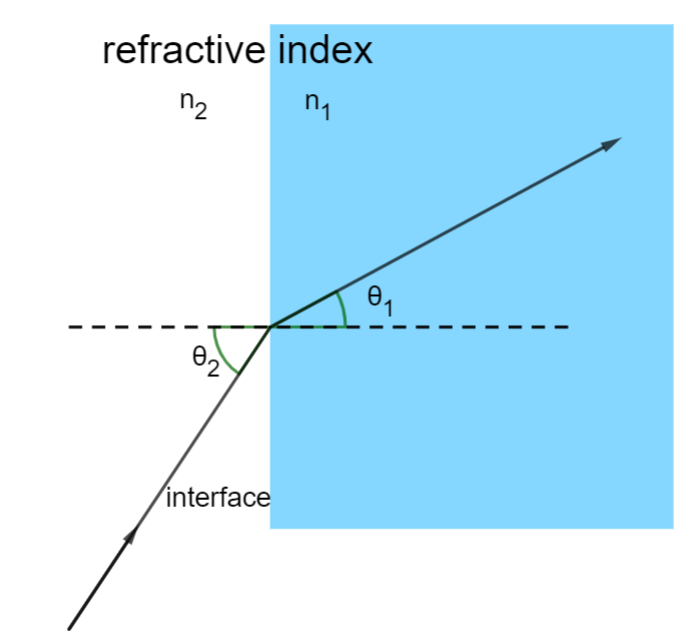
A denser medium provides more matter from which the light can scatter, so light will travel more slowly in a dense medium. A slower speed means a higher index of refraction.
So, \[{n_2} > {n_1}\]
Were,
\[{n_2}{\text{ is rarer medium}}{\text{.}}\]
\[{n_1}{\text{ is denser medium}}{\text{.}}\]
Light-Year is the unit of distance denoted by the symbol ‘ly’. It is the distance travelled by a light in one year.
One light year equals to \[9.5 \times {10^{12}}{\text{ km}}{\text{.}}\]
We can see both the Assertion and the Reason statements are correct. But Reason is not an explanation for Assertion. Hence, the correct option is (B).
Note:
It should be remembered that refraction is a phenomenon that exists due to change in the speed of light in a different medium. When light rays travel from optically rarer medium to denser medium they bend towards the normal, i.e., angle of incidence is more than the angle of refraction. Similarly, when light rays travel from optically denser medium to optically rarer medium it bends away from the normal, i.e., angle of incidence if less than the angle of refraction.
Complete step by step answer:
Light travels with different speeds in a different medium and due to this property of light, we encounter a phenomenon called refraction of light. The change in the direction of light when passing from one medium to another. This phenomenon is called the refraction of light. The light ray passes from one medium to another, it experiences the change in the path of the ray of light.
We define two types of medium according to the speed of light in that medium relative to other mediums.
1. Optically rarer medium: In this medium the speed of light is more.
2. Optically denser medium: In this medium speed of light is less.
A denser medium provides more matter from which the light can scatter, so light will travel more slowly in a dense medium. A slower speed means a higher index of refraction.
So, \[{n_2} > {n_1}\]
Were,
\[{n_2}{\text{ is rarer medium}}{\text{.}}\]
\[{n_1}{\text{ is denser medium}}{\text{.}}\]
Light-Year is the unit of distance denoted by the symbol ‘ly’. It is the distance travelled by a light in one year.
One light year equals to \[9.5 \times {10^{12}}{\text{ km}}{\text{.}}\]
We can see both the Assertion and the Reason statements are correct. But Reason is not an explanation for Assertion. Hence, the correct option is (B).
Note:
It should be remembered that refraction is a phenomenon that exists due to change in the speed of light in a different medium. When light rays travel from optically rarer medium to denser medium they bend towards the normal, i.e., angle of incidence is more than the angle of refraction. Similarly, when light rays travel from optically denser medium to optically rarer medium it bends away from the normal, i.e., angle of incidence if less than the angle of refraction.
Recently Updated Pages
Master Class 12 Social Science: Engaging Questions & Answers for Success

Master Class 12 Physics: Engaging Questions & Answers for Success
Master Class 12 Maths: Engaging Questions & Answers for Success
Master Class 12 Economics: Engaging Questions & Answers for Success
Master Class 12 Chemistry: Engaging Questions & Answers for Success
Master Class 12 Business Studies: Engaging Questions & Answers for Success
Trending doubts
Which are the Top 10 Largest Countries of the World?
Draw a labelled sketch of the human eye class 12 physics CBSE
Explain the structure of megasporangium class 12 biology CBSE
What are the major means of transport Explain each class 12 social science CBSE
How many chromosomes are found in human ovum a 46 b class 12 biology CBSE
The diagram of the section of a maize grain is given class 12 biology CBSE