




Assertion: The fertile part of the seed is tigellum
Reason: Tigellum produces root and shoot system of the plant body
(a)Both assertion and reason are true and the reason is the right explanation for the assertion.
(b)Both assertion and reason are true but the reason is not the right explanation for the assertion.
(c)Assertion is true but the reason is false.
(d)Assertion is false but the reason is true.
Answer
 Verified
599.1k+ views
Hint: Seed is formed in the angiosperms which are considered as the most advanced plants. Tigellum in collective form is also known as the embryonal axis.
Complete answer:
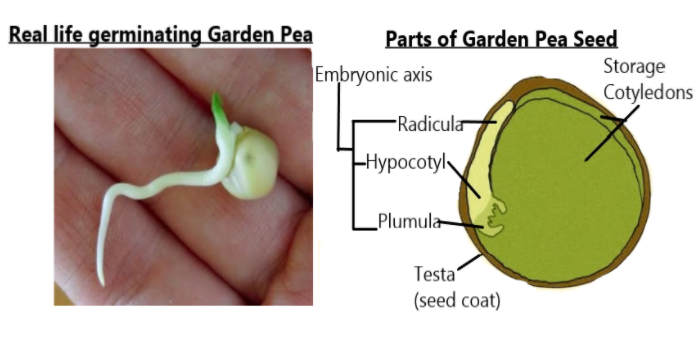
The assertion is false, but the reason is true. The fertile part of the seed is the endosperm. The tigellum is also known as the embryonal axis which produces the plumule and radicle, which later develop into shoot and root.
Additional Information:
A seed is made up of a seed coat and an embryo. The embryo is made up of a radicle, an embryonal axis, and cotyledons. The outermost covering of a seed is the seed coat. The seed coat has two layers, the outer testa, and the inner tegmen. The hilum is a scar on the seed coat through which the developing seeds were attached to the fruit. Seeds containing two cotyledons are called dicots such as wheat and maize, whereas seeds containing a single cotyledon are called monocots such as gram and pea. In some seeds, the outer seed coat is proteinaceous and is called the Aleurone layer. In plants that still contain endosperm even after maturation are called endospermous, whereas the ones which lose their endosperm, or consume all of their endosperms during maturation are called non-endospermous like the bean, gram, and pea.
So, the correct answer is 'Assertion is false, but the reason is true'.
Note:Few important points to remember
>Ovules after fertilization, develop into seeds.
>Seeds under fertile and favorable conditions can develop into a new plant.
>Double fertilization occurs when 2 male gametes enter the sac and fertilize the ovule and synergids to form embryo and endosperm respectively.
>Seeds are a dormant phase.
Complete answer:
The assertion is false, but the reason is true. The fertile part of the seed is the endosperm. The tigellum is also known as the embryonal axis which produces the plumule and radicle, which later develop into shoot and root.
Additional Information:
A seed is made up of a seed coat and an embryo. The embryo is made up of a radicle, an embryonal axis, and cotyledons. The outermost covering of a seed is the seed coat. The seed coat has two layers, the outer testa, and the inner tegmen. The hilum is a scar on the seed coat through which the developing seeds were attached to the fruit. Seeds containing two cotyledons are called dicots such as wheat and maize, whereas seeds containing a single cotyledon are called monocots such as gram and pea. In some seeds, the outer seed coat is proteinaceous and is called the Aleurone layer. In plants that still contain endosperm even after maturation are called endospermous, whereas the ones which lose their endosperm, or consume all of their endosperms during maturation are called non-endospermous like the bean, gram, and pea.
So, the correct answer is 'Assertion is false, but the reason is true'.
Note:Few important points to remember
>Ovules after fertilization, develop into seeds.
>Seeds under fertile and favorable conditions can develop into a new plant.
>Double fertilization occurs when 2 male gametes enter the sac and fertilize the ovule and synergids to form embryo and endosperm respectively.
>Seeds are a dormant phase.
Recently Updated Pages
Master Class 12 Social Science: Engaging Questions & Answers for Success

Master Class 12 Physics: Engaging Questions & Answers for Success
Master Class 12 Maths: Engaging Questions & Answers for Success
Master Class 12 Economics: Engaging Questions & Answers for Success
Master Class 12 Chemistry: Engaging Questions & Answers for Success
Master Class 12 Business Studies: Engaging Questions & Answers for Success
Trending doubts
Which are the Top 10 Largest Countries of the World?
Draw a labelled sketch of the human eye class 12 physics CBSE
Explain the structure of megasporangium class 12 biology CBSE
What are the major means of transport Explain each class 12 social science CBSE
How many chromosomes are found in human ovum a 46 b class 12 biology CBSE
The diagram of the section of a maize grain is given class 12 biology CBSE