




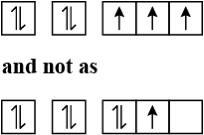
Assertion: The electronic configuration of nitrogen atoms is represented by the given figure.
Reason: The electronic configuration of the ground state of an atom is the one which has greatest multiplicity.
A. Both Assertion and Reason are correct and Reason is the correct explanation for Assertion.
B. Both Assertion and Reason are correct but Reason is not the correct explanation for Assertion.
C. Assertion is correct but Reason is incorrect.
D. Both Assertion and Reason are incorrect.
Answer
 Verified
533.1k+ views
Hint: Electronic configuration tells us about the distribution of electrons of an atom or molecule in atomic or molecular orbitals. Electronic configuration was first discovered through the Bohr model of the atom which generally describes shells and subshells.
Complete answer:
Nitrogen atom have atomic number 7 and the distribution of electron is based on the three principles called Aufbau principle, Pauli Exclusion Principle and Hund’s rule which can be described as follows:
1. Aufbau principle: It states that electrons fill lowest atomic orbitals first after their completion and it moves towards higher level atomic orbitals. The subshell ordering according to this rule is given by: $1s,2s,2p,3s,3p,4s,3d,4p,5s,4d,5p,6s,4f,5d,6p,7s,5f,6d,7p,8s,5g...$
2. Pauli Exclusion Principle: It states that no electrons in an atom are allowed to have the same set of quantum numbers.
3. Hund’s rule: This rule states that before the double occupation of any orbital it firstly singly occupied.
Thus according to Hund’s rule we can say that option A is the correct answer.
Note:
The electron distribution in electronic configuration firstly states the maximum number of electrons in their shells like s subshell acquire at most 2 electrons, p subshell have 6, d have 10 electrons, f subshell have 14 electrons and g subshell acquire 18 electrons in its orbit.
Complete answer:
Nitrogen atom have atomic number 7 and the distribution of electron is based on the three principles called Aufbau principle, Pauli Exclusion Principle and Hund’s rule which can be described as follows:
1. Aufbau principle: It states that electrons fill lowest atomic orbitals first after their completion and it moves towards higher level atomic orbitals. The subshell ordering according to this rule is given by: $1s,2s,2p,3s,3p,4s,3d,4p,5s,4d,5p,6s,4f,5d,6p,7s,5f,6d,7p,8s,5g...$
2. Pauli Exclusion Principle: It states that no electrons in an atom are allowed to have the same set of quantum numbers.
3. Hund’s rule: This rule states that before the double occupation of any orbital it firstly singly occupied.
Thus according to Hund’s rule we can say that option A is the correct answer.
Note:
The electron distribution in electronic configuration firstly states the maximum number of electrons in their shells like s subshell acquire at most 2 electrons, p subshell have 6, d have 10 electrons, f subshell have 14 electrons and g subshell acquire 18 electrons in its orbit.
Recently Updated Pages
Master Class 11 Computer Science: Engaging Questions & Answers for Success

Master Class 11 Business Studies: Engaging Questions & Answers for Success
Master Class 11 Economics: Engaging Questions & Answers for Success
Master Class 11 English: Engaging Questions & Answers for Success
Master Class 11 Maths: Engaging Questions & Answers for Success
Master Class 11 Biology: Engaging Questions & Answers for Success
Trending doubts
One Metric ton is equal to kg A 10000 B 1000 C 100 class 11 physics CBSE
There are 720 permutations of the digits 1 2 3 4 5 class 11 maths CBSE
Discuss the various forms of bacteria class 11 biology CBSE
Draw a diagram of a plant cell and label at least eight class 11 biology CBSE
State the laws of reflection of light
Explain zero factorial class 11 maths CBSE