




Assertion: Sound waves do not travel through vacuum
Reason: Sound waves are mechanical waves which require a medium for their propagation
A. Both Assertion and Reason are correct and Reason is the correct explanation for Assertion
B. Both Assertion and Reason are correct but Reason is not the correct explanation for Assertion
C. Assertion is correct but Reason is incorrect
D. Both Assertion and Reason are incorrect
Answer
 Verified
634.5k+ views
Hint: Sound waves depend on the particles of the medium for their propagation. Sound waves propagate by causing a disturbance in the medium by constantly stretching and compressing it. This disturbance is carried forward by the particles of the medium.
Complete step by step answer:
Sound waves are mechanical waves. Mechanical waves travel by constantly stretching and compressing the particles of the medium and creating a disturbance in it. This disturbance is carried forward by the vibration of the particles in the medium which pass the vibrations on to their neighboring particles.
In the absence of a medium, there are no particles that can carry forward the disturbance via vibrations to their neighbouring particles. Hence, sound waves cannot travel in the absence of a medium. Therefore, sound waves do not travel in vacuum.
The below diagram will make the physical explanation of the propagation of sound waves with the help of the particles of the medium, clearer.
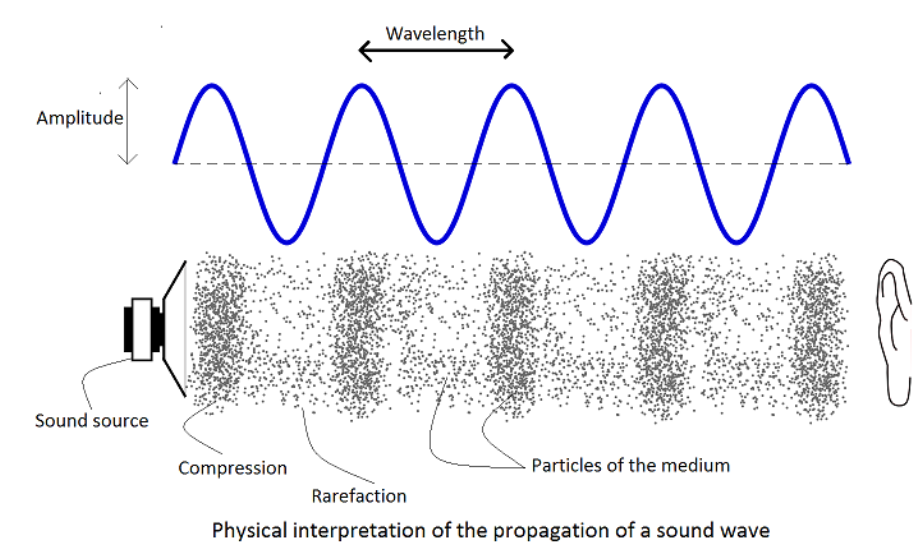
As can be seen in the diagram, the sound wave travels as packets of spaces with more density of particles (compression – medium compressed together) and less density of particles (rarefaction – medium stretched out) corresponding to the positive and negative amplitudes of the sound wave respectively.
If there are no particles, that is, no medium, then it will not be possible to compress and stretch the medium so as to make such pockets of varying densities of particles.
Hence, the correct option is A) Both assertion and reason are correct and reason is the correct explanation for the assertion.
Note: This is also the reason why astronauts cannot talk to each other directly in space. In space there is no material medium. Hence, they talk using other signals such as radio waves, which are electromagnetic waves. Electromagnetic waves do not require a material medium for their propagation and can even travel through vacuum.
Complete step by step answer:
Sound waves are mechanical waves. Mechanical waves travel by constantly stretching and compressing the particles of the medium and creating a disturbance in it. This disturbance is carried forward by the vibration of the particles in the medium which pass the vibrations on to their neighboring particles.
In the absence of a medium, there are no particles that can carry forward the disturbance via vibrations to their neighbouring particles. Hence, sound waves cannot travel in the absence of a medium. Therefore, sound waves do not travel in vacuum.
The below diagram will make the physical explanation of the propagation of sound waves with the help of the particles of the medium, clearer.
As can be seen in the diagram, the sound wave travels as packets of spaces with more density of particles (compression – medium compressed together) and less density of particles (rarefaction – medium stretched out) corresponding to the positive and negative amplitudes of the sound wave respectively.
If there are no particles, that is, no medium, then it will not be possible to compress and stretch the medium so as to make such pockets of varying densities of particles.
Hence, the correct option is A) Both assertion and reason are correct and reason is the correct explanation for the assertion.
Note: This is also the reason why astronauts cannot talk to each other directly in space. In space there is no material medium. Hence, they talk using other signals such as radio waves, which are electromagnetic waves. Electromagnetic waves do not require a material medium for their propagation and can even travel through vacuum.
Recently Updated Pages
Master Class 11 English: Engaging Questions & Answers for Success

Master Class 11 Social Science: Engaging Questions & Answers for Success
Master Class 11 Maths: Engaging Questions & Answers for Success
Master Class 11 Biology: Engaging Questions & Answers for Success
Master Class 11 Physics: Engaging Questions & Answers for Success
Master Class 11 Chemistry: Engaging Questions & Answers for Success
Trending doubts
One Metric ton is equal to kg A 10000 B 1000 C 100 class 11 physics CBSE
Difference Between Prokaryotic Cells and Eukaryotic Cells
Find the value of the expression given below sin 30circ class 11 maths CBSE
Two of the body parts which do not appear in MRI are class 11 biology CBSE
Draw a diagram of a plant cell and label at least eight class 11 biology CBSE
10 examples of friction in our daily life