



Assertion: Pascal’s law is the working principle of a hydraulic lift.
Reason: Pressure is thrust per unit area.
A. Both assertion and reason are correct and reason is the correct explanation for assertion.
B. Both assertion and reason are correct and reason is not the correct explanation for assertion.
C. Assertion is correct but reason is incorrect.
D. Assertion is incorrect but reason is correct.
Answer
 Verified
610.2k+ views
Hint: A hydraulic lift is used to perform a large amount of work with a small force. It is mostly used to lift heavy objects. It works on the principle that a pressure applied on a confined liquid spreads out uniformly in all the directions.
Formula used:
$P=\dfrac{F}{A}$
Complete answer:
Let us first understand what a hydraulic lift is. Hydraulic lift is used to do a large amount of work with a force of small magnitude. A hydraulic lift consists of two pistons. One piston with a very small area and other with a larger area. A tube containing a liquid connects the two pistons. A figure of a hydraulic lift is shown below.
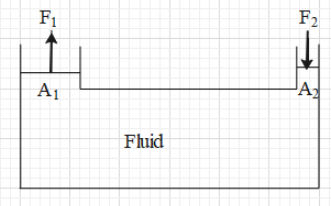
The most common use of a hydraulic lift is lifting up cars while servicing. We will understand the working of the hydraulic lift with this example.The car is placed over the piston 1 (the one with the larger area). To lift a car we need a large force. However, a hydraulic lift makes it very simple. With just a small force on piston 2 (the one with small area), the car on the other side will move up.
This process works on Pascal's law. According to Pascal’s law, the change in pressure in a confined liquid occurs uniformly everywhere inside the liquid irrespective of the size and shape of the container. Meaning, if we apply a pressure P on piston 2, this pressure will be transmitted uniformly in all the directions. Thus, the liquid will apply a pressure on piston 1, which is equal to pressure P. This means the liquid will apply a force on piston 2.
Now, let the area of piston 1 be ${{A}_{1}}$ and the force applied on it be ${{F}_{1}}$. Let the area of piston 2 be ${{A}_{2}}$ and the force applied on it be ${{F}_{2}}$. The pressure on each piston is equal to the force applied upon its area. This means that,
$P=\dfrac{{{F}_{1}}}{{{A}_{1}}}
\Rightarrow P=\dfrac{{{F}_{2}}}{{{A}_{2}}}$.
$\Rightarrow {{F}_{1}}=\dfrac{{{F}_{2}}{{A}_{1}}}{{{A}_{2}}}$.
As discussed ${{A}_{1}}$ > ${{A}_{2}}$.
$\Rightarrow \dfrac{{{A}_{1}}}{{{A}_{2}}}$ > 1.
This means that ${{F}_{1}}$ will always be greater than ${{F}_{2}}$. Hence, if the ratio of the areas of the respective piston is very large, we can lift the car with a small force. This means that the given assertion is correct.
Let us now understand the reason.
It is given that pressure is that pressure is thrust per unit area.Pressure is defined as the perpendicular force acting per unit area of a surface . The perpendicular force is called thrust. This means that the reason is correct. However, the reason is not the correct explanation for the assertion.
Hence, the correct option is B.
Note: If the force acting on a surface of a body is not perpendicular to the surface, then only the component of the force that is normal to the surface is considered for calculating the pressure. The force parallel to the surface does not contribute to the pressure.
Formula used:
$P=\dfrac{F}{A}$
Complete answer:
Let us first understand what a hydraulic lift is. Hydraulic lift is used to do a large amount of work with a force of small magnitude. A hydraulic lift consists of two pistons. One piston with a very small area and other with a larger area. A tube containing a liquid connects the two pistons. A figure of a hydraulic lift is shown below.
The most common use of a hydraulic lift is lifting up cars while servicing. We will understand the working of the hydraulic lift with this example.The car is placed over the piston 1 (the one with the larger area). To lift a car we need a large force. However, a hydraulic lift makes it very simple. With just a small force on piston 2 (the one with small area), the car on the other side will move up.
This process works on Pascal's law. According to Pascal’s law, the change in pressure in a confined liquid occurs uniformly everywhere inside the liquid irrespective of the size and shape of the container. Meaning, if we apply a pressure P on piston 2, this pressure will be transmitted uniformly in all the directions. Thus, the liquid will apply a pressure on piston 1, which is equal to pressure P. This means the liquid will apply a force on piston 2.
Now, let the area of piston 1 be ${{A}_{1}}$ and the force applied on it be ${{F}_{1}}$. Let the area of piston 2 be ${{A}_{2}}$ and the force applied on it be ${{F}_{2}}$. The pressure on each piston is equal to the force applied upon its area. This means that,
$P=\dfrac{{{F}_{1}}}{{{A}_{1}}}
\Rightarrow P=\dfrac{{{F}_{2}}}{{{A}_{2}}}$.
$\Rightarrow {{F}_{1}}=\dfrac{{{F}_{2}}{{A}_{1}}}{{{A}_{2}}}$.
As discussed ${{A}_{1}}$ > ${{A}_{2}}$.
$\Rightarrow \dfrac{{{A}_{1}}}{{{A}_{2}}}$ > 1.
This means that ${{F}_{1}}$ will always be greater than ${{F}_{2}}$. Hence, if the ratio of the areas of the respective piston is very large, we can lift the car with a small force. This means that the given assertion is correct.
Let us now understand the reason.
It is given that pressure is that pressure is thrust per unit area.Pressure is defined as the perpendicular force acting per unit area of a surface . The perpendicular force is called thrust. This means that the reason is correct. However, the reason is not the correct explanation for the assertion.
Hence, the correct option is B.
Note: If the force acting on a surface of a body is not perpendicular to the surface, then only the component of the force that is normal to the surface is considered for calculating the pressure. The force parallel to the surface does not contribute to the pressure.
Recently Updated Pages
Master Class 11 English: Engaging Questions & Answers for Success

Master Class 11 Social Science: Engaging Questions & Answers for Success
Master Class 11 Maths: Engaging Questions & Answers for Success
Master Class 11 Biology: Engaging Questions & Answers for Success
Master Class 11 Physics: Engaging Questions & Answers for Success
Master Class 11 Chemistry: Engaging Questions & Answers for Success
Trending doubts
One Metric ton is equal to kg A 10000 B 1000 C 100 class 11 physics CBSE
Difference Between Prokaryotic Cells and Eukaryotic Cells
Find the value of the expression given below sin 30circ class 11 maths CBSE
Difference between physical and chemical change class 11 chemistry CBSE
Two of the body parts which do not appear in MRI are class 11 biology CBSE
Draw a diagram of a plant cell and label at least eight class 11 biology CBSE