




Assertion: Nitrogen have five valence electrons
Reason: The electron configuration for nitrogen is $1{s^2}2{s^2}2{p^6}$.
(A) Both assertion and reason are correct and the reason is the correct explanation of assertion.
(B) Both assertion and reason are correct but the reason is incorrect explanation of the assertion.
(C) The assertion is correct but the reason is incorrect
(D) The assertion is incorrect but the reason is correct
(E) Both assertion and reason are incorrect
Answer
 Verified
614.7k+ views
Hint: Writing the atomic number and electronic configuration will give you a better picture of the answer. Electronic configuration can be written correctly by following the Aufbau principle which will give us the correct order of stability of the orbitals in increasing trend.
Complete step by step answer:
Nitrogen belongs to the p-block element and is located exactly in group 15 in the periodic table. Atomic number of nitrogen is 7. The electronic configuration is a representation of the number of electrons present in each orbital of a particular element. The electronic configuration is written according to Aufbau principle. Aufbau principle states that in the ground state of the atoms, the orbitals are filled in the order of their increasing energies and this principle is based on Pauli's exclusion principle and Hund's rule of multiplicity. The electron occupies the lowest energy orbital first then occupies higher energy orbital. The order of increasing energy orbital are:1s, 2s, 2p, 3s, 3p, 4s, 3d, 4p, 5s, 4d, 5d, 4f, 5d, 6p.. goes on. The number of electrons in the outermost shell is known as valence bond electrons.
We know that the atomic number of nitrogen is 7. The electronic configuration of nitrogen is $1{s^2}2{s^2}2{p^3}$.
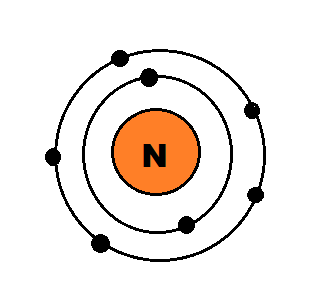
Nitrogen has five valence electrons and the electronic configuration is $1{s^2}2{s^2}2{p^3}$.
So, the assertion is correct but the reason is wrong.
Thus option C is the correct answer.
Note: The electronic configuration given in question is $1{s^2}2{s^2}2{p^6}$, then the atomic number will be 10 which is the atomic number of Neon and number of valence electrons are 8. But the electronic configuration of nitrogen $1{s^2}2{s^2}2{p^3}$ and the number of electrons in the outermost shell that is valence electrons are 5.
Complete step by step answer:
Nitrogen belongs to the p-block element and is located exactly in group 15 in the periodic table. Atomic number of nitrogen is 7. The electronic configuration is a representation of the number of electrons present in each orbital of a particular element. The electronic configuration is written according to Aufbau principle. Aufbau principle states that in the ground state of the atoms, the orbitals are filled in the order of their increasing energies and this principle is based on Pauli's exclusion principle and Hund's rule of multiplicity. The electron occupies the lowest energy orbital first then occupies higher energy orbital. The order of increasing energy orbital are:1s, 2s, 2p, 3s, 3p, 4s, 3d, 4p, 5s, 4d, 5d, 4f, 5d, 6p.. goes on. The number of electrons in the outermost shell is known as valence bond electrons.
We know that the atomic number of nitrogen is 7. The electronic configuration of nitrogen is $1{s^2}2{s^2}2{p^3}$.
Nitrogen has five valence electrons and the electronic configuration is $1{s^2}2{s^2}2{p^3}$.
So, the assertion is correct but the reason is wrong.
Thus option C is the correct answer.
Note: The electronic configuration given in question is $1{s^2}2{s^2}2{p^6}$, then the atomic number will be 10 which is the atomic number of Neon and number of valence electrons are 8. But the electronic configuration of nitrogen $1{s^2}2{s^2}2{p^3}$ and the number of electrons in the outermost shell that is valence electrons are 5.
Recently Updated Pages
Master Class 11 Social Science: Engaging Questions & Answers for Success

Master Class 11 Chemistry: Engaging Questions & Answers for Success
Master Class 12 Business Studies: Engaging Questions & Answers for Success
Master Class 12 Chemistry: Engaging Questions & Answers for Success
Master Class 12 Biology: Engaging Questions & Answers for Success
Class 12 Question and Answer - Your Ultimate Solutions Guide
Trending doubts
One Metric ton is equal to kg A 10000 B 1000 C 100 class 11 physics CBSE
Difference Between Prokaryotic Cells and Eukaryotic Cells
Two of the body parts which do not appear in MRI are class 11 biology CBSE
Explain zero factorial class 11 maths CBSE
10 examples of friction in our daily life
Name the Largest and the Smallest Cell in the Human Body ?