




Assertion: Heart of fish contains only deoxygenated blood.
Reason: Oxygenated blood do not return back to the heart in fishes.
(a) Both assertion and reason are correct and reason is the correct explanation for assertion
(b) Both assertion and reason are correct but reason is not the correct explanation for assertion
(c) Assertion is correct but reason is incorrect
(d) Both assertion and reason are incorrect
Answer
 Verified
610.2k+ views
Hint: The heart is a blood circulation pumping organ that consists of chambers communicating with each other. Two other chambers can also be located in the fish heart: bulbus arteriosus and the sinus venosus. Fish have a single pathway for circulation.
Complete answer:
The heart of a fish is two-chambered, consisting of an auricle and a ventricle. There is also an accessory chamber called sinus venosus, which acts as a reservoir and opens into the auricle through the sino-atrial aperture beforehand. The fish heart contains and pumps only deoxygenated blood, since the blood does not return to the heart after being oxygenated from the gills. Instead, it is supplied to the different parts of the body directly.
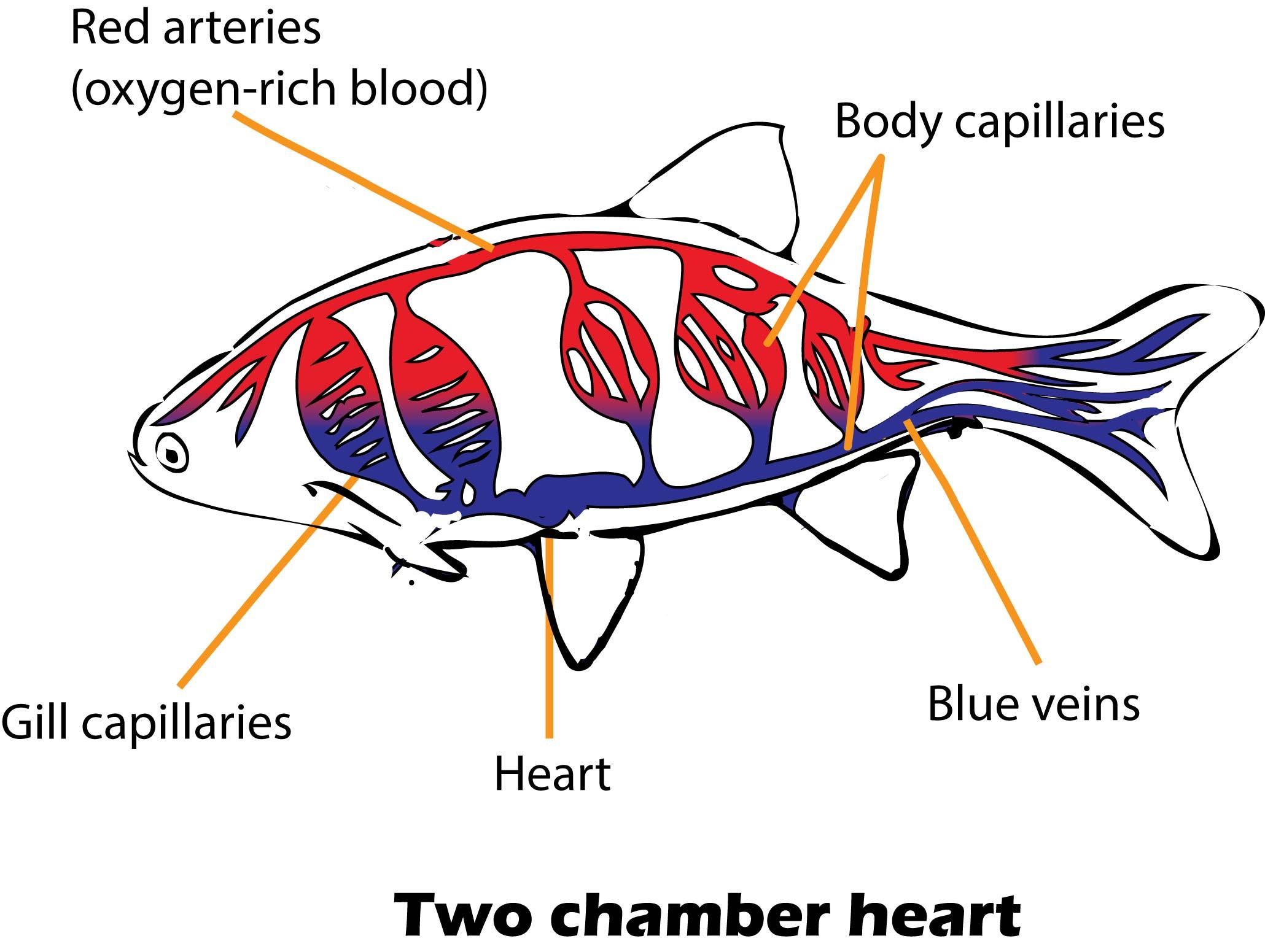
Via the sinus venosus, which includes the pacemaker cells that cause the contractions, blood from the body that is low in oxygen reaches the atrium. The blood is pumped by the atrium, which is a thin-walled muscular chamber, into the ventricle. The blood is then pumped out of the ventricle into the bulbus arteriosus: a thick-walled cavity with lots of cardiac muscle. The ventricle is in charge of producing blood pressure.
So, the correct answer is, ‘(a) Both assertion and reason are correct and the reason is the correct explanation for assertion’.
Note: The heart pumps out deoxygenated blood in fish that is oxygenated by the gills and distributed to the body parts from where deoxygenated blood is returned (single circulation) to the heart. It is referred to as a venous heart since the heart pumps deoxygenated blood into fish.
Oxygenated blood can simply be described as a blood cell with a high oxygen content and a low carbon dioxide content. Deoxygenated blood is low in oxygen.
Complete answer:
The heart of a fish is two-chambered, consisting of an auricle and a ventricle. There is also an accessory chamber called sinus venosus, which acts as a reservoir and opens into the auricle through the sino-atrial aperture beforehand. The fish heart contains and pumps only deoxygenated blood, since the blood does not return to the heart after being oxygenated from the gills. Instead, it is supplied to the different parts of the body directly.
Via the sinus venosus, which includes the pacemaker cells that cause the contractions, blood from the body that is low in oxygen reaches the atrium. The blood is pumped by the atrium, which is a thin-walled muscular chamber, into the ventricle. The blood is then pumped out of the ventricle into the bulbus arteriosus: a thick-walled cavity with lots of cardiac muscle. The ventricle is in charge of producing blood pressure.
So, the correct answer is, ‘(a) Both assertion and reason are correct and the reason is the correct explanation for assertion’.
Note: The heart pumps out deoxygenated blood in fish that is oxygenated by the gills and distributed to the body parts from where deoxygenated blood is returned (single circulation) to the heart. It is referred to as a venous heart since the heart pumps deoxygenated blood into fish.
Oxygenated blood can simply be described as a blood cell with a high oxygen content and a low carbon dioxide content. Deoxygenated blood is low in oxygen.
Recently Updated Pages
Master Class 11 English: Engaging Questions & Answers for Success

Master Class 11 Social Science: Engaging Questions & Answers for Success
Master Class 11 Maths: Engaging Questions & Answers for Success
Master Class 11 Biology: Engaging Questions & Answers for Success
Master Class 11 Physics: Engaging Questions & Answers for Success
Master Class 11 Chemistry: Engaging Questions & Answers for Success
Trending doubts
One Metric ton is equal to kg A 10000 B 1000 C 100 class 11 physics CBSE
Difference Between Prokaryotic Cells and Eukaryotic Cells
Find the value of the expression given below sin 30circ class 11 maths CBSE
Difference between physical and chemical change class 11 chemistry CBSE
Two of the body parts which do not appear in MRI are class 11 biology CBSE
Draw a diagram of a plant cell and label at least eight class 11 biology CBSE