



Assertion
Allylic and benzylic halides show high reactivity towards ${{S}_{N}}1$ reaction
Reason
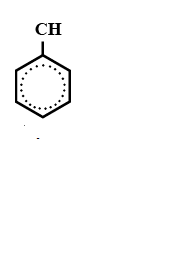
$C{{H}_{3}}-CH=C{{H}_{2}}$ and can show hyper conjugation
a.) Both assertion and the reason are correct and reason is the correct explanation for assertion
b.) Both assertion and the reason are correct and reason is not the correct explanation for assertion
c.) Assertion is correct but the reason is incorrect
d.) Both assertion and reason are incorrect
Answer
 Verified
636.9k+ views
Hint: ${{S}_{N}}1$ Reactions are substitution reaction in organic chemistry. These reactions are unimolecular, they have a stepwise mechanism. The 1 in ${{S}_{N}}1$ reaction says that the rate determining step is unimolecular.
Complete step by step answer:
${{S}_{N}}1$ Reaction is a nucleophilic substitution reaction, it involves the attack of a positively charged or a partially positively charged atom or group by a nucleophile. Nucleophiles are species which are rich in electrons; they can donate an electron pair.
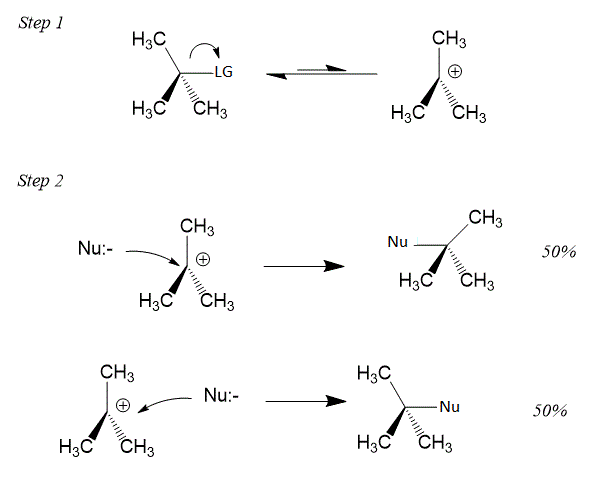
${{S}_{N}}1$ Reaction follows the first order kinetics and it is a two-step reaction. The rate of the reaction depends upon the concentration of the substrate. Carbocation is formed as an intermediate in the ${{S}_{N}}1$ reaction after the removal of the leaving group. ${{S}_{N}}1$ Reaction gives the mixture of product with the retention and inversion in configuration. This leads to racemization.
Mechanism of ${{S}_{N}}1$ reaction is shown below:
In both Allylic and benzylic halides carbocation is more stable, hence it becomes easy for the nucleophile to attack the carbocation and form a product.
The correct answer is option “A” .
Additional Information :
${{S}_{N}}2$ Reaction follows the second order kinetics and it is a single step reaction. The rate of the reaction depends upon the concentration of the substrate and nucleophile. There is a formation of a single transition state in ${{S}_{N}}2$ reaction. ${{S}_{N}}2$ Reaction leads to a back-side attack, which leads to the inversion of stereochemistry of the carbon atom, here a complete inversion of configuration takes place.
Note: Hyperconjugation is the interaction of the sigma bond, it can explain the stability of carbocations. Tertiary carbocation is more stable due to the presence of three methyl groups which distribute its positive charge. The order of stability of carbocation is:
Tertiary carbocation > secondary carbocation > primary carbocation
Complete step by step answer:
${{S}_{N}}1$ Reaction is a nucleophilic substitution reaction, it involves the attack of a positively charged or a partially positively charged atom or group by a nucleophile. Nucleophiles are species which are rich in electrons; they can donate an electron pair.
${{S}_{N}}1$ Reaction follows the first order kinetics and it is a two-step reaction. The rate of the reaction depends upon the concentration of the substrate. Carbocation is formed as an intermediate in the ${{S}_{N}}1$ reaction after the removal of the leaving group. ${{S}_{N}}1$ Reaction gives the mixture of product with the retention and inversion in configuration. This leads to racemization.
Mechanism of ${{S}_{N}}1$ reaction is shown below:
In both Allylic and benzylic halides carbocation is more stable, hence it becomes easy for the nucleophile to attack the carbocation and form a product.
The correct answer is option “A” .
Additional Information :
${{S}_{N}}2$ Reaction follows the second order kinetics and it is a single step reaction. The rate of the reaction depends upon the concentration of the substrate and nucleophile. There is a formation of a single transition state in ${{S}_{N}}2$ reaction. ${{S}_{N}}2$ Reaction leads to a back-side attack, which leads to the inversion of stereochemistry of the carbon atom, here a complete inversion of configuration takes place.
Note: Hyperconjugation is the interaction of the sigma bond, it can explain the stability of carbocations. Tertiary carbocation is more stable due to the presence of three methyl groups which distribute its positive charge. The order of stability of carbocation is:
Tertiary carbocation > secondary carbocation > primary carbocation
Recently Updated Pages
Explain the structure of megasporangium class 12 biology CBSE

Why is chloroform kept in dark coloured bottles class 12 chemistry CBSE
Derive the balancing condition of a Wheatstone bri class 12 physics CBSE
Draw VI characteristics of a pn junction diode Explain class 12 physics CBSE
Is it possible to carry pride in ones language too class 12 english CBSE
In a population at Hardy Weinberg equilibrium the allele class 12 biology CBSE
Trending doubts
Draw a labelled sketch of the human eye class 12 physics CBSE
Which are the Top 10 Largest Countries of the World?
Draw ray diagrams each showing i myopic eye and ii class 12 physics CBSE
One megawatt is equal to how many units of electri class 12 physics CBSE
Which is the correct genotypic ratio of mendel dihybrid class 12 biology CBSE
Give 10 examples of unisexual and bisexual flowers