




Assertion (A): The line $2x+y=5$ is a diameter of the circle ${{x}^{2}}+{{y}^{2}}-6x+2y=0$.
Reason (R): Normal of a circle always pass through the center of a circle
a) Both A and R are individually true and R is the correct explanation of A
b) Both A and R are individually true but R is not the correct explanation of A
c) A is true but R is false
d) A is false but R is true
Answer
 Verified
584.4k+ views
Hint: We start solving the problem by converting the obtained equation of the circle into the standard form. We then find the coordinates of the center of the circle and then substitute in the given equation of the diameter whether it is passing through it or not. We then find the slope of tangent using which we find the slope of normal and eventually equation of it. We then substitute the center of the circle to check the reason.
Complete step-by-step solution:
According to the problem, we are given that the equation of a circle as ${{x}^{2}}+{{y}^{2}}-6x+2y=0$--(1).
We know that the standard form of the equation of a circle is ${{x}^{2}}+{{y}^{2}}+2gx+2fy+c=0$.
Let us rewrite the equation (1) in the standard equation of the circle.
So, we get ${{x}^{2}}+{{y}^{2}}+2(-3)x+2(1)y+0=0$ ---(2).
Comparing with the standard equation of the circle we get $g=-3$ and $f=1$.
We know that the centre of the circle ${{x}^{2}}+{{y}^{2}}+2gx+2fy+c=0$ is defined as $\left( -g,-f \right)$.
So, we get the centre of the circle ${{x}^{2}}+{{y}^{2}}-6x+2y=0$ as $\left( -\left( -3 \right),-1 \right)=\left( 3,-1 \right)$.
We have found the centre of the circle ${{x}^{2}}+{{y}^{2}}-6x+2y=0$ as $\left( 3,-1 \right)$.
Let us draw the circle to get a clear view.
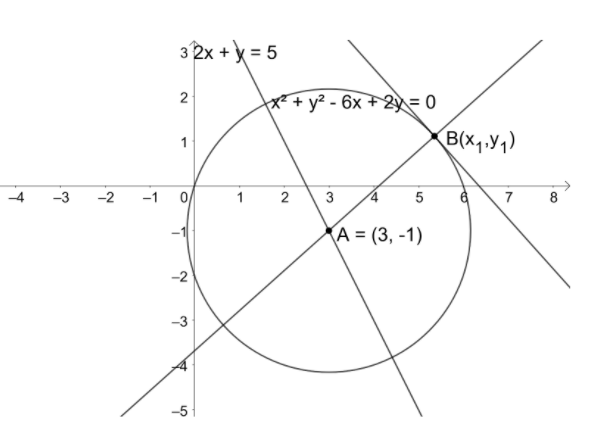
We know that the diameter of a circle passes through the center. This means that the point $\left( 3,-1 \right)$ should satisfy the equation of the line $2x+y=5$.
Let us substitute the point $\left( 3,-1 \right)$ in the equation of the line $2x+y=5$.
So, we get $2\left( 3 \right)-1=5$.
$\Rightarrow 6-1=5$.
$\Rightarrow 5=5$.
We have got L.H.S = R.H.S, which means that the line $2x+y=5$ is the diameter of the circle.
So, the given assertion (A) is true.
Now let us consider Reason(R)
Let us assume the point $\left( {{x}_{1}},{{y}_{1}} \right)$ on the circle ${{x}^{2}}+{{y}^{2}}-6x+2y=0$.
Now, let us find the slope of the tangent at this point to the circle.
So, we get $\dfrac{d}{dx}\left( {{x}^{2}}+{{y}^{2}}-6x+2y \right)=\dfrac{d}{dx}\left( 0 \right)$.
$\Rightarrow 2x+2y\dfrac{dy}{dx}-6+2\dfrac{dy}{dx}=0$.
$\Rightarrow \left( 2y+2 \right)\dfrac{dy}{dx}=6-2x$.
$\Rightarrow \dfrac{dy}{dx}=\dfrac{\left( 6-2x \right)}{\left( 2y+2 \right)}$.
So, the slope(m) of the tangent at the point $\left( {{x}_{1}},{{y}_{1}} \right)$ is \[m={{\left. \dfrac{dy}{dx} \right|}_{\left( {{x}_{1}},{{y}_{1}} \right)}}=\dfrac{\left( 6-2{{x}_{1}} \right)}{\left( 2{{y}_{1}}+2 \right)}\].
We know that the tangent and normal are perpendicular to each other and we also know that the product of slopes of perpendicular lines is $-1$.
Let us assume the slope of normal be ${{m}_{n}}$. So, we get $\dfrac{\left( 6-2{{x}_{1}} \right)}{\left( 2{{y}_{1}}+2 \right)}\times {{m}_{1}}=-1$.
$\Rightarrow {{m}_{1}}=\dfrac{\left( 2{{y}_{1}}+2 \right)}{\left( 2{{x}_{1}}-6 \right)}$.
We have to find the equation of the normal passing through the point $\left( {{x}_{1}},{{y}_{1}} \right)$ and having slope ${{m}_{1}}=\dfrac{\left( 2{{y}_{1}}+2 \right)}{\left( 2{{x}_{1}}-6 \right)}$.
So, the equation of the normal is $y-{{y}_{1}}=\dfrac{\left( 2{{y}_{1}}+2 \right)}{\left( 2{{x}_{1}}-6 \right)}\times \left( x-{{x}_{1}} \right)$.
$\Rightarrow \left( y-{{y}_{1}} \right)\times \left( {{x}_{1}}-3 \right)=\left( x-{{x}_{1}} \right)\times \left( {{y}_{1}}+1 \right)$.
Let us substitute the centre of circle $\left( 3,-1 \right)$ in this equation.
$\Rightarrow \left( y-{{y}_{1}} \right)\times \left( 3-3 \right)=\left( x-{{x}_{1}} \right)\times \left( -1+1 \right)$.
$\Rightarrow \left( y-{{y}_{1}} \right)\times \left( 0 \right)=\left( x-{{x}_{1}} \right)\times \left( 0 \right)$.
$\Rightarrow 0=0$.
So, we have got L.H.S = R.H.S which means that the normal is passing through the center of the circle.
This tells us that Reason (R) is correct.
We can see that both normal and diameter are passing through the center and connecting opposite sides of the diameter which means that the diameter of the circle is also the normal of the circle.
So, the reason (R) is the correct explanation for the Assertion (A). The correct option for the given problem is (a).
Note: We should check whether assertion can be explained with the given reason in any way possible. We should not directly say anything without proof of this type of problem. We should not make calculation mistakes while solving this problem. We should know that all the diameters of the circle are normal to it as we proved the result.
Complete step-by-step solution:
According to the problem, we are given that the equation of a circle as ${{x}^{2}}+{{y}^{2}}-6x+2y=0$--(1).
We know that the standard form of the equation of a circle is ${{x}^{2}}+{{y}^{2}}+2gx+2fy+c=0$.
Let us rewrite the equation (1) in the standard equation of the circle.
So, we get ${{x}^{2}}+{{y}^{2}}+2(-3)x+2(1)y+0=0$ ---(2).
Comparing with the standard equation of the circle we get $g=-3$ and $f=1$.
We know that the centre of the circle ${{x}^{2}}+{{y}^{2}}+2gx+2fy+c=0$ is defined as $\left( -g,-f \right)$.
So, we get the centre of the circle ${{x}^{2}}+{{y}^{2}}-6x+2y=0$ as $\left( -\left( -3 \right),-1 \right)=\left( 3,-1 \right)$.
We have found the centre of the circle ${{x}^{2}}+{{y}^{2}}-6x+2y=0$ as $\left( 3,-1 \right)$.
Let us draw the circle to get a clear view.
We know that the diameter of a circle passes through the center. This means that the point $\left( 3,-1 \right)$ should satisfy the equation of the line $2x+y=5$.
Let us substitute the point $\left( 3,-1 \right)$ in the equation of the line $2x+y=5$.
So, we get $2\left( 3 \right)-1=5$.
$\Rightarrow 6-1=5$.
$\Rightarrow 5=5$.
We have got L.H.S = R.H.S, which means that the line $2x+y=5$ is the diameter of the circle.
So, the given assertion (A) is true.
Now let us consider Reason(R)
Let us assume the point $\left( {{x}_{1}},{{y}_{1}} \right)$ on the circle ${{x}^{2}}+{{y}^{2}}-6x+2y=0$.
Now, let us find the slope of the tangent at this point to the circle.
So, we get $\dfrac{d}{dx}\left( {{x}^{2}}+{{y}^{2}}-6x+2y \right)=\dfrac{d}{dx}\left( 0 \right)$.
$\Rightarrow 2x+2y\dfrac{dy}{dx}-6+2\dfrac{dy}{dx}=0$.
$\Rightarrow \left( 2y+2 \right)\dfrac{dy}{dx}=6-2x$.
$\Rightarrow \dfrac{dy}{dx}=\dfrac{\left( 6-2x \right)}{\left( 2y+2 \right)}$.
So, the slope(m) of the tangent at the point $\left( {{x}_{1}},{{y}_{1}} \right)$ is \[m={{\left. \dfrac{dy}{dx} \right|}_{\left( {{x}_{1}},{{y}_{1}} \right)}}=\dfrac{\left( 6-2{{x}_{1}} \right)}{\left( 2{{y}_{1}}+2 \right)}\].
We know that the tangent and normal are perpendicular to each other and we also know that the product of slopes of perpendicular lines is $-1$.
Let us assume the slope of normal be ${{m}_{n}}$. So, we get $\dfrac{\left( 6-2{{x}_{1}} \right)}{\left( 2{{y}_{1}}+2 \right)}\times {{m}_{1}}=-1$.
$\Rightarrow {{m}_{1}}=\dfrac{\left( 2{{y}_{1}}+2 \right)}{\left( 2{{x}_{1}}-6 \right)}$.
We have to find the equation of the normal passing through the point $\left( {{x}_{1}},{{y}_{1}} \right)$ and having slope ${{m}_{1}}=\dfrac{\left( 2{{y}_{1}}+2 \right)}{\left( 2{{x}_{1}}-6 \right)}$.
So, the equation of the normal is $y-{{y}_{1}}=\dfrac{\left( 2{{y}_{1}}+2 \right)}{\left( 2{{x}_{1}}-6 \right)}\times \left( x-{{x}_{1}} \right)$.
$\Rightarrow \left( y-{{y}_{1}} \right)\times \left( {{x}_{1}}-3 \right)=\left( x-{{x}_{1}} \right)\times \left( {{y}_{1}}+1 \right)$.
Let us substitute the centre of circle $\left( 3,-1 \right)$ in this equation.
$\Rightarrow \left( y-{{y}_{1}} \right)\times \left( 3-3 \right)=\left( x-{{x}_{1}} \right)\times \left( -1+1 \right)$.
$\Rightarrow \left( y-{{y}_{1}} \right)\times \left( 0 \right)=\left( x-{{x}_{1}} \right)\times \left( 0 \right)$.
$\Rightarrow 0=0$.
So, we have got L.H.S = R.H.S which means that the normal is passing through the center of the circle.
This tells us that Reason (R) is correct.
We can see that both normal and diameter are passing through the center and connecting opposite sides of the diameter which means that the diameter of the circle is also the normal of the circle.
So, the reason (R) is the correct explanation for the Assertion (A). The correct option for the given problem is (a).
Note: We should check whether assertion can be explained with the given reason in any way possible. We should not directly say anything without proof of this type of problem. We should not make calculation mistakes while solving this problem. We should know that all the diameters of the circle are normal to it as we proved the result.
Recently Updated Pages
Master Class 10 Computer Science: Engaging Questions & Answers for Success

Master Class 10 General Knowledge: Engaging Questions & Answers for Success
Master Class 10 English: Engaging Questions & Answers for Success
Master Class 10 Social Science: Engaging Questions & Answers for Success
Master Class 10 Maths: Engaging Questions & Answers for Success
Master Class 10 Science: Engaging Questions & Answers for Success
Trending doubts
What is the median of the first 10 natural numbers class 10 maths CBSE
Which women's tennis player has 24 Grand Slam singles titles?
Who is the Brand Ambassador of Incredible India?
Why is there a time difference of about 5 hours between class 10 social science CBSE
Write a letter to the principal requesting him to grant class 10 english CBSE
A moving boat is observed from the top of a 150 m high class 10 maths CBSE