




Assertion: A spring has potential energy, both when it is compressed or stretched.
Reason: In compressing or stretching, work is done against the restoring force.
A. Both Assertion and Reason are correct and reason is the correct explanation for assertion.
B. Both Assertion and Reason are correct but reason is not the correct explanation for assertion.
C. Assertion is correct but reason is incorrect.
D. Assertion is incorrect but the reason is correct.
Answer
 Verified
522.6k+ views
Hint: Potential energy is due to its position. When the original position of an object changes then it stores some potential. Also potential energy can be due to work done against some other forces which are in the opposite direction of its motion. We will analyze the stretching and compressing procedure of spring.
Complete step by step answer:
In physics, spring is a device which basically stores the potential energy whenever a compression or stretching of spring takes place. Basically it is elastic potential energy which gets stored on compression or stretching of spring.
Let a spring is stretched or compressed by \[x\] distance then the restoring force to regain its original position can be determined by Hooke’s law.According to Hooke’s Law,
\[F{\text{ = - kx}}\]
Where, k is called spring constant and x is the distance through which it is compressed or stretched.
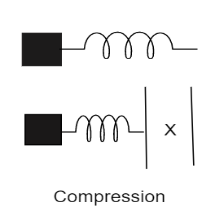
When the spring regains its original shape then work is done against restoring force which is the reason for potential energy. Work done in doing so is calculated as:
\[\text{Work done} = {\text{ F }} \times {\text{ x}}\]
\[\Rightarrow \text{Work done} = {\text{ }}\left( {{\text{ - kx}}} \right){\text{ }} \times {\text{ x}}\]
\[\therefore \text{Work done} = {\text{ - k}}{{\text{x}}^2}\]
Therefore this work will be stored in the form of energy which is the elastic potential energy of spring.
Therefore the correct option is A.
Note: For compression of spring we take the value of x as negative while in case of stretching we take the positive value of x. When stretching or compression is more than its limit then spring can even break or lose its elasticity. When a block is attached to the spring then there will be kinetic energy of the block while compression or stretching of the spring.
Complete step by step answer:
In physics, spring is a device which basically stores the potential energy whenever a compression or stretching of spring takes place. Basically it is elastic potential energy which gets stored on compression or stretching of spring.
Let a spring is stretched or compressed by \[x\] distance then the restoring force to regain its original position can be determined by Hooke’s law.According to Hooke’s Law,
\[F{\text{ = - kx}}\]
Where, k is called spring constant and x is the distance through which it is compressed or stretched.
When the spring regains its original shape then work is done against restoring force which is the reason for potential energy. Work done in doing so is calculated as:
\[\text{Work done} = {\text{ F }} \times {\text{ x}}\]
\[\Rightarrow \text{Work done} = {\text{ }}\left( {{\text{ - kx}}} \right){\text{ }} \times {\text{ x}}\]
\[\therefore \text{Work done} = {\text{ - k}}{{\text{x}}^2}\]
Therefore this work will be stored in the form of energy which is the elastic potential energy of spring.
Therefore the correct option is A.
Note: For compression of spring we take the value of x as negative while in case of stretching we take the positive value of x. When stretching or compression is more than its limit then spring can even break or lose its elasticity. When a block is attached to the spring then there will be kinetic energy of the block while compression or stretching of the spring.
Recently Updated Pages
Master Class 11 Social Science: Engaging Questions & Answers for Success

Master Class 11 English: Engaging Questions & Answers for Success
Master Class 11 Maths: Engaging Questions & Answers for Success
Master Class 11 Chemistry: Engaging Questions & Answers for Success
Master Class 11 Biology: Engaging Questions & Answers for Success
Master Class 11 Physics: Engaging Questions & Answers for Success
Trending doubts
One Metric ton is equal to kg A 10000 B 1000 C 100 class 11 physics CBSE
Difference Between Prokaryotic Cells and Eukaryotic Cells
There are 720 permutations of the digits 1 2 3 4 5 class 11 maths CBSE
Draw a diagram of a plant cell and label at least eight class 11 biology CBSE
Two of the body parts which do not appear in MRI are class 11 biology CBSE
Which gas is abundant in air class 11 chemistry CBSE