




Assertion: A frame moving in a circle with a constant speed can never be an inertial frame.
Reason: It has a constant acceleration.
A. Both Assertion and Reason are correct and the reason is the correct explanation for Assertion.
B. Both Assertion and Reason are correct and the reason is not the correct explanation for Assertion.
C. Assertion is correct but Reason is incorrect.
D. Assertion is incorrect but the reason is correct.
Answer
 Verified
585.3k+ views
Hint: The speed of a body is a scalar quantity that only has a magnitude and there is no specific direction of the body. On the other hand, acceleration is a vector quantity which has some specific velocity as well as the direction.
Complete answer:
When an object is moving in a circular path with the uniform speed as V shown in the diagram,
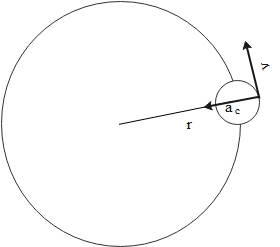
The speed of a moving body is the scalar quantity. There is no specific direction of such quantities. The linear speed is given by:
$\begin{align}
& \omega =\dfrac{\Delta \theta }{\Delta t} \\
& \Rightarrow v=r\omega \\
\end{align}$
Where,
$\omega $ Is the angular speed
$\Delta \theta $ Is the angle rotation
$t$ Is the time duration
$r$ Is the radius of the circle
$v$ Is the linear speed.
The object moving in the circular path will have a non-inertial frame. This is due to the centripetal acceleration acting on the body. The centripetal acceleration is towards the center. The centripetal force is given by,
${{a}_{c}}=r{{\omega }^{2}}$
Here we can say that the Assertion given in the question is correct.
The acceleration of the body always towards the center of the circle. But its pointing direction always changes according to the position of the object.
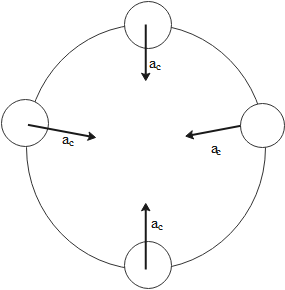
Thus the vector of acceleration ( $\vec{a}$ ) will be variable concerning the center of the circle. We can say that the reason is incorrect.
So, the correct answer is “Option C”.
Note:
When an object is moving into a circular path with a uniform speed the force acting on it is known as centripetal force. Concerning Newton’s 3rd law of motion, every acting force has its equal and opposite reaction force. The opposite force acting on the body is known as centrifugal force.
Complete answer:
When an object is moving in a circular path with the uniform speed as V shown in the diagram,
The speed of a moving body is the scalar quantity. There is no specific direction of such quantities. The linear speed is given by:
$\begin{align}
& \omega =\dfrac{\Delta \theta }{\Delta t} \\
& \Rightarrow v=r\omega \\
\end{align}$
Where,
$\omega $ Is the angular speed
$\Delta \theta $ Is the angle rotation
$t$ Is the time duration
$r$ Is the radius of the circle
$v$ Is the linear speed.
The object moving in the circular path will have a non-inertial frame. This is due to the centripetal acceleration acting on the body. The centripetal acceleration is towards the center. The centripetal force is given by,
${{a}_{c}}=r{{\omega }^{2}}$
Here we can say that the Assertion given in the question is correct.
The acceleration of the body always towards the center of the circle. But its pointing direction always changes according to the position of the object.
Thus the vector of acceleration ( $\vec{a}$ ) will be variable concerning the center of the circle. We can say that the reason is incorrect.
So, the correct answer is “Option C”.
Note:
When an object is moving into a circular path with a uniform speed the force acting on it is known as centripetal force. Concerning Newton’s 3rd law of motion, every acting force has its equal and opposite reaction force. The opposite force acting on the body is known as centrifugal force.
Recently Updated Pages
Master Class 11 Business Studies: Engaging Questions & Answers for Success

Master Class 11 Economics: Engaging Questions & Answers for Success
Master Class 11 Computer Science: Engaging Questions & Answers for Success
Master Class 11 English: Engaging Questions & Answers for Success
Master Class 11 Maths: Engaging Questions & Answers for Success
Master Class 11 Biology: Engaging Questions & Answers for Success
Trending doubts
One Metric ton is equal to kg A 10000 B 1000 C 100 class 11 physics CBSE
Discuss the various forms of bacteria class 11 biology CBSE
Draw a diagram of a plant cell and label at least eight class 11 biology CBSE
State the laws of reflection of light
Explain zero factorial class 11 maths CBSE
10 examples of friction in our daily life