




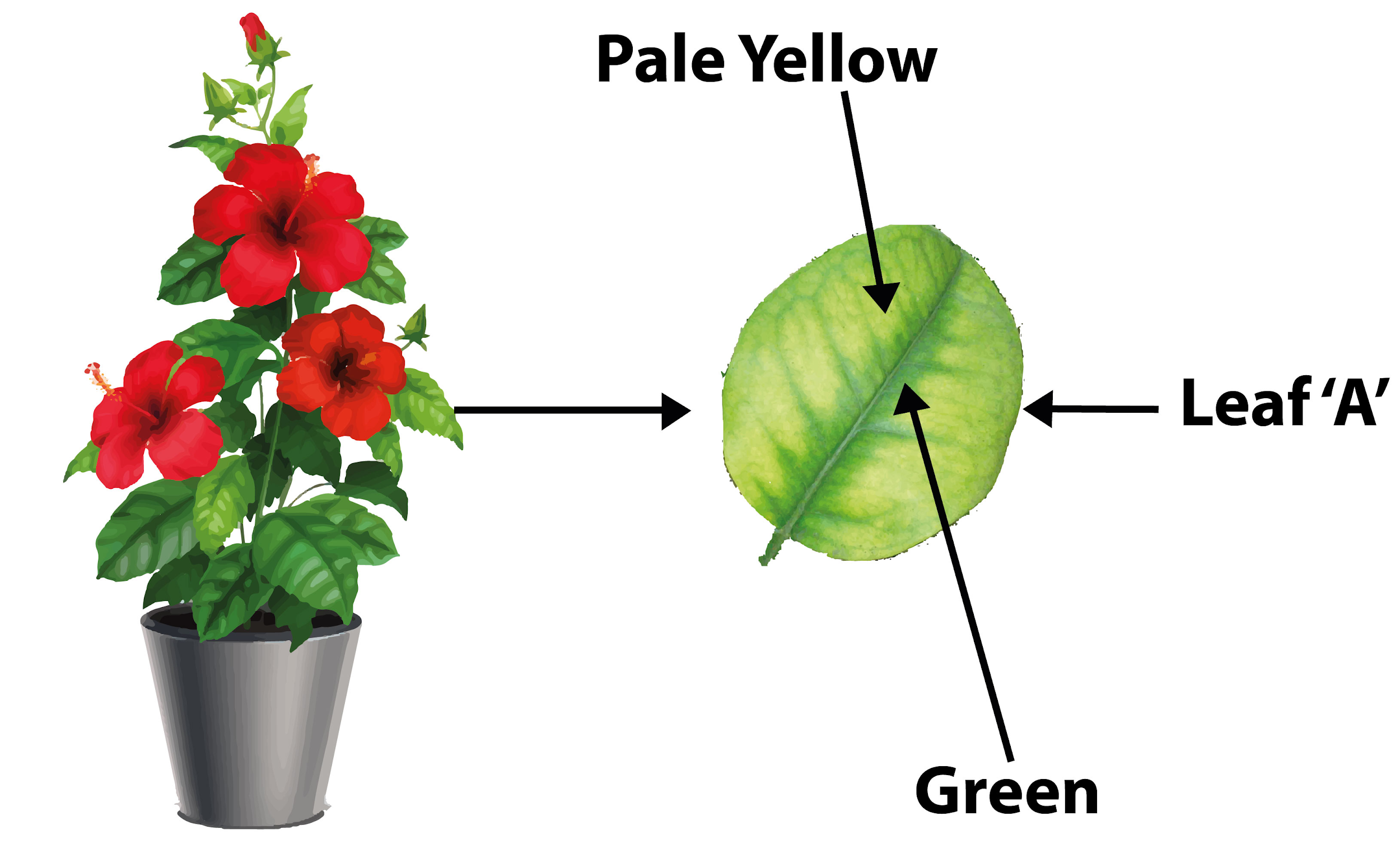
What aspect of photosynthesis is being tested in the diagram?
Answer
 Verified
585.9k+ views
Hint: Photosynthesis is the process of conversion of light energy to chemical energy by the plants in order to make food. They do this with the help of certain coloured pigments. This diagram tests the necessity of that pigment for photosynthesis.
Complete answer:
Plants perform photosynthesis to produce energy in the form of food. They carry out photosynthesis using a green pigment called Chlorophyll. Photosynthesis occurs in all green parts, chiefly the leaves. Plants store this energy in the form of starch which is the reserve food material.
The given diagram is the experiment to show that variegated leaves with yellow spots do not photosynthesize in the areas of those spots where chlorophyll is missing. This is proven by pouring iodine solution on the leaves to show the presence or absence of starch which ultimately proves the necessity of chlorophyll or the green pigments on leaves for photosynthesis.
The plant is left in the open sunlight to undergo photosynthesis. A leaf is then plucked and an iodine solution is poured on it. If the area of the leaf contains starch, iodine turns to purple, and areas of leaves without starch are stained to brownish colour. This change to purple indicating starch occurs only in the green areas of the leaf.
Note: -Plants with variegated leaves such as Oxalis are used for this experiment.
-Before keeping the plant in sunlight, the plant is kept in the dark for 24 hours.
-This is done to ensure that the plant completely utilizes its starch reserve and the results of the experiment are not altered.
Complete answer:
Plants perform photosynthesis to produce energy in the form of food. They carry out photosynthesis using a green pigment called Chlorophyll. Photosynthesis occurs in all green parts, chiefly the leaves. Plants store this energy in the form of starch which is the reserve food material.
The given diagram is the experiment to show that variegated leaves with yellow spots do not photosynthesize in the areas of those spots where chlorophyll is missing. This is proven by pouring iodine solution on the leaves to show the presence or absence of starch which ultimately proves the necessity of chlorophyll or the green pigments on leaves for photosynthesis.
The plant is left in the open sunlight to undergo photosynthesis. A leaf is then plucked and an iodine solution is poured on it. If the area of the leaf contains starch, iodine turns to purple, and areas of leaves without starch are stained to brownish colour. This change to purple indicating starch occurs only in the green areas of the leaf.
Note: -Plants with variegated leaves such as Oxalis are used for this experiment.
-Before keeping the plant in sunlight, the plant is kept in the dark for 24 hours.
-This is done to ensure that the plant completely utilizes its starch reserve and the results of the experiment are not altered.
Recently Updated Pages
Master Class 11 Computer Science: Engaging Questions & Answers for Success

Master Class 11 Business Studies: Engaging Questions & Answers for Success
Master Class 11 Economics: Engaging Questions & Answers for Success
Master Class 11 English: Engaging Questions & Answers for Success
Master Class 11 Maths: Engaging Questions & Answers for Success
Master Class 11 Biology: Engaging Questions & Answers for Success
Trending doubts
One Metric ton is equal to kg A 10000 B 1000 C 100 class 11 physics CBSE
There are 720 permutations of the digits 1 2 3 4 5 class 11 maths CBSE
Discuss the various forms of bacteria class 11 biology CBSE
Draw a diagram of a plant cell and label at least eight class 11 biology CBSE
State the laws of reflection of light
Explain zero factorial class 11 maths CBSE