




As the wavelength is increased from violet to red, the luminosity
$\left. A \right)$ Increases continuously
$\left. B \right)$ Decreases continuously
$\left. C \right)$ First increases then decreases
$\left. D \right)$ First decreases then increases
Answer
 Verified
597.9k+ views
Hint: The luminosity of radiant flux of any source emitting electromagnetic radiation is the measure of capacity of source to produce brightness sensation in eyes. The radiant flux can be defined as the total energy of electromagnetic radiation emitted by a source per unit time, whose unit is the same as that of power that is watt.
Complete step-by-step answer:
The brightness produced by radiation from any source not only depends on radiant flux but also depends on the wavelength of radiation. For example if two sources of light, one emitting red light and other emitting yellow light, have the same radiant flux, that is the total energy emitted by them per unit time is the same, still the source which is emitting yellow light will look brighter.
To understand the relation between luminosity and wavelength we need to define relative luminosity, it is defined as the ratio of the luminous flux of source of given wavelength to the luminous flux of a $555\;nm$ source of same power.
Also the luminous flux is the quantity directly representing the total brightness producing capacity of the source which is measured in lumen.
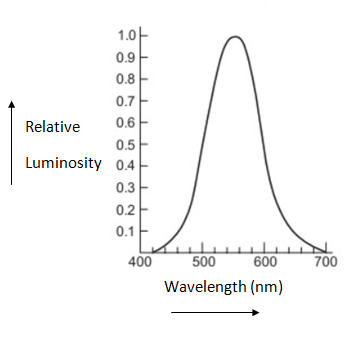
When graph is drawn between relative luminosity and wavelength it is found that as wavelength increases from violet to red, violet being the minimum the relative luminosity first increases with wavelength reaches a maximum value of relative luminosity at $555\;nm$ and then decreases to minimum as wavelength is increased further.
So as the wavelength is increased from violet to red the luminosity first increases, reaches maximum and then decreases.
So, the correct answer is “Option C”.
Note: The terms luminosity and relative luminosity are used interchangeably, also the term luminosity should not be confused with intensity, luminosity is the measure of capacity of source to produce brightness sensation in eyes and intensity is the rate at which energy is delivered per unit time on per unit area.
Complete step-by-step answer:
The brightness produced by radiation from any source not only depends on radiant flux but also depends on the wavelength of radiation. For example if two sources of light, one emitting red light and other emitting yellow light, have the same radiant flux, that is the total energy emitted by them per unit time is the same, still the source which is emitting yellow light will look brighter.
To understand the relation between luminosity and wavelength we need to define relative luminosity, it is defined as the ratio of the luminous flux of source of given wavelength to the luminous flux of a $555\;nm$ source of same power.
Also the luminous flux is the quantity directly representing the total brightness producing capacity of the source which is measured in lumen.
When graph is drawn between relative luminosity and wavelength it is found that as wavelength increases from violet to red, violet being the minimum the relative luminosity first increases with wavelength reaches a maximum value of relative luminosity at $555\;nm$ and then decreases to minimum as wavelength is increased further.
So as the wavelength is increased from violet to red the luminosity first increases, reaches maximum and then decreases.
So, the correct answer is “Option C”.
Note: The terms luminosity and relative luminosity are used interchangeably, also the term luminosity should not be confused with intensity, luminosity is the measure of capacity of source to produce brightness sensation in eyes and intensity is the rate at which energy is delivered per unit time on per unit area.
Recently Updated Pages
Master Class 11 Social Science: Engaging Questions & Answers for Success

Master Class 11 Physics: Engaging Questions & Answers for Success
Master Class 11 Maths: Engaging Questions & Answers for Success
Master Class 11 Economics: Engaging Questions & Answers for Success
Master Class 11 Computer Science: Engaging Questions & Answers for Success
Master Class 11 Chemistry: Engaging Questions & Answers for Success
Trending doubts
One Metric ton is equal to kg A 10000 B 1000 C 100 class 11 physics CBSE
There are 720 permutations of the digits 1 2 3 4 5 class 11 maths CBSE
1 Quintal is equal to a 110 kg b 10 kg c 100kg d 1000 class 11 physics CBSE
State and prove Bernoullis theorem class 11 physics CBSE
Difference Between Prokaryotic Cells and Eukaryotic Cells
Which among the following are examples of coming together class 11 social science CBSE