




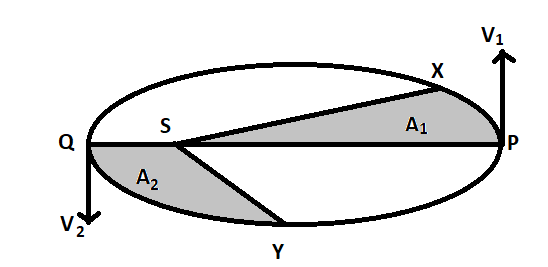
As the planet revolves from point P to point Q, the velocity of the planet:
A. increases
B. decreases
C. remains same
D. remains equal in magnitude but opposite in direction
Answer
 Verified
568.8k+ views
Hint:
The above problem can be resolved using the concept and the mathematical formula for the orbital velocity. One can define the orbital velocity as that magnitude of velocity, which is possessed by any heavenly object, especially planets while moving around the sun's orbits. The orbital velocity gives an inverse square root relation for the distance from the planet to the sun's centre, which is analysed accordingly.
Complete step by step solution
The planets have the tendency to revolve around the sun and the magnitude of velocity possessed by the planets are typically called orbital velocity.
The expression for the orbital velocity is given as,
\[{v_o} = \sqrt {\dfrac{{GM}}{r}} \]
Here, G is the universal gravitational constant, M is the mass of sun and r is the distance of the planet to the centre of the sun.
The above relation clears that for the constant value of gravitational constant and the mass of the sun. The orbital velocity varies as,
\[{v_o} \propto \dfrac{1}{{\sqrt r }}\]
The distance is in inverse relation with the velocity.
And as the distance SP is greater than the distance SQ, the velocity at Q is more than that at point P.
Therefore, the velocity increases from point P to Q and option (A) is correct.
Note:
To resolve the given problem, one must go through the concepts involving the planet's orbital speed. The orbital speed of any planet depends on the mass of any object around which such a revolution takes place. Along with this, the practical significance of the orbital speed is to be remembered.
The above problem can be resolved using the concept and the mathematical formula for the orbital velocity. One can define the orbital velocity as that magnitude of velocity, which is possessed by any heavenly object, especially planets while moving around the sun's orbits. The orbital velocity gives an inverse square root relation for the distance from the planet to the sun's centre, which is analysed accordingly.
Complete step by step solution
The planets have the tendency to revolve around the sun and the magnitude of velocity possessed by the planets are typically called orbital velocity.
The expression for the orbital velocity is given as,
\[{v_o} = \sqrt {\dfrac{{GM}}{r}} \]
Here, G is the universal gravitational constant, M is the mass of sun and r is the distance of the planet to the centre of the sun.
The above relation clears that for the constant value of gravitational constant and the mass of the sun. The orbital velocity varies as,
\[{v_o} \propto \dfrac{1}{{\sqrt r }}\]
The distance is in inverse relation with the velocity.
And as the distance SP is greater than the distance SQ, the velocity at Q is more than that at point P.
Therefore, the velocity increases from point P to Q and option (A) is correct.
Note:
To resolve the given problem, one must go through the concepts involving the planet's orbital speed. The orbital speed of any planet depends on the mass of any object around which such a revolution takes place. Along with this, the practical significance of the orbital speed is to be remembered.
Recently Updated Pages
Master Class 11 English: Engaging Questions & Answers for Success

Master Class 11 Maths: Engaging Questions & Answers for Success
Master Class 11 Biology: Engaging Questions & Answers for Success
Master Class 11 Physics: Engaging Questions & Answers for Success
Master Class 11 Accountancy: Engaging Questions & Answers for Success
Class 11 Question and Answer - Your Ultimate Solutions Guide
Trending doubts
One Metric ton is equal to kg A 10000 B 1000 C 100 class 11 physics CBSE
Discuss the various forms of bacteria class 11 biology CBSE
Draw a diagram of a plant cell and label at least eight class 11 biology CBSE
State the laws of reflection of light
Explain zero factorial class 11 maths CBSE
10 examples of friction in our daily life