



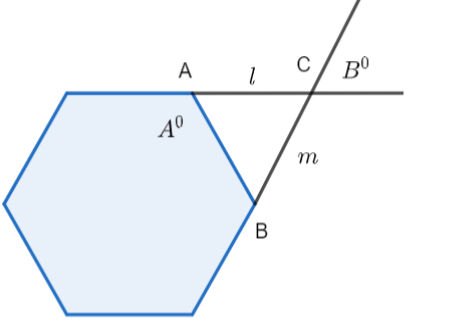
As shown in the below figure, the two sides of the regular hexagon when extended meet at the intersection of the lines l and m. If the measure of angle A is 120 degrees, then the measure of angle B, in degree, is:
\[\begin{align}
& (A)\text{ }30 \\
& (B)\text{ }60 \\
& (C)\text{ }90 \\
& (D)\text{ }140 \\
\end{align}\]
Answer
 Verified
576.9k+ views
Complete step-by-step solution:
From the question, it was given that the two sides of the regular hexagon when extended meet at the intersection of the lines l and m.
The lines l and m form a triangle. Let us assume this triangle as \[\Delta ABC\] with vertices A, B, and C respectively.
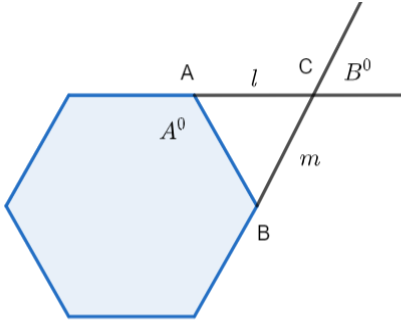
From the question, it was given that the measure of angle A is 120 degrees. We know that the angle on a straight line is 180 degrees. So, the sum of \[\angle BAC\]and \[{{A}^{{}^\circ }}\] is equal to \[{{180}^{{}^\circ }}\].
\[\begin{align}
& \Rightarrow \angle BAC+{{A}^{{}^\circ }}={{180}^{{}^\circ }} \\
& \Rightarrow \angle BAC+{{120}^{{}^\circ }}={{180}^{{}^\circ }} \\
& \Rightarrow \angle BAC={{60}^{{}^\circ }}....(1) \\
\end{align}\]
In the question, it was given that all angles in a regular hexagon are equal to 120 degrees. So, the exterior angle of \[\angle ABC\] is equal to 120 degrees.
So, on line m we get
\[\begin{align}
& \Rightarrow \angle ABC+{{120}^{{}^\circ }}={{180}^{{}^\circ }} \\
& \Rightarrow \angle ABC={{60}^{{}^\circ }}....(2) \\
\end{align}\]
We know that the sum of all angles in a triangle is equal to 180 degrees.
So, we get
From equation (1) and equation (2) we get
\[\begin{align}
& \Rightarrow {{60}^{{}^\circ }}+{{60}^{{}^\circ }}+\angle BCA={{180}^{{}^\circ }} \\
& \Rightarrow \angle BCA={{180}^{{}^\circ }}-{{120}^{{}^\circ }} \\
& \Rightarrow \angle BCA={{60}^{{}^\circ }}....(3) \\
\end{align}\]
We know that the angle on a straight line is 180 degrees. So, the sum of \[\angle BCA\] and exterior angle of \[\angle BCA\] in triangle ABC is equal to \[{{180}^{{}^\circ }}\].
Let us assume the exterior angle of \[\angle BCA\] as \[{{C}^{{}^\circ }}\].
From equation (3), we get
\[\begin{align}
& \Rightarrow \angle BCA+{{C}^{{}^\circ }}={{180}^{{}^\circ }} \\
& \Rightarrow {{C}^{{}^\circ }}={{180}^{{}^\circ }}-\angle BCA \\
& \Rightarrow {{C}^{{}^\circ }}={{180}^{{}^\circ }}-{{60}^{{}^\circ }} \\
& \Rightarrow {{C}^{{}^\circ }}={{120}^{{}^\circ }}....(4) \\
\end{align}\]
In a similar manner, the sum of \[{{C}^{{}^\circ }}\] and \[{{B}^{{}^\circ }}\] is equal to 180.
From equation (4), we get
\[\begin{align}
& \Rightarrow {{C}^{{}^\circ }}+{{B}^{{}^\circ }}={{180}^{{}^\circ }} \\
& \Rightarrow {{B}^{{}^\circ }}={{180}^{{}^\circ }}-{{120}^{{}^\circ }} \\
& \Rightarrow {{B}^{{}^\circ }}={{60}^{{}^\circ }}....(5) \\
\end{align}\]
So, from equation (5) it is clear that measure of angle B is equal to 60 degrees.
Hence, option (B) is correct.
Note: There can be chances of mistakes while solving the question. So, apply each property properly and avoid making any calculation errors. They must understand that since a regular hexagon is given, all the interior angles of the regular hexagon will be 120 degrees. After obtaining the angle $\angle BCA={{60}^{\circ }}$, we can also use the fact that angles $\angle BCA={{60}^{\circ }}$ and \[{{B}^{{}^\circ }}\] are vertically opposite to each other, so they would be equal. Hence, the last part can be solved in this manner too.
Recently Updated Pages
Master Class 8 Social Science: Engaging Questions & Answers for Success

Master Class 8 English: Engaging Questions & Answers for Success
Class 8 Question and Answer - Your Ultimate Solutions Guide
Master Class 8 Maths: Engaging Questions & Answers for Success
Master Class 8 Science: Engaging Questions & Answers for Success
Master Class 7 English: Engaging Questions & Answers for Success
Trending doubts
What is BLO What is the full form of BLO class 8 social science CBSE
Citizens of India can vote at the age of A 18 years class 8 social science CBSE
Full form of STD, ISD and PCO
Advantages and disadvantages of science
Right to vote is a AFundamental Right BFundamental class 8 social science CBSE
What are the 12 elements of nature class 8 chemistry CBSE