




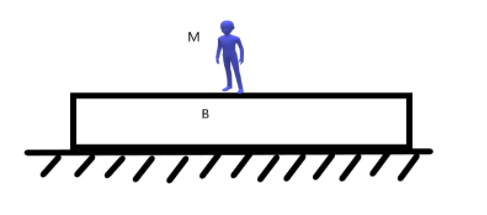
As shown in figure, M is a mass 60kg standing on a block of mass 40kg kept on ground. The coefficient of friction between the feet of the man and the block is 0.3 and that between B and the ground is 0.1. If the man accelerates with an acceleration $2m/{s^2}$ in the forward direction, then:
A. If is not possible
B. B will move backward with an acceleration $0.5m/{s^2} $
C. B will not move.
D. B will move forward with an acceleration$0.5m/{s^2} $
Answer
 Verified
649.5k+ views
- Hint: Friction is resistance to motion of one object moving relatively to another. It is not said as a fundamental force, like gravity or electromagnetism. To understand friction the best example from our daily life is; friction is what holds your shoe to ground. Moreover in ice the friction is very little that is the reason it is hard to walk on ice.
Complete step-by-step solution -
Let us begin this problem with an assumption that the block will remain stationary.
The force on the man is:
$F = m {a_{man}} = (60kg) (2m/{s^2}) = 120N$ Towards left.
Now, the force required for the block to remain stationary is 120N towards the left on block from ground.
But since normal force on block from ground is:
$N = (40 + 60kg) (10m/{s^2}) = 1000N$,
Maximum friction on it is:
$f = (100N) (0.1) = 100N$ Towards left (since the block has the tendency to move towards right).
Hence, block will move towards left and forces on it will be:
$120 - 100N = 20N$
Therefore, acceleration of the block is
${a_{block}} = 20N/40kg = 0.5m/{s^2}$ Towards left, that is backwards.
Therefore option (B) B will move backward with an acceleration $0.5m/{s^2} $ is a correct answer.
Note: The term acceleration means; Acceleration is a vector quantity and it is described as the rate at which an object changes its velocity. An object is accelerating if it is changing its velocity. Therefore, acceleration is a change in speed.
Complete step-by-step solution -
Let us begin this problem with an assumption that the block will remain stationary.
The force on the man is:
$F = m {a_{man}} = (60kg) (2m/{s^2}) = 120N$ Towards left.
Now, the force required for the block to remain stationary is 120N towards the left on block from ground.
But since normal force on block from ground is:
$N = (40 + 60kg) (10m/{s^2}) = 1000N$,
Maximum friction on it is:
$f = (100N) (0.1) = 100N$ Towards left (since the block has the tendency to move towards right).
Hence, block will move towards left and forces on it will be:
$120 - 100N = 20N$
Therefore, acceleration of the block is
${a_{block}} = 20N/40kg = 0.5m/{s^2}$ Towards left, that is backwards.
Therefore option (B) B will move backward with an acceleration $0.5m/{s^2} $ is a correct answer.
Note: The term acceleration means; Acceleration is a vector quantity and it is described as the rate at which an object changes its velocity. An object is accelerating if it is changing its velocity. Therefore, acceleration is a change in speed.
Recently Updated Pages
Basicity of sulphurous acid and sulphuric acid are

Master Class 11 English: Engaging Questions & Answers for Success
Master Class 11 Physics: Engaging Questions & Answers for Success
Master Class 11 Computer Science: Engaging Questions & Answers for Success
Master Class 11 Chemistry: Engaging Questions & Answers for Success
Master Class 11 Social Science: Engaging Questions & Answers for Success
Trending doubts
Difference Between Prokaryotic Cells and Eukaryotic Cells
Two of the body parts which do not appear in MRI are class 11 biology CBSE
One Metric ton is equal to kg A 10000 B 1000 C 100 class 11 physics CBSE
10 examples of friction in our daily life
Draw a diagram of nephron and explain its structur class 11 biology CBSE
What will happen if the mucus is not secreted by the class 11 biology CBSE