




What is Aristotle’s lantern?
(a) Special equipment designed by Aristotle with which sea creatures could be found in ocean deep darkness
(b) A group of fireflies living together in a tree and glowing
(c) A community of starfishes living together
(d) A special arrangement of teeth in sea urchins
Answer
 Verified
612.9k+ views
Hint: Aristotle's lantern can be forward in the class of Echinoidea. It can be found in an aquatic environment and is calcareous and also the formation of a place can be seen.It is named based on the arrangement of their teeth.
Complete answer:
The class Echinoidea shows the formation of Aristotle’s lantern. Aristotle’s lantern is an arrangement of five teeth which are surrounding the mouth of sea urchins and attached to a special appendage used for mastication. After the discovery of Aristotle’s lantern, the discovery saw the arrangement of the five teeth as a resemblance to that of a lantern in an ancient Greek ship.
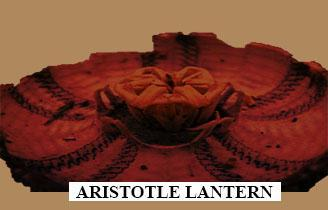
The teeth are situated close to the mouth and protrude slightly out of the mouth. The arrangement of the five teeth in Aristotle’s lantern consists of five calcareous plates which are enormous and are also known as Alveoli or pyramids.
Additional Information:
- There is the presence of special muscles around the five teeth which are surrounding the mouth of the sea urchin.
- These special muscles are in the form of specially designed protecting and retracting muscles and are responsible for the mastication process.
- The arrangement of the five teeth all the pyramids which are made of the calcareous plates can be partially retracted or it can also be retracted into the mouth by movements of the specialized retractor and protractor muscles.
- The arrangement of five teeth that are present in the mouth of the sea urchin is used by the organisms belonging to the class and Echinoidea and are used to grind materials.
So, the correct option is, “A special arrangement of teeth in sea urchins”.
Note:
- The muscles which form a complex arrangement around the mouth of the sea urchin and the formation of the calcareous teeth which are also known as the pyramids forms an organ which is mainly concentrated on the function of mastication in sea urchins.
- Aristotle’s lantern may also contain venomous teeth which are used mainly for defense.
Complete answer:
The class Echinoidea shows the formation of Aristotle’s lantern. Aristotle’s lantern is an arrangement of five teeth which are surrounding the mouth of sea urchins and attached to a special appendage used for mastication. After the discovery of Aristotle’s lantern, the discovery saw the arrangement of the five teeth as a resemblance to that of a lantern in an ancient Greek ship.
The teeth are situated close to the mouth and protrude slightly out of the mouth. The arrangement of the five teeth in Aristotle’s lantern consists of five calcareous plates which are enormous and are also known as Alveoli or pyramids.
Additional Information:
- There is the presence of special muscles around the five teeth which are surrounding the mouth of the sea urchin.
- These special muscles are in the form of specially designed protecting and retracting muscles and are responsible for the mastication process.
- The arrangement of the five teeth all the pyramids which are made of the calcareous plates can be partially retracted or it can also be retracted into the mouth by movements of the specialized retractor and protractor muscles.
- The arrangement of five teeth that are present in the mouth of the sea urchin is used by the organisms belonging to the class and Echinoidea and are used to grind materials.
So, the correct option is, “A special arrangement of teeth in sea urchins”.
Note:
- The muscles which form a complex arrangement around the mouth of the sea urchin and the formation of the calcareous teeth which are also known as the pyramids forms an organ which is mainly concentrated on the function of mastication in sea urchins.
- Aristotle’s lantern may also contain venomous teeth which are used mainly for defense.
Recently Updated Pages
Master Class 11 English: Engaging Questions & Answers for Success

Master Class 11 Social Science: Engaging Questions & Answers for Success
Master Class 11 Maths: Engaging Questions & Answers for Success
Master Class 11 Biology: Engaging Questions & Answers for Success
Master Class 11 Physics: Engaging Questions & Answers for Success
Master Class 11 Chemistry: Engaging Questions & Answers for Success
Trending doubts
One Metric ton is equal to kg A 10000 B 1000 C 100 class 11 physics CBSE
Difference Between Prokaryotic Cells and Eukaryotic Cells
1 ton equals to A 100 kg B 1000 kg C 10 kg D 10000 class 11 physics CBSE
Find the value of the expression given below sin 30circ class 11 maths CBSE
Two of the body parts which do not appear in MRI are class 11 biology CBSE
Draw a diagram of a plant cell and label at least eight class 11 biology CBSE