



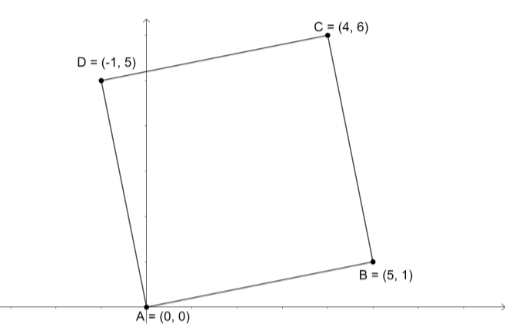
What is the area of the square shown in the figure?
Answer
 Verified
620.4k+ views
Hint: We will find the length of a side by using the coordinates of the vertices on that side. For this, we will use the distance formula to find the distance between the two vertices. The distance formula is given as $D=\sqrt{{{\left( {{x}_{2}}-{{x}_{1}} \right)}^{2}}+{{\left( {{y}_{2}}-{{y}_{1}} \right)}^{2}}}$ where $\left( {{x}_{1}},{{y}_{1}} \right),\left( {{x}_{2}},{{y}_{2}} \right)$ are the coordinates of the two points. Then, we will use the formula for area of square. Area of the square is given as $A={{\left( \text{side} \right)}^{2}}$.
Complete step-by-step solution:
We have a square with the following points as its vertices, $\text{A}\left( 0,0 \right),\text{B}\left( 5,1 \right),\text{C}\left( 4,6 \right),\text{D}\left( -1,5 \right)$. Since the figure is a square, we have to find the length of only one side. Now, we have to find the distance between two vertices lying on the same side. Let us choose the two vertices to be $\text{A}\left( 0,0 \right),\text{B}\left( 5,1 \right)$ on the side AB. Now, we know that the distance formula is given as $D=\sqrt{{{\left( {{x}_{2}}-{{x}_{1}} \right)}^{2}}+{{\left( {{y}_{2}}-{{y}_{1}} \right)}^{2}}}$ where $\left( {{x}_{1}},{{y}_{1}} \right),\left( {{x}_{2}},{{y}_{2}} \right)$ are the coordinates of the two points. So, we will substitute $\left( {{x}_{1}},{{y}_{1}} \right)=\left( 0,0 \right)$ and $\left( {{x}_{2}},{{y}_{2}} \right)=\left( 5,1 \right)$ in the distance formula in the following manner,
$D=\sqrt{{{\left( 5-0 \right)}^{2}}+{{\left( 1-0 \right)}^{2}}}$
Solving the above equation, we get
$\begin{align}
& D=\sqrt{{{\left( 5-0 \right)}^{2}}+{{\left( 1-0 \right)}^{2}}} \\
& \Rightarrow D=\sqrt{{{\left( 5 \right)}^{2}}+{{\left( 1 \right)}^{2}}} \\
& \Rightarrow D=\sqrt{25+1} \\
& \therefore D=\sqrt{26}\text{ units} \\
\end{align}$
So, the length of side AB is $\sqrt{26}$. Next, we will use this side length to find the area of the square. We will use the formula for area of square. Area of the square is given as $A={{\left( \text{side} \right)}^{2}}$. Substituting the side length in this formula we get,
$\begin{align}
& A={{\left( \sqrt{26} \right)}^{2}} \\
& \therefore A=26\text{ sq}\text{. units} \\
\end{align}$
Hence, the area of the square is 26 sq. units.
Note: We should know the properties of the geometric figures like squares, circles, parallelograms, etc. We should also be familiar with the formulae for the area, volume, etc of these objects. These properties are useful while solving such type of questions. Knowledge of the distance formula is the key aspect of this question. We can use the coordinates of any two vertices on the same side of the square. The choice depends on convenience and ease of calculation.
Complete step-by-step solution:
We have a square with the following points as its vertices, $\text{A}\left( 0,0 \right),\text{B}\left( 5,1 \right),\text{C}\left( 4,6 \right),\text{D}\left( -1,5 \right)$. Since the figure is a square, we have to find the length of only one side. Now, we have to find the distance between two vertices lying on the same side. Let us choose the two vertices to be $\text{A}\left( 0,0 \right),\text{B}\left( 5,1 \right)$ on the side AB. Now, we know that the distance formula is given as $D=\sqrt{{{\left( {{x}_{2}}-{{x}_{1}} \right)}^{2}}+{{\left( {{y}_{2}}-{{y}_{1}} \right)}^{2}}}$ where $\left( {{x}_{1}},{{y}_{1}} \right),\left( {{x}_{2}},{{y}_{2}} \right)$ are the coordinates of the two points. So, we will substitute $\left( {{x}_{1}},{{y}_{1}} \right)=\left( 0,0 \right)$ and $\left( {{x}_{2}},{{y}_{2}} \right)=\left( 5,1 \right)$ in the distance formula in the following manner,
$D=\sqrt{{{\left( 5-0 \right)}^{2}}+{{\left( 1-0 \right)}^{2}}}$
Solving the above equation, we get
$\begin{align}
& D=\sqrt{{{\left( 5-0 \right)}^{2}}+{{\left( 1-0 \right)}^{2}}} \\
& \Rightarrow D=\sqrt{{{\left( 5 \right)}^{2}}+{{\left( 1 \right)}^{2}}} \\
& \Rightarrow D=\sqrt{25+1} \\
& \therefore D=\sqrt{26}\text{ units} \\
\end{align}$
So, the length of side AB is $\sqrt{26}$. Next, we will use this side length to find the area of the square. We will use the formula for area of square. Area of the square is given as $A={{\left( \text{side} \right)}^{2}}$. Substituting the side length in this formula we get,
$\begin{align}
& A={{\left( \sqrt{26} \right)}^{2}} \\
& \therefore A=26\text{ sq}\text{. units} \\
\end{align}$
Hence, the area of the square is 26 sq. units.
Note: We should know the properties of the geometric figures like squares, circles, parallelograms, etc. We should also be familiar with the formulae for the area, volume, etc of these objects. These properties are useful while solving such type of questions. Knowledge of the distance formula is the key aspect of this question. We can use the coordinates of any two vertices on the same side of the square. The choice depends on convenience and ease of calculation.

Recently Updated Pages
Basicity of sulphurous acid and sulphuric acid are

Master Class 12 Economics: Engaging Questions & Answers for Success
Master Class 12 Biology: Engaging Questions & Answers for Success
Master Class 11 English: Engaging Questions & Answers for Success
Master Class 11 Physics: Engaging Questions & Answers for Success
Master Class 11 Computer Science: Engaging Questions & Answers for Success
Trending doubts
Difference Between Plant Cell and Animal Cell
Fill the blanks with the suitable prepositions 1 The class 9 english CBSE
What is pollution? How many types of pollution? Define it
What is the full form of pH?
What is the Full Form of ICSE, CBSE and SSC
Name 10 Living and Non living things class 9 biology CBSE