




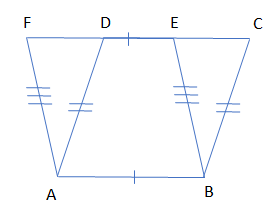
Area of the parallelogram $ABCD=60c{{m}^{2}}$. From the figure, find the area of the parallelogram ABEF.
(a) $30c{{m}^{2}}$
(b) $60c{{m}^{2}}$
(c) $40c{{m}^{2}}$
(d) None of the above
Answer
 Verified
615k+ views
Hint: Firstly, we should know the condition from the figure that states that if both the parallelograms are on the same base which is AB in this case and are made between the same parallels, then the area of both the parallelograms are equal. Then, we will use this condition to get the area of the parallelogram ABEF by using the parallelogram area of ABCD from the given figure. Then, by using the condition, we get the same area of parallelogram ABEF as the area of parallelogram ABCD which is $60c{{m}^{2}}$.
Complete step by step solution:
In this question, we will use the given figure in the question to find the area of the parallelogram ABEF by using the figure as follows:
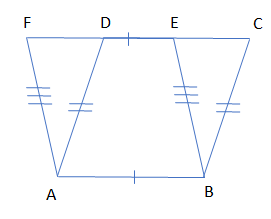
Here, in the figure the number of lines on the sides of the parallelogram shows which sides of the parallelogram ABCD and parallelogram ABEF are parallel.
So, from the figure, it is clear that:
AB||EF
AD||BC
EF||AF
All the above conditions state that both the parallelograms are on the same base AB from the figure and moreover they are made in between the same parallels.
Now, we know the condition that if both the parallelograms are on the same base which is AB in this case and are made between the same parallels, then the area of both the parallelograms are equal.
So, by using the above stated property, we can conclude that the area of the parallelogram ABEF is the same as the area of the parallelogram ABCD.
Then, we know the area of the parallelogram ABCD is $60c{{m}^{2}}$ that is given in the question.
So, the area of the parallelogram ABEF is also $60c{{m}^{2}}$as both of them are on the same base and between the same parallels.
Hence, option (b) is correct.
Note: The most common mistake we can occur while solving this type of problem is that we may consider the sides equal instead of taking them parallel as from the figure of parallelograms ABCD and ABEF, if we take sides equal instead of parallel, then
AB=EF
AD=BC
EF=AF
Now, this assumption is totally wrong as nothing is mentioned about the equality of sides and the lines on the sides shows the parallel property of the lines.
So, if we consider the sides as equal then it will not follow the property of the parallelograms and we are unable to conclude them as equal.
Complete step by step solution:
In this question, we will use the given figure in the question to find the area of the parallelogram ABEF by using the figure as follows:
Here, in the figure the number of lines on the sides of the parallelogram shows which sides of the parallelogram ABCD and parallelogram ABEF are parallel.
So, from the figure, it is clear that:
AB||EF
AD||BC
EF||AF
All the above conditions state that both the parallelograms are on the same base AB from the figure and moreover they are made in between the same parallels.
Now, we know the condition that if both the parallelograms are on the same base which is AB in this case and are made between the same parallels, then the area of both the parallelograms are equal.
So, by using the above stated property, we can conclude that the area of the parallelogram ABEF is the same as the area of the parallelogram ABCD.
Then, we know the area of the parallelogram ABCD is $60c{{m}^{2}}$ that is given in the question.
So, the area of the parallelogram ABEF is also $60c{{m}^{2}}$as both of them are on the same base and between the same parallels.
Hence, option (b) is correct.
Note: The most common mistake we can occur while solving this type of problem is that we may consider the sides equal instead of taking them parallel as from the figure of parallelograms ABCD and ABEF, if we take sides equal instead of parallel, then
AB=EF
AD=BC
EF=AF
Now, this assumption is totally wrong as nothing is mentioned about the equality of sides and the lines on the sides shows the parallel property of the lines.
So, if we consider the sides as equal then it will not follow the property of the parallelograms and we are unable to conclude them as equal.
Recently Updated Pages
Master Class 10 Social Science: Engaging Questions & Answers for Success

Master Class 10 Science: Engaging Questions & Answers for Success
Master Class 10 Maths: Engaging Questions & Answers for Success
Master Class 10 General Knowledge: Engaging Questions & Answers for Success
Master Class 10 Computer Science: Engaging Questions & Answers for Success
Class 10 Question and Answer - Your Ultimate Solutions Guide
Trending doubts
What is the full form of PNG A Petrol Natural Gas B class 10 chemistry CBSE
Explain the Treaty of Vienna of 1815 class 10 social science CBSE
In cricket, how many legal balls are there in a standard over?
Why is there a time difference of about 5 hours between class 10 social science CBSE
Who Won 36 Oscar Awards? Record Holder Revealed
What is the median of the first 10 natural numbers class 10 maths CBSE