



What is the area of a square whose diagonals are $12\,cm$?
Answer
 Verified
525.9k+ views
Hint: In the question we have to find the area of the square whose diagonal is of $12\,cm$. We know that if $x$ is the length of the side of the square, then the length of the diagonal is equal to $\sqrt 2 x$. First, we will find the length of the side of the square then we will calculate the area of the square. As area of square$ = $${(side)^2}$.
Complete step by step answer:
A square is a two-dimensional figure with four equal sides and all four angles are adequate to $90^\circ $. The diagonals of the square are equal and also they bisect each other at $90^\circ $.
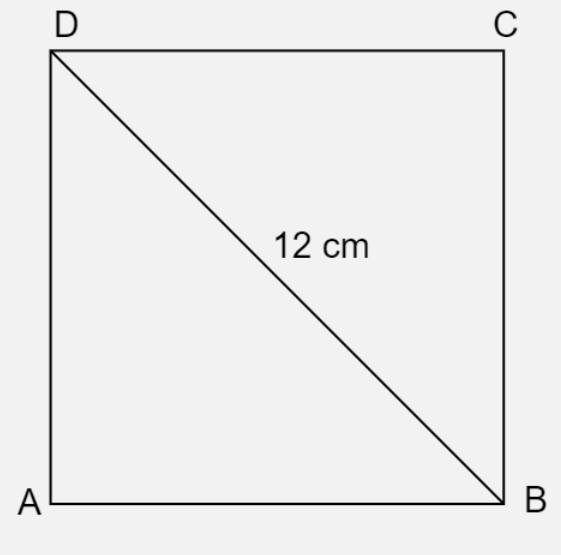
Now, let us assume a square ABCD whose length of diagonal is equal to $12\,cm$.
We know that if $x$ is the length of the side of the square, then the length of the diagonal is equal to $\sqrt 2 x$.
Let us assume the length of the square is equal to $x$
It is given that length of the diagonal is equal to $12\,cm$.
So, $\sqrt 2 x = 12$
By using cross multiplication, we get
$ \Rightarrow x = \dfrac{{12}}{{\sqrt 2 }} \ldots \ldots (1)$
We know that area of square$ = {(side)^2} = {x^2}$
Substitute the value of $x$ from equation $(1)$. We get,
Area of square $ = $${\left( {\dfrac{{12}}{{\sqrt 2 }}} \right)^2}$
Area of square $ = $$\dfrac{{144}}{2}$
Therefore, area of square $ = 72\,c{m^2}$
Hence, the area of the given square is equal to $72\,c{m^2}$.
Note: One should always remember that if the length of the side of the square is $x\,cm$ then the length of the diagonal is equal to $\sqrt 2 x\,cm$. Note that the length of the diagonal is greater than the sides of the square. The diagonal for the square when divided, comes out as two similar isosceles triangles.
Complete step by step answer:
A square is a two-dimensional figure with four equal sides and all four angles are adequate to $90^\circ $. The diagonals of the square are equal and also they bisect each other at $90^\circ $.
Now, let us assume a square ABCD whose length of diagonal is equal to $12\,cm$.
We know that if $x$ is the length of the side of the square, then the length of the diagonal is equal to $\sqrt 2 x$.
Let us assume the length of the square is equal to $x$
It is given that length of the diagonal is equal to $12\,cm$.
So, $\sqrt 2 x = 12$
By using cross multiplication, we get
$ \Rightarrow x = \dfrac{{12}}{{\sqrt 2 }} \ldots \ldots (1)$
We know that area of square$ = {(side)^2} = {x^2}$
Substitute the value of $x$ from equation $(1)$. We get,
Area of square $ = $${\left( {\dfrac{{12}}{{\sqrt 2 }}} \right)^2}$
Area of square $ = $$\dfrac{{144}}{2}$
Therefore, area of square $ = 72\,c{m^2}$
Hence, the area of the given square is equal to $72\,c{m^2}$.
Note: One should always remember that if the length of the side of the square is $x\,cm$ then the length of the diagonal is equal to $\sqrt 2 x\,cm$. Note that the length of the diagonal is greater than the sides of the square. The diagonal for the square when divided, comes out as two similar isosceles triangles.

Recently Updated Pages
Master Class 11 Social Science: Engaging Questions & Answers for Success

Master Class 11 English: Engaging Questions & Answers for Success
Master Class 11 Maths: Engaging Questions & Answers for Success
Master Class 11 Chemistry: Engaging Questions & Answers for Success
Master Class 11 Biology: Engaging Questions & Answers for Success
Class 11 Question and Answer - Your Ultimate Solutions Guide
Trending doubts
What is BLO What is the full form of BLO class 8 social science CBSE
Which Indian state shares the longest international class 8 social science CBSE
What are the 12 elements of nature class 8 chemistry CBSE
Citizens of India can vote at the age of A 18 years class 8 social science CBSE
Right to vote is a AFundamental Right BFundamental class 8 social science CBSE
Full form of STD, ISD and PCO