




What is the area of a square inscribed in a circle of radius 8 cm?
(a) $64c{{m}^{2}}$
(b) $100c{{m}^{2}}$
(c) $125c{{m}^{2}}$
(d) $128c{{m}^{2}}$
Answer
 Verified
637.8k+ views
Hint: In this question, we will divide the square in two equal triangles with a diagonal, which is also a diameter. We will then use Pythagoras theorem to find the side of the square, and hence area.
Complete step-by-step answer:
Let us consider a square ABCD of radius 8 cm. Let this square ABCD be inscribed by a circle with centre O.
Let us join point A and C of the square to form a diagonal of a square.
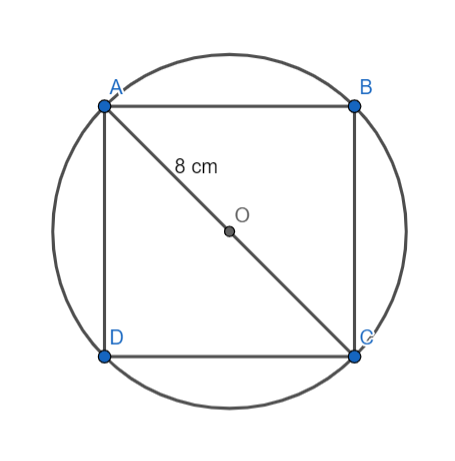
Now, this diagonal AB will pass through the centre of the circle. Also, A and B are the points on the circumference of the circle.
Therefore, AB will be the diameter of the circle.
Since the circle have radius 8 cm,
Therefore,
AC = AO + CO = 8 cm + 8 cm = 16 cm.
Now, we know that all the angles of a square are ${{90}^{\circ }}$. Therefore, here in our diagram, triangle ADC will be a right-angled triangle, right angled at D. So, we can apply Pythagoras theorem here.
Hence, applying Pythagoras theorem in triangle ABC, we have,
$\text{A}{{\text{D}}^{\text{2}}}\text{+D}{{\text{C}}^{\text{2}}}\text{=A}{{\text{C}}^{\text{2}}}$
Also, ABCD is a square and all sides of squares are equal in length. So, let sides of ABCD be $x$.
Therefore, AD = DC = BC = AB = $x$.
Using this and AC = 16 cm, in above equation, we get,
$\begin{align}
& \text{A}{{\text{D}}^{\text{2}}}\text{+D}{{\text{C}}^{\text{2}}}\text{=A}{{\text{C}}^{\text{2}}} \\
& \Rightarrow {{x}^{2}}+{{x}^{2}}={{\left( \text{16cm} \right)}^{2}} \\
& \Rightarrow 2{{x}^{2}}={{16}^{2}}\text{c}{{\text{m}}^{\text{2}}} \\
& \Rightarrow 2{{x}^{2}}=256\text{c}{{\text{m}}^{\text{2}}} \\
\end{align}$
Diving 2 from both sides of the above equation, we get,
$\begin{align}
& {{x}^{2}}=\dfrac{256}{2}\text{c}{{\text{m}}^{2}} \\
& \Rightarrow {{x}^{2}}=128\text{c}{{\text{m}}^{2}} \\
\end{align}$
Also, we know that, area of square is given by,
Area = ${{\left( \text{side} \right)}^{\text{2}}}$.
In square ABCD, side = $x$,
Therefore,
Area of square ABCD $=\,{{x}^{2}}$.
Putting value of ${{x}^{2}}$ here, we get,
Area of square ABCD $=128\text{c}{{\text{m}}^{2}}$ .
Hence the correct answer is option (d).
Note: In this type of question, when value of diagonal of a square is known but sides are not known, then you can directly use the formula: Area of square = $\dfrac{\text{diagona}{{\text{l}}^{\text{2}}}}{\text{2}}$.
Complete step-by-step answer:
Let us consider a square ABCD of radius 8 cm. Let this square ABCD be inscribed by a circle with centre O.
Let us join point A and C of the square to form a diagonal of a square.
Now, this diagonal AB will pass through the centre of the circle. Also, A and B are the points on the circumference of the circle.
Therefore, AB will be the diameter of the circle.
Since the circle have radius 8 cm,
Therefore,
AC = AO + CO = 8 cm + 8 cm = 16 cm.
Now, we know that all the angles of a square are ${{90}^{\circ }}$. Therefore, here in our diagram, triangle ADC will be a right-angled triangle, right angled at D. So, we can apply Pythagoras theorem here.
Hence, applying Pythagoras theorem in triangle ABC, we have,
$\text{A}{{\text{D}}^{\text{2}}}\text{+D}{{\text{C}}^{\text{2}}}\text{=A}{{\text{C}}^{\text{2}}}$
Also, ABCD is a square and all sides of squares are equal in length. So, let sides of ABCD be $x$.
Therefore, AD = DC = BC = AB = $x$.
Using this and AC = 16 cm, in above equation, we get,
$\begin{align}
& \text{A}{{\text{D}}^{\text{2}}}\text{+D}{{\text{C}}^{\text{2}}}\text{=A}{{\text{C}}^{\text{2}}} \\
& \Rightarrow {{x}^{2}}+{{x}^{2}}={{\left( \text{16cm} \right)}^{2}} \\
& \Rightarrow 2{{x}^{2}}={{16}^{2}}\text{c}{{\text{m}}^{\text{2}}} \\
& \Rightarrow 2{{x}^{2}}=256\text{c}{{\text{m}}^{\text{2}}} \\
\end{align}$
Diving 2 from both sides of the above equation, we get,
$\begin{align}
& {{x}^{2}}=\dfrac{256}{2}\text{c}{{\text{m}}^{2}} \\
& \Rightarrow {{x}^{2}}=128\text{c}{{\text{m}}^{2}} \\
\end{align}$
Also, we know that, area of square is given by,
Area = ${{\left( \text{side} \right)}^{\text{2}}}$.
In square ABCD, side = $x$,
Therefore,
Area of square ABCD $=\,{{x}^{2}}$.
Putting value of ${{x}^{2}}$ here, we get,
Area of square ABCD $=128\text{c}{{\text{m}}^{2}}$ .
Hence the correct answer is option (d).
Note: In this type of question, when value of diagonal of a square is known but sides are not known, then you can directly use the formula: Area of square = $\dfrac{\text{diagona}{{\text{l}}^{\text{2}}}}{\text{2}}$.
Recently Updated Pages
Master Class 11 English: Engaging Questions & Answers for Success

Master Class 11 Maths: Engaging Questions & Answers for Success
Class 11 Question and Answer - Your Ultimate Solutions Guide
Master Class 11 Biology: Engaging Questions & Answers for Success
Master Class 11 Physics: Engaging Questions & Answers for Success
Master Class 11 Accountancy: Engaging Questions & Answers for Success
Trending doubts
Differentiate between an exothermic and an endothermic class 11 chemistry CBSE
One Metric ton is equal to kg A 10000 B 1000 C 100 class 11 physics CBSE
Difference Between Prokaryotic Cells and Eukaryotic Cells
There are 720 permutations of the digits 1 2 3 4 5 class 11 maths CBSE
Draw a diagram of a plant cell and label at least eight class 11 biology CBSE
1 Quintal is equal to a 110 kg b 10 kg c 100kg d 1000 class 11 physics CBSE