




What are x-coordinate and y-coordinate called?
Answer
 Verified
619.2k+ views
Hint: We will describe what we understand by knowing the x-coordinate and the y-coordinate. We will look at the x-axis and the y-axis, and the plane formed by these two axes. We will study the four quadrants formed by these axes by seeing the change in the x-coordinate and the y-coordinate in every quadrant.
Complete step by step answer:
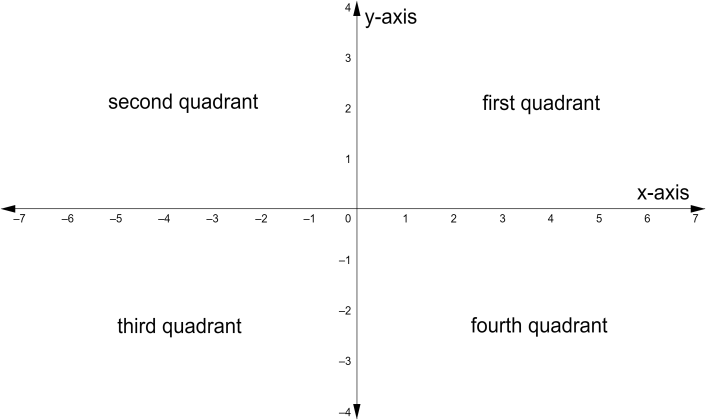
The x-coordinate gives us the distance of a point from the vertical axis, that is, the y-axis. The x-coordinate is also called abscissa. The y-coordinate tells us the distance of a point from the horizontal axis, that is, the x-axis. The y-coordinate is also called the ordinate. The two axes, x-axis and y-axis form the xy-plane. We can see it in the figure below,
While denoting the location of a point on the xy-plane, we use the following format: $\left( x,y \right)$, here $x$ is the x-coordinate and $y$ is the y-coordinate.
In the figure above, we can see that the xy-plane is divided into four quadrants. The first quadrant consists of all positive x-coordinates and all positive y-coordinates. The second quadrant has negative x-coordinates and positive y-coordinates. In the third quadrant all the x-coordinates as well as all the y-coordinates are negative. The fourth quadrant has positive x-coordinates and negative y-coordinates.
Note: The y-axis that lies above the x-axis is called as the positive y-axis and the y-axis that lies below the x-axis is called as the negative axis. This is intuitive, since the positive y-axis has all positive y-coordinates and the negative y-axis has all the negative y-coordinates. Similarly, The x-axis to the right side of the y-axis is called as the positive x-axis and to the left of the y-axis is called as the negative x-axis. For convenience, we can denote the positive axes as x-axis and y-axis and the negative axes by $\text{x }\!\!'\!\!\text{ }$-axis and $\text{y }\!\!'\!\!\text{ }$-axis.
Complete step by step answer:
The x-coordinate gives us the distance of a point from the vertical axis, that is, the y-axis. The x-coordinate is also called abscissa. The y-coordinate tells us the distance of a point from the horizontal axis, that is, the x-axis. The y-coordinate is also called the ordinate. The two axes, x-axis and y-axis form the xy-plane. We can see it in the figure below,
While denoting the location of a point on the xy-plane, we use the following format: $\left( x,y \right)$, here $x$ is the x-coordinate and $y$ is the y-coordinate.
In the figure above, we can see that the xy-plane is divided into four quadrants. The first quadrant consists of all positive x-coordinates and all positive y-coordinates. The second quadrant has negative x-coordinates and positive y-coordinates. In the third quadrant all the x-coordinates as well as all the y-coordinates are negative. The fourth quadrant has positive x-coordinates and negative y-coordinates.
Note: The y-axis that lies above the x-axis is called as the positive y-axis and the y-axis that lies below the x-axis is called as the negative axis. This is intuitive, since the positive y-axis has all positive y-coordinates and the negative y-axis has all the negative y-coordinates. Similarly, The x-axis to the right side of the y-axis is called as the positive x-axis and to the left of the y-axis is called as the negative x-axis. For convenience, we can denote the positive axes as x-axis and y-axis and the negative axes by $\text{x }\!\!'\!\!\text{ }$-axis and $\text{y }\!\!'\!\!\text{ }$-axis.
Recently Updated Pages
Master Class 11 English: Engaging Questions & Answers for Success

Master Class 11 Social Science: Engaging Questions & Answers for Success
Master Class 11 Maths: Engaging Questions & Answers for Success
Master Class 11 Biology: Engaging Questions & Answers for Success
Master Class 11 Physics: Engaging Questions & Answers for Success
Master Class 11 Chemistry: Engaging Questions & Answers for Success
Trending doubts
One Metric ton is equal to kg A 10000 B 1000 C 100 class 11 physics CBSE
Difference Between Prokaryotic Cells and Eukaryotic Cells
Two of the body parts which do not appear in MRI are class 11 biology CBSE
Find the value of the expression given below sin 30circ class 11 maths CBSE
Draw a diagram of a plant cell and label at least eight class 11 biology CBSE
10 examples of friction in our daily life