




What are two functions of Red Blood Cells?
Answer
 Verified
529.8k+ views
Hint: Red blood cells (RBCs), also termed as red cells, red blood corpuscles haematids, erythroid cells or erythrocytes are the most common type of blood cell. The cytoplasm of the RBCs is rich in haemoglobin, an iron-containing molecule which binds oxygen.
Complete Answer:
The two significant functions of red blood cells are as follows:
Red blood cells are cells in blood which assist in the transport of oxygen. It picks up oxygen from the lungs and delivers it to tissues elsewhere.
It picks up carbon dioxide from the tissues and unloads it in the lungs.
Vertebrate red blood cells consist mainly of haemoglobin, a complex metalloprotein containing heme groups. The iron atoms of these groups temporarily bind to oxygen molecules ($O_2$) in the lungs or gills and release them throughout the body. Haemoglobin also carries the waste product carbon dioxide back from the tissues.
As blood flows through the tissues, haemoglobin accepts $CO_2$ from surrounding cells and releases $O_2$ present in it. The loss of $O_2$ causes the colour of haemoglobin to change from red to purple. The situation is contrary to lungs where the haemoglobin bonds to $O_2$ and releases $CO_2$. An enzyme called carbonic anhydrase is also made and stored by the RBCs which catalyses a reversible reaction in the tissues which converts $CO_2$ to HCO3 (bicarbonate ions).
${C}{O}_{2} + {H}_{2}{O} ↔ {H}_{2}{C}{O}_{3} ↔ {H}{C}{O-}_{3} + {H+}$
Most of the $CO_2$ that enter the RBCs is converted to this water-soluble ion and released into the plasma. In the lungs, bicarbonate ions enter the RBCs from the plasma and are converted back into $CO_2$, which is eventually exhaled.
Note:
As a consequence of not containing mitochondria, RBCs use none of the oxygen they transport; instead they produce the energy carrier ATP by the glycolysis of glucose and lactic acid fermentation on the resulting pyruvate. When red blood cells undergo shear stress in constricted vessels, they will release ATP, which causes the vessel walls to relax and dilate so as to promote normal blood flow. Exposure of red blood cells to physiological levels of shear stress will activate nitric oxide synthase and export of nitric oxide, which helps in the regulation of vascular tonus.
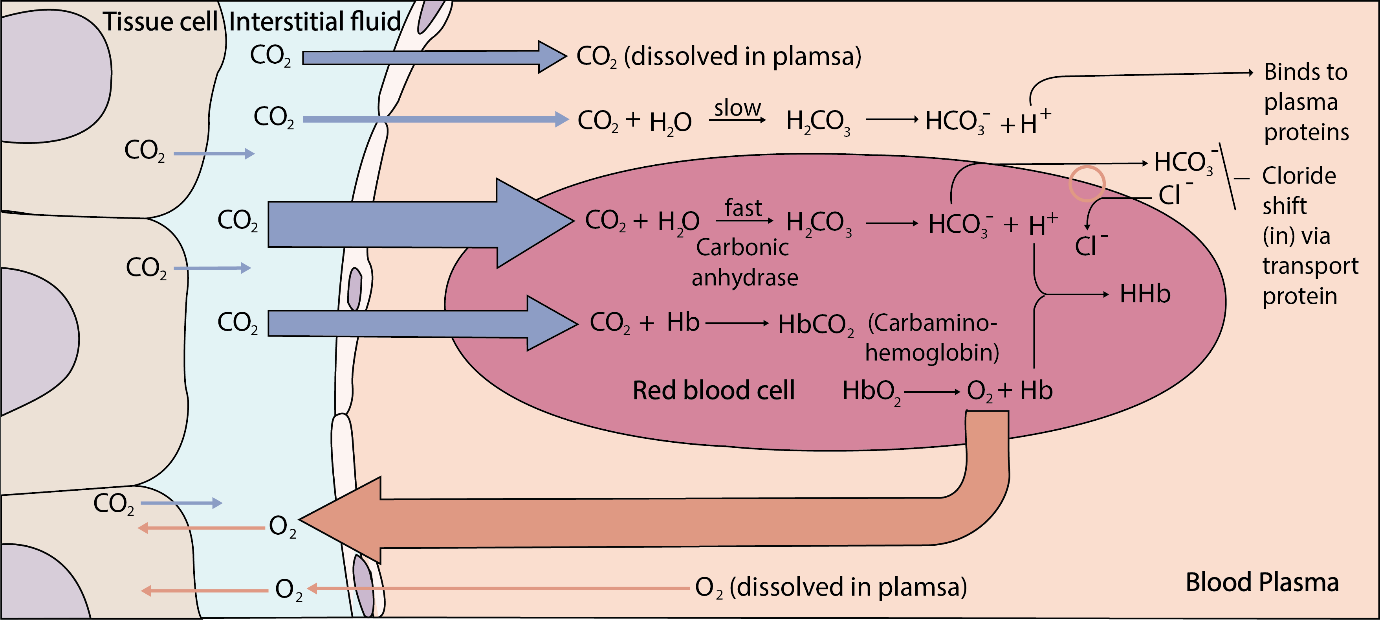
Figure: Role of RBC
Complete Answer:
The two significant functions of red blood cells are as follows:
Red blood cells are cells in blood which assist in the transport of oxygen. It picks up oxygen from the lungs and delivers it to tissues elsewhere.
It picks up carbon dioxide from the tissues and unloads it in the lungs.
Vertebrate red blood cells consist mainly of haemoglobin, a complex metalloprotein containing heme groups. The iron atoms of these groups temporarily bind to oxygen molecules ($O_2$) in the lungs or gills and release them throughout the body. Haemoglobin also carries the waste product carbon dioxide back from the tissues.
As blood flows through the tissues, haemoglobin accepts $CO_2$ from surrounding cells and releases $O_2$ present in it. The loss of $O_2$ causes the colour of haemoglobin to change from red to purple. The situation is contrary to lungs where the haemoglobin bonds to $O_2$ and releases $CO_2$. An enzyme called carbonic anhydrase is also made and stored by the RBCs which catalyses a reversible reaction in the tissues which converts $CO_2$ to HCO3 (bicarbonate ions).
${C}{O}_{2} + {H}_{2}{O} ↔ {H}_{2}{C}{O}_{3} ↔ {H}{C}{O-}_{3} + {H+}$
Most of the $CO_2$ that enter the RBCs is converted to this water-soluble ion and released into the plasma. In the lungs, bicarbonate ions enter the RBCs from the plasma and are converted back into $CO_2$, which is eventually exhaled.
Note:
As a consequence of not containing mitochondria, RBCs use none of the oxygen they transport; instead they produce the energy carrier ATP by the glycolysis of glucose and lactic acid fermentation on the resulting pyruvate. When red blood cells undergo shear stress in constricted vessels, they will release ATP, which causes the vessel walls to relax and dilate so as to promote normal blood flow. Exposure of red blood cells to physiological levels of shear stress will activate nitric oxide synthase and export of nitric oxide, which helps in the regulation of vascular tonus.
Figure: Role of RBC
Recently Updated Pages
Master Class 11 Social Science: Engaging Questions & Answers for Success

Master Class 11 English: Engaging Questions & Answers for Success
Master Class 11 Maths: Engaging Questions & Answers for Success
Master Class 11 Chemistry: Engaging Questions & Answers for Success
Master Class 11 Biology: Engaging Questions & Answers for Success
Master Class 11 Physics: Engaging Questions & Answers for Success
Trending doubts
Differentiate between an exothermic and an endothermic class 11 chemistry CBSE
One Metric ton is equal to kg A 10000 B 1000 C 100 class 11 physics CBSE
Difference Between Prokaryotic Cells and Eukaryotic Cells
There are 720 permutations of the digits 1 2 3 4 5 class 11 maths CBSE
Draw a diagram of a plant cell and label at least eight class 11 biology CBSE
1 Quintal is equal to a 110 kg b 10 kg c 100kg d 1000 class 11 physics CBSE