




What are the three types of capillaries?
Answer
 Verified
519.3k+ views
Hint: Blood is a connective tissue that supplies nutrients and oxygen to all the parts of the body. The blood circulation happens with the help of vessels. Three types of vessels that are found in blood are arteries, veins and capillaries. Each of these vessels perform specific functions.
Complete answer:
Capillaries are very fine blood vessels which connect arteries and the veins. It helps in exchange of certain substances such as oxygen, nutrients and waste products in between the blood and tissues. Capillaries are also called microcirculation as they are the smallest blood vessels involved in the circulation process.
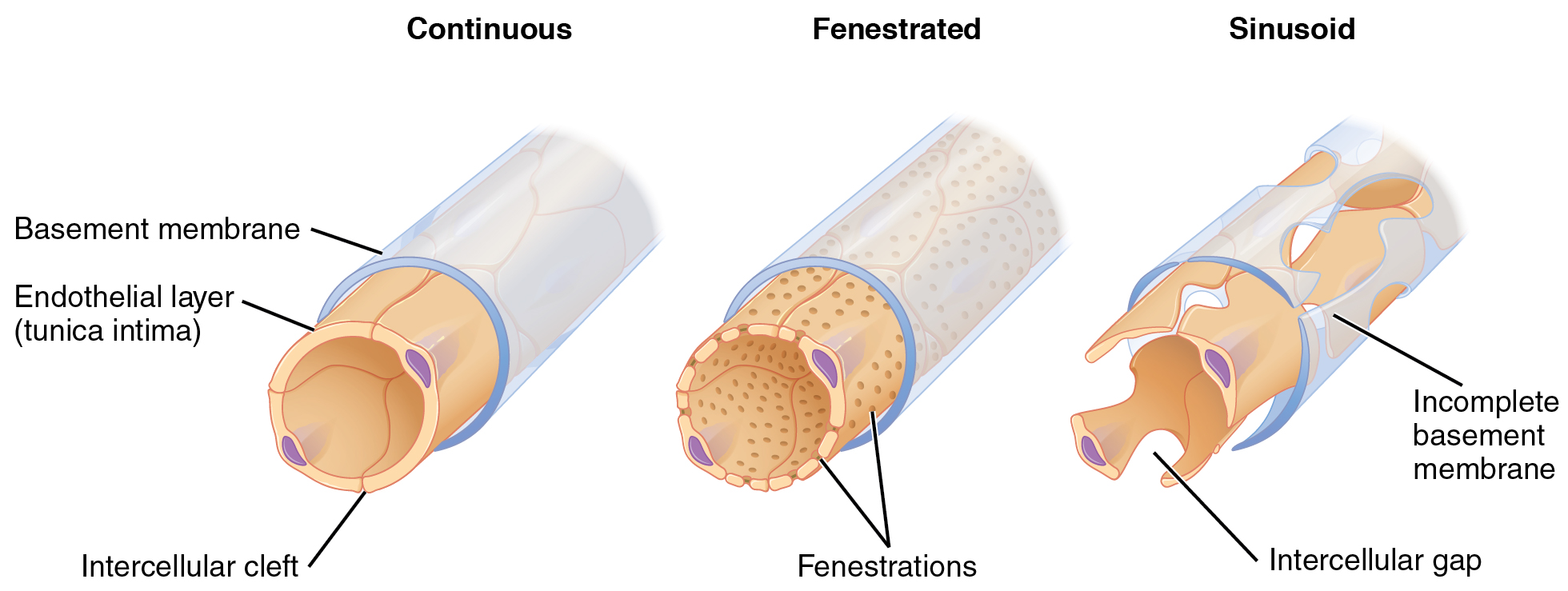
There are three types of capillaries on the basis of their function-
1. Continuous capillaries – This is the most common type of capillary in which small gaps are found in between the endothelial cells. These gaps help in the movement of water, sugar, gases and hormones. These capillaries are found in the brain but there is no gap in between the endothelial cells.
2. Fenestrated capillaries – In addition to small gaps these capillaries also contain small pores in between the cells. These pores are called fenestra and are present on the walls. Their main function is the exchange of large size molecules. They are present in the small intestine where absorption of nutrients takes place. It is also found in the kidneys to filter the blood.
3. Sinusoid capillaries – There are large gaps in the walls of these capillaries. Hence, they are involved in the exchange of larger molecules e.g. cells. These are rarely found capillaries. These capillaries are found in the liver and bone marrow.
Note:
Capillaries are made up of two layers of cells – endothelial and epithelial cells. The layer is called endothelial cell while the outer layer is made up of epithelial cells. The capillaries are surrounded by a basement membrane which is a protein layer.
Complete answer:
Capillaries are very fine blood vessels which connect arteries and the veins. It helps in exchange of certain substances such as oxygen, nutrients and waste products in between the blood and tissues. Capillaries are also called microcirculation as they are the smallest blood vessels involved in the circulation process.
There are three types of capillaries on the basis of their function-
1. Continuous capillaries – This is the most common type of capillary in which small gaps are found in between the endothelial cells. These gaps help in the movement of water, sugar, gases and hormones. These capillaries are found in the brain but there is no gap in between the endothelial cells.
2. Fenestrated capillaries – In addition to small gaps these capillaries also contain small pores in between the cells. These pores are called fenestra and are present on the walls. Their main function is the exchange of large size molecules. They are present in the small intestine where absorption of nutrients takes place. It is also found in the kidneys to filter the blood.
3. Sinusoid capillaries – There are large gaps in the walls of these capillaries. Hence, they are involved in the exchange of larger molecules e.g. cells. These are rarely found capillaries. These capillaries are found in the liver and bone marrow.
Note:
Capillaries are made up of two layers of cells – endothelial and epithelial cells. The layer is called endothelial cell while the outer layer is made up of epithelial cells. The capillaries are surrounded by a basement membrane which is a protein layer.
Recently Updated Pages
Master Class 11 English: Engaging Questions & Answers for Success

Master Class 11 Social Science: Engaging Questions & Answers for Success
Master Class 11 Maths: Engaging Questions & Answers for Success
Master Class 11 Biology: Engaging Questions & Answers for Success
Master Class 11 Physics: Engaging Questions & Answers for Success
Master Class 11 Chemistry: Engaging Questions & Answers for Success
Trending doubts
One Metric ton is equal to kg A 10000 B 1000 C 100 class 11 physics CBSE
Difference Between Prokaryotic Cells and Eukaryotic Cells
Find the value of the expression given below sin 30circ class 11 maths CBSE
Difference between physical and chemical change class 11 chemistry CBSE
Two of the body parts which do not appear in MRI are class 11 biology CBSE
Draw a diagram of a plant cell and label at least eight class 11 biology CBSE