




How are the structural genes inactivated in lac operon in E.coli? Explain.
Answer
 Verified
571.5k+ views
Hint: In E.coli, breakdown of lactose requires three enzymes which are synthesized together in an exceedingly coordinated manner and therefore the unit is known as lac operon. Lac operon is a group of many genes.
Complete answer:
Lac operon in E.coli generally accommodates following genes:
Regulatory gene (i)- It's also called inhibitory gene (i) that codes for a repressor protein. It is existing in two forms, in one it’s paratactic to an operator and binds with it and in other paratactic to inducer (lactose).
Promoter gene (P)- It is considered as initiations to the part where RNA polymerase remains attached.
Operator gene (O)- like other genes it’s also the sequence of bases. It interacts with a protein molecule (the regulatory molecule) which either promotes (inducer) or prevents (repressor) transcription of structural genes.
Structural genes- These genes code for the proteins needed by the cell including enzymes or other proteins.
In lac operon following three structural genes are functional-
-Lac A - gene coding for enzyme transacetylase
-Lac Y - gene coding for enzyme permease
-Lac Z - gene coding for enzyme beta galactosidase.
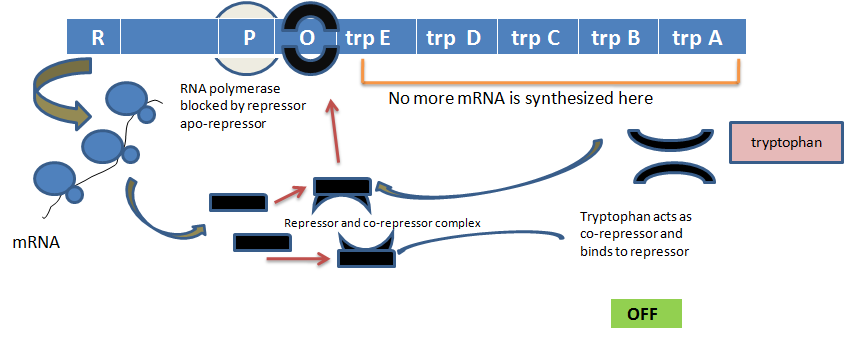
The operon model is switched 'off' within the following way - The transcription or function of lac genes if structural genes depend upon operator gene. When repressor protein produced by inhibitory gene (i) or regulatory gene binds to operator (O) gene, RNA polymerase gets blocked. There would be no transcription and the operon model remains in switched off position.
Note: The Lac operon in E.coli is controlled by the genes and structural gene enzymes. The structural gene can be switched on or off depending upon the regulatory gene. If it's bound to an operator by repressor then the processing of RNA polymerase is blocked and it would keep structural genes in switched off position and hence no transcription takes place by structural gene.
Complete answer:
Lac operon in E.coli generally accommodates following genes:
Regulatory gene (i)- It's also called inhibitory gene (i) that codes for a repressor protein. It is existing in two forms, in one it’s paratactic to an operator and binds with it and in other paratactic to inducer (lactose).
Promoter gene (P)- It is considered as initiations to the part where RNA polymerase remains attached.
Operator gene (O)- like other genes it’s also the sequence of bases. It interacts with a protein molecule (the regulatory molecule) which either promotes (inducer) or prevents (repressor) transcription of structural genes.
Structural genes- These genes code for the proteins needed by the cell including enzymes or other proteins.
In lac operon following three structural genes are functional-
-Lac A - gene coding for enzyme transacetylase
-Lac Y - gene coding for enzyme permease
-Lac Z - gene coding for enzyme beta galactosidase.
The operon model is switched 'off' within the following way - The transcription or function of lac genes if structural genes depend upon operator gene. When repressor protein produced by inhibitory gene (i) or regulatory gene binds to operator (O) gene, RNA polymerase gets blocked. There would be no transcription and the operon model remains in switched off position.
Note: The Lac operon in E.coli is controlled by the genes and structural gene enzymes. The structural gene can be switched on or off depending upon the regulatory gene. If it's bound to an operator by repressor then the processing of RNA polymerase is blocked and it would keep structural genes in switched off position and hence no transcription takes place by structural gene.
Recently Updated Pages
Master Class 11 Computer Science: Engaging Questions & Answers for Success

Master Class 11 Business Studies: Engaging Questions & Answers for Success
Master Class 11 Economics: Engaging Questions & Answers for Success
Master Class 11 English: Engaging Questions & Answers for Success
Master Class 11 Maths: Engaging Questions & Answers for Success
Master Class 11 Biology: Engaging Questions & Answers for Success
Trending doubts
One Metric ton is equal to kg A 10000 B 1000 C 100 class 11 physics CBSE
There are 720 permutations of the digits 1 2 3 4 5 class 11 maths CBSE
Discuss the various forms of bacteria class 11 biology CBSE
Draw a diagram of a plant cell and label at least eight class 11 biology CBSE
State the laws of reflection of light
Explain zero factorial class 11 maths CBSE