




What are the stages of follicular development?
Answer
 Verified
548.1k+ views
Hint: The development of follicles in females is also known as oogenesis. The process of formation of a female gamete (ova) is known as oogenesis. The ovarian follicles mature, develop and ultimately rupture to release an ovum in the fallopian tube which awaits fertilization, if it occurs. Oogenesis is initiated at birth itself in the embryonic stage when several gamete mother cells are formed within the fetal ovary. No more follicular cells are added thereafter.
Complete answer:
Now the stages of follicular development are:
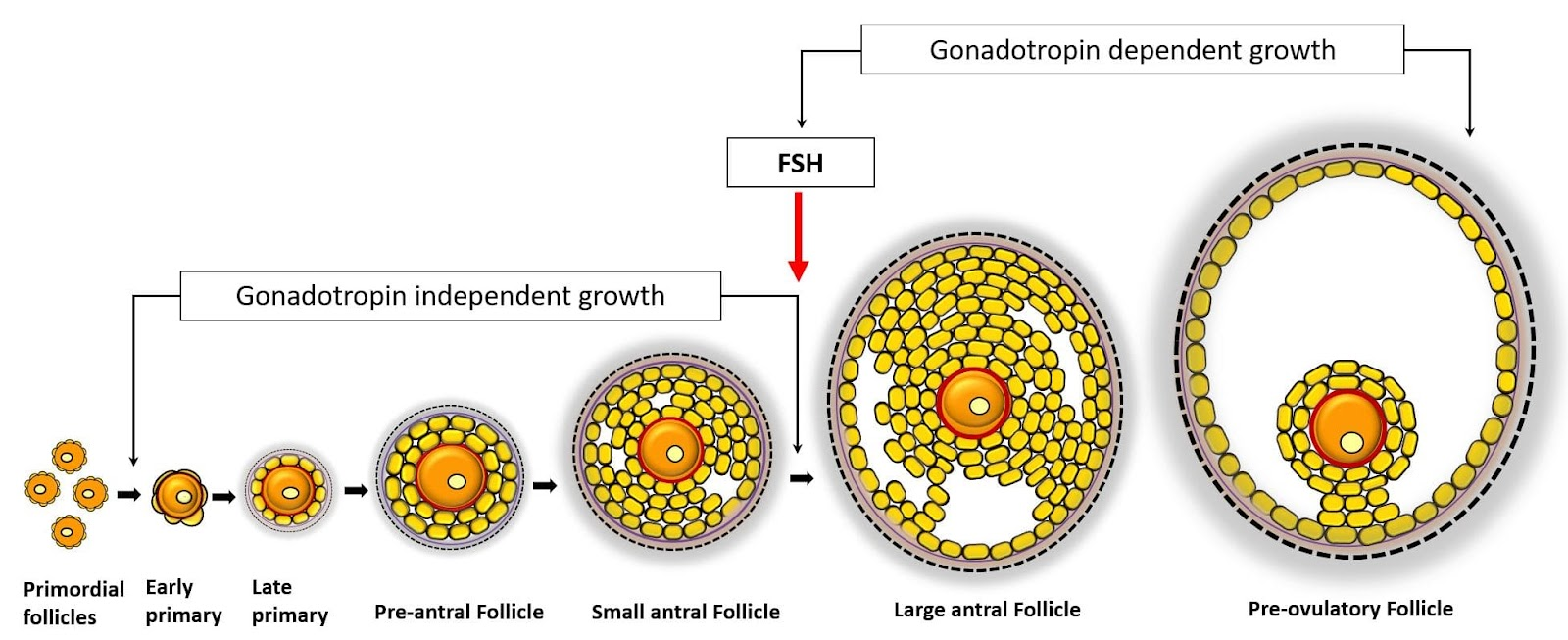
Primary Follicle $\to $ Secondary Follicle $\to $ Tertiary Follicle $\to $Graafian Follicle.
An ovarian follicle, on the onset of puberty, and thereafter during each menstrual cycle, begins to mature. It gets surrounded by a layer of flat germinal epithelium cells known as granulosa cells and are termed as primary follicles.
The primary follicles then mature further. The follicular cells get surrounded by more layers of granular cells and a new thecal layer. These cells are now known as secondary follicles. The granulosa cells rest on a basement membrane and the surrounding stromal cells form theca folliculi.
The secondary follicle soon transforms into a tertiary follicle which is characterized by a fluid filled cavity antrum, which appears between the granulosa cells.
Now, as the follicles grow, the theca folliculi become organized into an inner layer of secretory cells, the theca interna and an outer layer of connective tissue cells called fibroblast-like cells, the theca externa.
The maturing oocytes remain attached to the wall of the follicle through a narrow layer of cells which form the pedicle or stalk, known as the cumulus oophorus. This cumulus oophorus is formed by the granulosa cells. The developing ova thus remains suspended in the liquor folliculi.
The external thecal layer soon merges with the ovarian stroma wall. This stage is known as the Graafian Follicle stage.
The ova are soon released into the fallopian tube with the onset of the ovulatory phase.
Note:
Now, after release of ovum, the graafian follicle soon gets converted into a structure called corpus luteum, which secretes mainly progesterone with small amounts of estrogen. The corpus luteum is not considered under the phases of follicular development as it does not contain the ova. It supports pregnancy by secreting progesterone that maintains the endometrial lining and prevents menstruation, and thus abortion of the fetus. In absence of pregnancy, the corpus luteum persists for 7 days, after which it degenerates, and soon the menstrual cycle starts again.
Complete answer:
Now the stages of follicular development are:
Primary Follicle $\to $ Secondary Follicle $\to $ Tertiary Follicle $\to $Graafian Follicle.
An ovarian follicle, on the onset of puberty, and thereafter during each menstrual cycle, begins to mature. It gets surrounded by a layer of flat germinal epithelium cells known as granulosa cells and are termed as primary follicles.
The primary follicles then mature further. The follicular cells get surrounded by more layers of granular cells and a new thecal layer. These cells are now known as secondary follicles. The granulosa cells rest on a basement membrane and the surrounding stromal cells form theca folliculi.
The secondary follicle soon transforms into a tertiary follicle which is characterized by a fluid filled cavity antrum, which appears between the granulosa cells.
Now, as the follicles grow, the theca folliculi become organized into an inner layer of secretory cells, the theca interna and an outer layer of connective tissue cells called fibroblast-like cells, the theca externa.
The maturing oocytes remain attached to the wall of the follicle through a narrow layer of cells which form the pedicle or stalk, known as the cumulus oophorus. This cumulus oophorus is formed by the granulosa cells. The developing ova thus remains suspended in the liquor folliculi.
The external thecal layer soon merges with the ovarian stroma wall. This stage is known as the Graafian Follicle stage.
The ova are soon released into the fallopian tube with the onset of the ovulatory phase.
Note:
Now, after release of ovum, the graafian follicle soon gets converted into a structure called corpus luteum, which secretes mainly progesterone with small amounts of estrogen. The corpus luteum is not considered under the phases of follicular development as it does not contain the ova. It supports pregnancy by secreting progesterone that maintains the endometrial lining and prevents menstruation, and thus abortion of the fetus. In absence of pregnancy, the corpus luteum persists for 7 days, after which it degenerates, and soon the menstrual cycle starts again.
Recently Updated Pages
Master Class 12 Business Studies: Engaging Questions & Answers for Success

Master Class 12 Biology: Engaging Questions & Answers for Success
Master Class 12 Chemistry: Engaging Questions & Answers for Success
Class 12 Question and Answer - Your Ultimate Solutions Guide
Master Class 12 Economics: Engaging Questions & Answers for Success
Basicity of sulphurous acid and sulphuric acid are
Trending doubts
Draw a labelled sketch of the human eye class 12 physics CBSE
Which are the Top 10 Largest Countries of the World?
Draw ray diagrams each showing i myopic eye and ii class 12 physics CBSE
Which is the correct genotypic ratio of mendel dihybrid class 12 biology CBSE
Differentiate between homogeneous and heterogeneous class 12 chemistry CBSE
Give 10 examples of unisexual and bisexual flowers