




What are the set of d orbitals involved in forming capped octahedral geometry?
Answer
 Verified
494.1k+ views
Hint: An atomic orbital is a mathematical function in atomic theory and quantum physics that describes the position and wave-like behaviour of an electron in an atom. This function may be used to determine the likelihood of locating any atom's electron in any given area surrounding the nucleus. The phrase atomic orbital can also refer to the actual region or space in which the electron can be calculated to be present, based on the orbital's mathematical structure.
Complete answer:
The form of compounds containing six atoms or groups of atoms or ligands symmetrically grouped around a central atom, defining the vertices of an octahedron, is described by octahedral molecular geometry in chemistry. The prefix octa comes from the fact that the octahedron has eight faces. Although octahedral compounds generally contain a single atom in the centre and no links between the ligand atoms, the octahedron is one of the Platonic solids.
The capped octahedral molecular geometry in chemistry defines the structure of compounds with seven atoms or groups of atoms or ligands grouped around a central atom, defining the vertices of a gyroelongated triangular pyramid. This form, along with the pentagonal bipyramid and the capped trigonal prism, has ${{C}_{3v}}$ symmetry and is one of three typical geometries for heptacoordinate transition metal complexes.
The ions heptafluoro molybdate (\[Mo{{F}_{7}}^{-}\]) and heptafluoro tungstate (\[W{{F}_{7}}^{-}\]) both have a capped octahedral molecular shape.
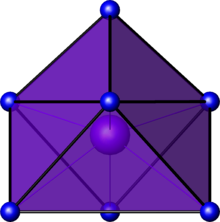
A capped octahedral geometry is octahedral with an additional ligand above the equatorial plane, in between the equatorial ligands. The primary axis of rotation is the ${{C}_{3(z)}}$ axis, which belongs to the ${{C}_{3v}}$ point group. Another perspective is to look down the ${{C}_{3(z)}}$ axis.
The \[{{d}_{{{z}^{2}}}}\] points to the cap atom since the z axis passes through it. Because the atoms on the octahedral face (which form the triangle in the second image) are on the xy plane, we require both on-axis and off-axis d orbitals (${{d}_{{{x}^{2}}-{{y}^{2}}}}$ and ${{d}_{xy}}$) to explain this hybridization.
As a result, one possibility that comes to mind is \[{{d}_{{{z}^{2}}}},{{d}_{{{x}^{2}}-{{y}^{2}}}},{{d}_{xy}}\].
Note:
Alfred Werner established the idea of octahedral coordination geometry to explain stoichiometries and isomerism in coordination compounds. Chemists were able to rationalise the number of isomers of coordination compounds because of his understanding. Werner-type transition-metal complexes are octahedral transition-metal complexes with amines and simple anions.
Complete answer:
The form of compounds containing six atoms or groups of atoms or ligands symmetrically grouped around a central atom, defining the vertices of an octahedron, is described by octahedral molecular geometry in chemistry. The prefix octa comes from the fact that the octahedron has eight faces. Although octahedral compounds generally contain a single atom in the centre and no links between the ligand atoms, the octahedron is one of the Platonic solids.
The capped octahedral molecular geometry in chemistry defines the structure of compounds with seven atoms or groups of atoms or ligands grouped around a central atom, defining the vertices of a gyroelongated triangular pyramid. This form, along with the pentagonal bipyramid and the capped trigonal prism, has ${{C}_{3v}}$ symmetry and is one of three typical geometries for heptacoordinate transition metal complexes.
The ions heptafluoro molybdate (\[Mo{{F}_{7}}^{-}\]) and heptafluoro tungstate (\[W{{F}_{7}}^{-}\]) both have a capped octahedral molecular shape.
A capped octahedral geometry is octahedral with an additional ligand above the equatorial plane, in between the equatorial ligands. The primary axis of rotation is the ${{C}_{3(z)}}$ axis, which belongs to the ${{C}_{3v}}$ point group. Another perspective is to look down the ${{C}_{3(z)}}$ axis.
The \[{{d}_{{{z}^{2}}}}\] points to the cap atom since the z axis passes through it. Because the atoms on the octahedral face (which form the triangle in the second image) are on the xy plane, we require both on-axis and off-axis d orbitals (${{d}_{{{x}^{2}}-{{y}^{2}}}}$ and ${{d}_{xy}}$) to explain this hybridization.
As a result, one possibility that comes to mind is \[{{d}_{{{z}^{2}}}},{{d}_{{{x}^{2}}-{{y}^{2}}}},{{d}_{xy}}\].
Note:
Alfred Werner established the idea of octahedral coordination geometry to explain stoichiometries and isomerism in coordination compounds. Chemists were able to rationalise the number of isomers of coordination compounds because of his understanding. Werner-type transition-metal complexes are octahedral transition-metal complexes with amines and simple anions.
Recently Updated Pages
Master Class 11 Computer Science: Engaging Questions & Answers for Success

Master Class 11 Business Studies: Engaging Questions & Answers for Success
Master Class 11 Economics: Engaging Questions & Answers for Success
Master Class 11 English: Engaging Questions & Answers for Success
Master Class 11 Maths: Engaging Questions & Answers for Success
Master Class 11 Biology: Engaging Questions & Answers for Success
Trending doubts
One Metric ton is equal to kg A 10000 B 1000 C 100 class 11 physics CBSE
There are 720 permutations of the digits 1 2 3 4 5 class 11 maths CBSE
Discuss the various forms of bacteria class 11 biology CBSE
Draw a diagram of a plant cell and label at least eight class 11 biology CBSE
State the laws of reflection of light
Explain zero factorial class 11 maths CBSE