




What are the property of ideal cloning vectors?
Answer
 Verified
569.8k+ views
Hint: A cloning vector may be a small piece of DNA which will be stably maintained in an organism, and into which a far off DNA fragment is often inserted for cloning purposes.
Complete answer: The property of ideal cloning vectors are –
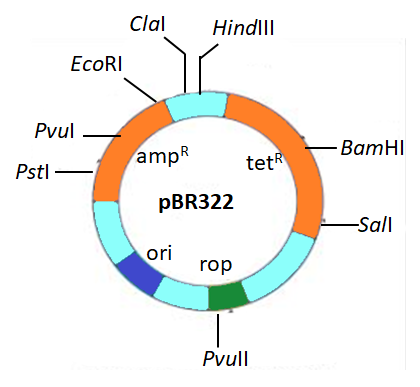
1. It must be small in size 2. It must possess multiple cloning site 3. It must be self-replicating inside the host cell. 4. It must possess a unique restriction site Restriction Endonuclease enzymes 5. The introduction of donor DNA fragments must not interfere with the replication property of the vector. 6. They should be easily isolated from the host cell. 7. It must possess some marker gene such that it can be used for later identification of the recombinant cell. Examples include Plasmid (PBR322), Cosmids, M-13 phage, YAC (Yeast Artificial Chromosome), Ti plasmid (Tumor inducing plasmid), S V-40 (Simian Virus 40).
Additional information: 1. Plasmids are autonomously replicating circular extrachromosomal DNA. They are the quality cloning vectors and therefore the ones most ordinarily used. 2. The bacteriophages used for cloning are the λ phage and M13 phage.
3. Cosmids incorporate a segment of bacteriophage λ DNA which has the cohesive end site known as cos and contains elements required for packaging DNA into λ particles. 4. Bacterial artificial chromosomes are maintained in E. coli with a replica number of just one per cell. BACs are supported by an F plasmid, another artificial chromosome called the PAC is predicated on the P1 phage. 5. Yeast artificial chromosomes are used as vectors to clone DNA fragments of more than one. They are useful in cloning larger DNA fragments as needed in mapping genomes like in the human genome project.
Note: Plasmids are the most commonly used genetically engineered plasmids. Cloning is generally first performed using Escherichia coli, and the cloning vector in E. coli includes plasmids.
The expression vector contains suitable elements for the expression of a cloned target gene like a promoter and ribosomal binding site.
Complete answer: The property of ideal cloning vectors are –
1. It must be small in size 2. It must possess multiple cloning site 3. It must be self-replicating inside the host cell. 4. It must possess a unique restriction site Restriction Endonuclease enzymes 5. The introduction of donor DNA fragments must not interfere with the replication property of the vector. 6. They should be easily isolated from the host cell. 7. It must possess some marker gene such that it can be used for later identification of the recombinant cell. Examples include Plasmid (PBR322), Cosmids, M-13 phage, YAC (Yeast Artificial Chromosome), Ti plasmid (Tumor inducing plasmid), S V-40 (Simian Virus 40).
Additional information: 1. Plasmids are autonomously replicating circular extrachromosomal DNA. They are the quality cloning vectors and therefore the ones most ordinarily used. 2. The bacteriophages used for cloning are the λ phage and M13 phage.
3. Cosmids incorporate a segment of bacteriophage λ DNA which has the cohesive end site known as cos and contains elements required for packaging DNA into λ particles. 4. Bacterial artificial chromosomes are maintained in E. coli with a replica number of just one per cell. BACs are supported by an F plasmid, another artificial chromosome called the PAC is predicated on the P1 phage. 5. Yeast artificial chromosomes are used as vectors to clone DNA fragments of more than one. They are useful in cloning larger DNA fragments as needed in mapping genomes like in the human genome project.
Note: Plasmids are the most commonly used genetically engineered plasmids. Cloning is generally first performed using Escherichia coli, and the cloning vector in E. coli includes plasmids.
The expression vector contains suitable elements for the expression of a cloned target gene like a promoter and ribosomal binding site.
Recently Updated Pages
Master Class 12 Business Studies: Engaging Questions & Answers for Success

Master Class 12 Chemistry: Engaging Questions & Answers for Success
Master Class 12 Biology: Engaging Questions & Answers for Success
Class 12 Question and Answer - Your Ultimate Solutions Guide
Master Class 11 English: Engaging Questions & Answers for Success
Master Class 11 Social Science: Engaging Questions & Answers for Success
Trending doubts
Which are the Top 10 Largest Countries of the World?
Draw a labelled sketch of the human eye class 12 physics CBSE
Differentiate between homogeneous and heterogeneous class 12 chemistry CBSE
Differentiate between Pyramid of energy and pyramid class 12 biology CBSE
Why is the cell called the structural and functional class 12 biology CBSE
Draw the diagram of the pyramid of energy Explain In class 12 biology CBSE