




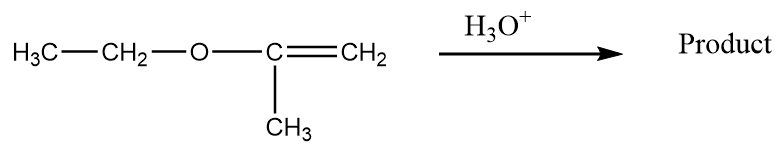
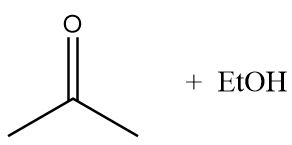
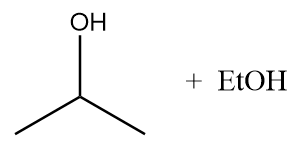
What are the products formed in the given reaction?
A.
B.

C.
D.

Answer
 Verified
514.2k+ views
Hint : When ethers are reacted to a nucleophile in the presence of strong acid, then their bond cleaves to give respective alcohols and other compounds that depend on the type of nucleophile considered. The mechanism involved in the process in bimolecular nucleophilic substitution reaction.
Complete Step By Step Answer:
The reaction proceeds in certain steps which are given as follows:
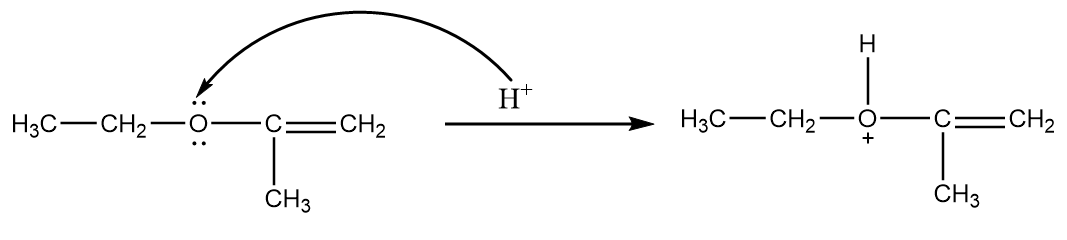
Step-1: Protonation of ether.
The hydrogen ion present in the medium attacks the lone pair of electrons of the oxygen atom due to which formation of a protonated compound takes place. The reaction proceeds as follows:
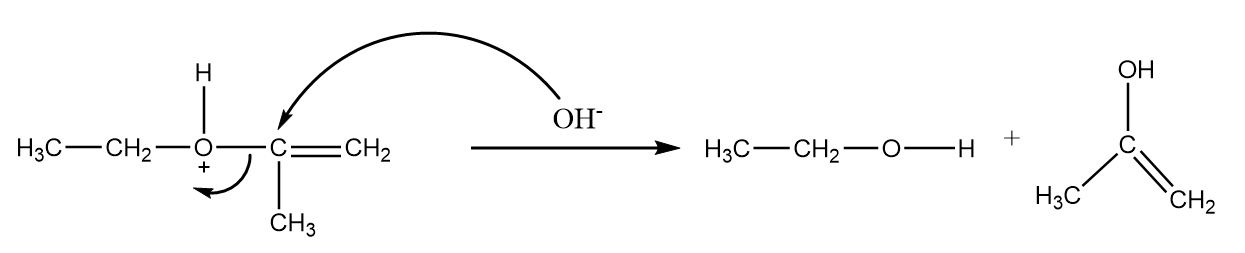
Step-2: attack of nucleophile via $ S{N_2} $ reaction mechanism.
The hydroxide ion of the water molecule will act as a nucleophile and replace the alcohol group from the compound. The reaction takes place as follows:
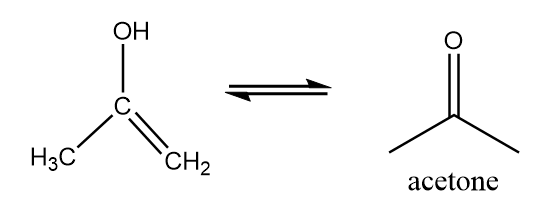
Step-3: Keto-enol tautomerism.
The unsaturated alcohol will undergo keto-enol tautomerism to form acetone. The reaction proceeds as follows:
Hence, final products formed after the reaction are given below:
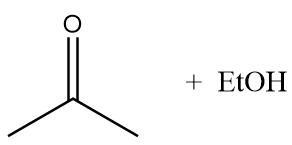
Therefore, option (A) is the correct answer.
Note :
It is important to note that, because of the acidity of alpha hydrogens, carbonyl compounds undergo a proton transfer equilibrium termed as tautomerism. In keto-enol tautomerism, the keto tautomer is preferred because of its structure. The ketone consists of two alkyl groups which shows $ + I $ effect and donate electron density to the carbon atom at the carbonyl centre and thus lead to a more stable compound. Also, the carbonyl bond i.e., $ C = O $ bond is much stronger than $ C = C $ bond and hence, the unsaturated alcohols generally exist as keto tautomers.
Complete Step By Step Answer:
The reaction proceeds in certain steps which are given as follows:
Step-1: Protonation of ether.
The hydrogen ion present in the medium attacks the lone pair of electrons of the oxygen atom due to which formation of a protonated compound takes place. The reaction proceeds as follows:
Step-2: attack of nucleophile via $ S{N_2} $ reaction mechanism.
The hydroxide ion of the water molecule will act as a nucleophile and replace the alcohol group from the compound. The reaction takes place as follows:
Step-3: Keto-enol tautomerism.
The unsaturated alcohol will undergo keto-enol tautomerism to form acetone. The reaction proceeds as follows:
Hence, final products formed after the reaction are given below:
Therefore, option (A) is the correct answer.
Note :
It is important to note that, because of the acidity of alpha hydrogens, carbonyl compounds undergo a proton transfer equilibrium termed as tautomerism. In keto-enol tautomerism, the keto tautomer is preferred because of its structure. The ketone consists of two alkyl groups which shows $ + I $ effect and donate electron density to the carbon atom at the carbonyl centre and thus lead to a more stable compound. Also, the carbonyl bond i.e., $ C = O $ bond is much stronger than $ C = C $ bond and hence, the unsaturated alcohols generally exist as keto tautomers.
Recently Updated Pages
Master Class 11 Computer Science: Engaging Questions & Answers for Success

Master Class 11 Business Studies: Engaging Questions & Answers for Success
Master Class 11 Economics: Engaging Questions & Answers for Success
Master Class 11 English: Engaging Questions & Answers for Success
Master Class 11 Maths: Engaging Questions & Answers for Success
Master Class 11 Biology: Engaging Questions & Answers for Success
Trending doubts
One Metric ton is equal to kg A 10000 B 1000 C 100 class 11 physics CBSE
There are 720 permutations of the digits 1 2 3 4 5 class 11 maths CBSE
Discuss the various forms of bacteria class 11 biology CBSE
Draw a diagram of a plant cell and label at least eight class 11 biology CBSE
State the laws of reflection of light
Explain zero factorial class 11 maths CBSE