




What are the parallelograms and the polygon method?
Answer
 Verified
579.3k+ views
Hint: Let us first understand the parallelogram of vectors. It states that the sum of any two vectors can be represented as the diagonal of a parallelogram where these vectors will form the parallel sides of the polygon.
Complete step-by-step solution:
The parallelogram and the polygon methods are different methods of vector addition which uses different basic principles to find the net sum of any two vectors. As the name suggests, one uses the construction of a parallelogram and the other uses the construction of a polygon to find the resultant vector. We shall use this definition as a base to proceed ahead in our problem.
For example, let there be two unequal vectors, $\overrightarrow{a}$ and $\overrightarrow{b}$in space such that we need to find the resultant of these vectors. This can be done by joining the tails of these vectors and then producing them parallel to oneself to construct a parallelogram. Then the diagonal arising from their point of connection in the resultant vector. This is depicted as follows:
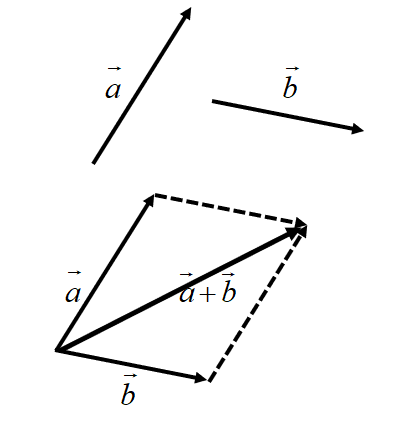
Here, we can clearly see that the resultant vector is calculated using the parallelogram method.
Now, we have the polygon method of vector addition. In this method, the resultant vector can be represented as the closing side of a polygon. This method is valid for adding any number of vectors unlike the parallelogram method.
For example, if we have ‘n’ number of vectors starting from $\overrightarrow{{{a}_{1}}}$ to $\overrightarrow{{{a}_{n}}}$, then the resultant of these vectors (say $\overrightarrow{R}$ )can be represented as follows:
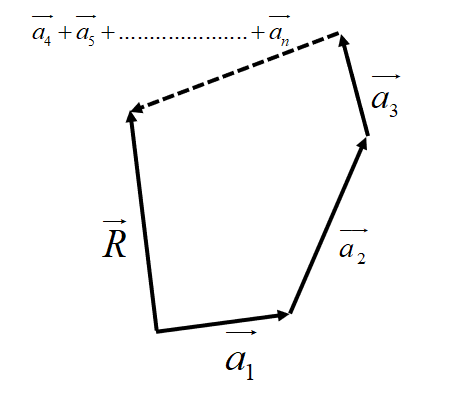
Thus, we can see that the resultant vector is calculated by constructing a polygon, hence the name, polygon method of vector addition.
Note: The triangle method of vector addition of two vectors is the special case of polygon method of vector addition of two vectors. For addition of two vectors, its totally up to the students to decide which method is more convenient and easier and takes less time to solve.
Complete step-by-step solution:
The parallelogram and the polygon methods are different methods of vector addition which uses different basic principles to find the net sum of any two vectors. As the name suggests, one uses the construction of a parallelogram and the other uses the construction of a polygon to find the resultant vector. We shall use this definition as a base to proceed ahead in our problem.
For example, let there be two unequal vectors, $\overrightarrow{a}$ and $\overrightarrow{b}$in space such that we need to find the resultant of these vectors. This can be done by joining the tails of these vectors and then producing them parallel to oneself to construct a parallelogram. Then the diagonal arising from their point of connection in the resultant vector. This is depicted as follows:
Here, we can clearly see that the resultant vector is calculated using the parallelogram method.
Now, we have the polygon method of vector addition. In this method, the resultant vector can be represented as the closing side of a polygon. This method is valid for adding any number of vectors unlike the parallelogram method.
For example, if we have ‘n’ number of vectors starting from $\overrightarrow{{{a}_{1}}}$ to $\overrightarrow{{{a}_{n}}}$, then the resultant of these vectors (say $\overrightarrow{R}$ )can be represented as follows:
Thus, we can see that the resultant vector is calculated by constructing a polygon, hence the name, polygon method of vector addition.
Note: The triangle method of vector addition of two vectors is the special case of polygon method of vector addition of two vectors. For addition of two vectors, its totally up to the students to decide which method is more convenient and easier and takes less time to solve.
Recently Updated Pages
Master Class 10 Computer Science: Engaging Questions & Answers for Success

Master Class 10 Social Science: Engaging Questions & Answers for Success
Master Class 10 Science: Engaging Questions & Answers for Success
Class 10 Question and Answer - Your Ultimate Solutions Guide
Master Class 10 Maths: Engaging Questions & Answers for Success
Master Class 10 English: Engaging Questions & Answers for Success
Trending doubts
Difference Between Prokaryotic Cells and Eukaryotic Cells
Two of the body parts which do not appear in MRI are class 11 biology CBSE
10 examples of friction in our daily life
Draw a diagram of nephron and explain its structur class 11 biology CBSE
One Metric ton is equal to kg A 10000 B 1000 C 100 class 11 physics CBSE
Draw a diagram of a plant cell and label at least eight class 11 biology CBSE