




What are the minimum components needed for an electrical circuit to do work? What device allows us to control whether or not current flows in the circuit?
Answer
 Verified
560.4k+ views
Hint: For an electrical circuit to do useful work, we will need equipment that acts as a power supply source. Then, we will need equipment that can turn this power supplied to them into useful work by converting electrical energy into other forms of useful energies. And lastly, we need a medium to supply this power from one point in the circuit to another.
Complete answer:
We saw that, we basically need at least three components to construct an electrical circuit that does work.
The first component of our electrical circuit is a power supply equipment. A cell is a device which can be used to provide power in the circuit.
Now, the second component in our electrical circuit is a load that can utilize this power. We can use a heater (which is basically a resistance) to convert this electrical energy into thermal energy.
And, lastly to transfer this power from the cell to the load and to complete the circuit, we will use a conductor. For this purpose, we will use conducting wires in our circuit.
Thus, our three-component circuit is complete and an example of such a circuit is:
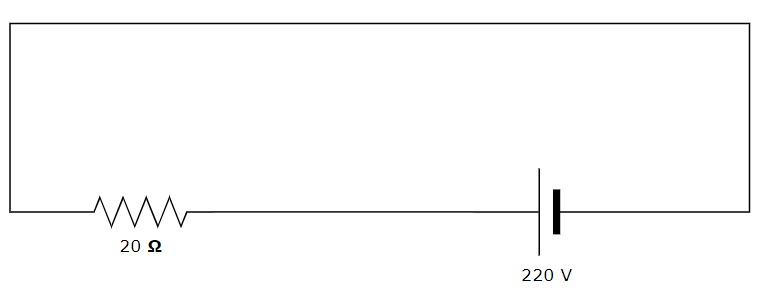
Here, the power dissipated by the resistance (heater) is equal to:
$\begin{align}
& \Rightarrow P=\dfrac{{{V}^{2}}}{R} \\
& \Rightarrow P=\dfrac{{{220}^{2}}}{20} \\
& \Rightarrow P=2.42kW \\
\end{align}$
Hence, the minimum components needed for an electrical circuit to do work is three, that are, a power supply, a load and a conductor.
A switch is a device that allows us to control whether or not current flows in the circuit.
Note:
Whenever constructing an electrical circuit, one should be very careful of the power load of the appliance used. Providing excessive power to the appliance may heat up and burn the appliance whereas providing less power might affect its performance and gradually affect its shelf life. These are some key thoughts that go into the manufacturing of these appliances too.
Complete answer:
We saw that, we basically need at least three components to construct an electrical circuit that does work.
The first component of our electrical circuit is a power supply equipment. A cell is a device which can be used to provide power in the circuit.
Now, the second component in our electrical circuit is a load that can utilize this power. We can use a heater (which is basically a resistance) to convert this electrical energy into thermal energy.
And, lastly to transfer this power from the cell to the load and to complete the circuit, we will use a conductor. For this purpose, we will use conducting wires in our circuit.
Thus, our three-component circuit is complete and an example of such a circuit is:
Here, the power dissipated by the resistance (heater) is equal to:
$\begin{align}
& \Rightarrow P=\dfrac{{{V}^{2}}}{R} \\
& \Rightarrow P=\dfrac{{{220}^{2}}}{20} \\
& \Rightarrow P=2.42kW \\
\end{align}$
Hence, the minimum components needed for an electrical circuit to do work is three, that are, a power supply, a load and a conductor.
A switch is a device that allows us to control whether or not current flows in the circuit.
Note:
Whenever constructing an electrical circuit, one should be very careful of the power load of the appliance used. Providing excessive power to the appliance may heat up and burn the appliance whereas providing less power might affect its performance and gradually affect its shelf life. These are some key thoughts that go into the manufacturing of these appliances too.
Recently Updated Pages
Master Class 12 Economics: Engaging Questions & Answers for Success

Master Class 12 English: Engaging Questions & Answers for Success
Master Class 12 Social Science: Engaging Questions & Answers for Success
Master Class 12 Maths: Engaging Questions & Answers for Success
Master Class 12 Physics: Engaging Questions & Answers for Success
Master Class 11 Social Science: Engaging Questions & Answers for Success
Trending doubts
One Metric ton is equal to kg A 10000 B 1000 C 100 class 11 physics CBSE
Difference Between Prokaryotic Cells and Eukaryotic Cells
Find the value of the expression given below sin 30circ class 11 maths CBSE
Two of the body parts which do not appear in MRI are class 11 biology CBSE
1 ton equals to A 100 kg B 1000 kg C 10 kg D 10000 class 11 physics CBSE
Draw a diagram of nephron and explain its structur class 11 biology CBSE