




What are the interesting facts about cocci?
Answer
 Verified
530.4k+ views
Hint: Bacteria are small unicellular organisms. These microscopic organisms are called prokaryotes, they lack true nucleus and other cellular organelles. The shape of Bacteria varies with types and length of a Bacteria.
Complete answer:
The Bacteria can be classified based on Gram Staining method, and morphological characters. By Gram staining method it can be grouped into Gram Positive Cocci and Gram Negative Cocci. By morphological characters they are classified as Cocci, Rod shape, Spiral shape.
Cocci shaped Bacteria is referred as Coccus. The word coccus is derived from the Greek word Berry. They are spherical,Ovoid, generally round shaped bacterium. Cocci may be pathogenic, commensal, or symbiotic when residing in their host organism. Many cocci shaped bacteria lack flagella and they are non-motile, in comparison to so many other bacilli-shaped bacteria. Based on the orientation and connection throughout cell division, the coccus shape may develop in pairs, lines, or bundles.
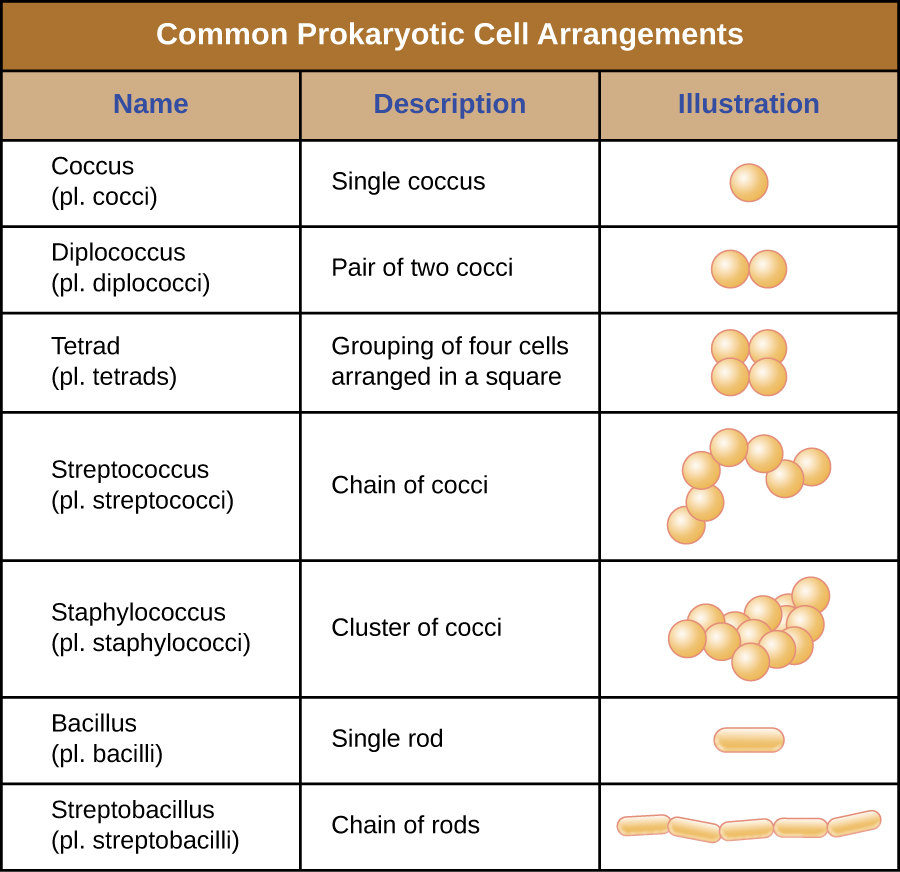
The cocci are classified based on their aggregations. The structure of cocci may vary between Gram positive and Gram Negative cell wall types. Cocci have characteristic arrangements that are useful in identification. The cocci that occurs in pairs are called Diplococci. The cocci is arranged in long chain-like patterns ( Streptococci). The cocci are arranged in grape-like clusters (staphylococci). The cocci is arranged in four Tetrad pairs. The cocci is arranged in three planes (cubes) called Sarcina.
Cocci are capable of causing severe infections in humans like pneumonia, meningitis, urinary tract infections, Eye infection, Toxic shock syndrome, food poisoning and throat infections.
Note:
The Cocci Bacteria can be further grouped into Aerobic Cocci and Anaerobic Cocci Bacteria. Some of the notable Cocci bacteria are Micrococcus, Diplococcus, Streptococcus, Tetracoccus.
Complete answer:
The Bacteria can be classified based on Gram Staining method, and morphological characters. By Gram staining method it can be grouped into Gram Positive Cocci and Gram Negative Cocci. By morphological characters they are classified as Cocci, Rod shape, Spiral shape.
Cocci shaped Bacteria is referred as Coccus. The word coccus is derived from the Greek word Berry. They are spherical,Ovoid, generally round shaped bacterium. Cocci may be pathogenic, commensal, or symbiotic when residing in their host organism. Many cocci shaped bacteria lack flagella and they are non-motile, in comparison to so many other bacilli-shaped bacteria. Based on the orientation and connection throughout cell division, the coccus shape may develop in pairs, lines, or bundles.
The cocci are classified based on their aggregations. The structure of cocci may vary between Gram positive and Gram Negative cell wall types. Cocci have characteristic arrangements that are useful in identification. The cocci that occurs in pairs are called Diplococci. The cocci is arranged in long chain-like patterns ( Streptococci). The cocci are arranged in grape-like clusters (staphylococci). The cocci is arranged in four Tetrad pairs. The cocci is arranged in three planes (cubes) called Sarcina.
Cocci are capable of causing severe infections in humans like pneumonia, meningitis, urinary tract infections, Eye infection, Toxic shock syndrome, food poisoning and throat infections.
Note:
The Cocci Bacteria can be further grouped into Aerobic Cocci and Anaerobic Cocci Bacteria. Some of the notable Cocci bacteria are Micrococcus, Diplococcus, Streptococcus, Tetracoccus.
Recently Updated Pages
Master Class 11 English: Engaging Questions & Answers for Success

Master Class 11 Social Science: Engaging Questions & Answers for Success
Master Class 11 Maths: Engaging Questions & Answers for Success
Master Class 11 Biology: Engaging Questions & Answers for Success
Master Class 11 Physics: Engaging Questions & Answers for Success
Master Class 11 Chemistry: Engaging Questions & Answers for Success
Trending doubts
One Metric ton is equal to kg A 10000 B 1000 C 100 class 11 physics CBSE
Difference Between Prokaryotic Cells and Eukaryotic Cells
Find the value of the expression given below sin 30circ class 11 maths CBSE
Difference between physical and chemical change class 11 chemistry CBSE
Two of the body parts which do not appear in MRI are class 11 biology CBSE
Draw a diagram of a plant cell and label at least eight class 11 biology CBSE