




How are the graphs $f\left( x \right)={{x}^{3}}$ and $g\left( x \right)={{\left( x+2 \right)}^{3}}-5$ related?
Answer
 Verified
598.8k+ views
Hint: Here in this question we have been asked to explain the relation between the graphs for $f\left( x \right)={{x}^{3}}$ and $g\left( x \right)={{\left( x+2 \right)}^{3}}-5$ . Let us consider that the curve of the function $f\left( x \right)$ has the curve positioned at the origin.
Complete step by step solution:
Now considering from the question we have been asked to explain the relation between the graphs for $f\left( x \right)={{x}^{3}}$ and $g\left( x \right)={{\left( x+2 \right)}^{3}}-5$ .
For answering this question let us consider that the curve of the function $f\left( x \right)$ has the curve positioned at the origin.
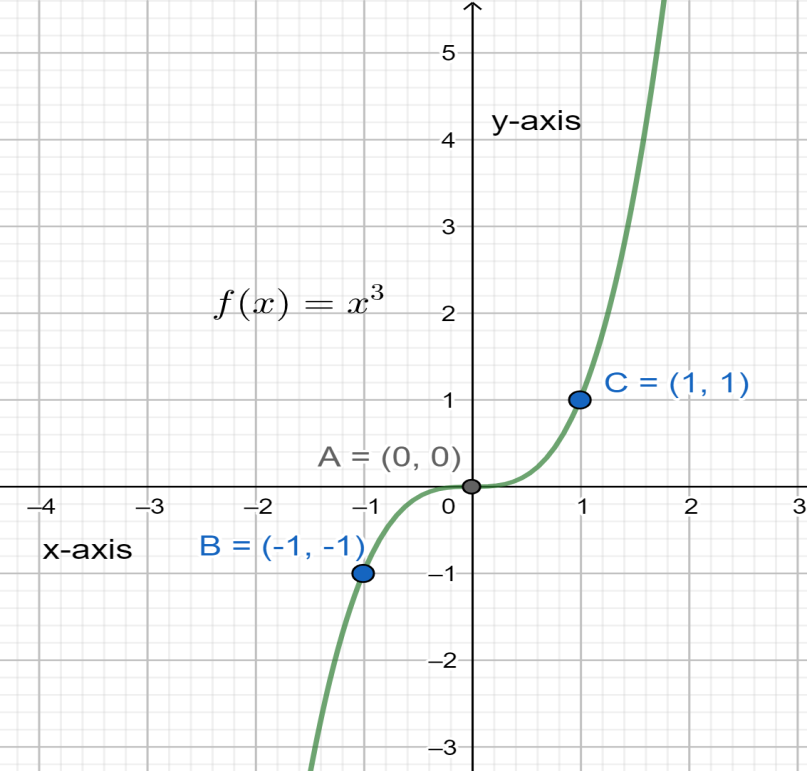
The graph of $f\left( x \right)$ has been illustrated below:
Now $g\left( x \right)$ can be simple written as $g\left( x \right)=f\left( x+2 \right)-5$ since $f\left( x+2 \right)={{\left( x+2 \right)}^{3}}$ . By observing this we can say that $f\left( x \right)$ has been shifted by 2 horizontally left and 5 vertically down for obtaining the graph of $g\left( x \right)$ .
The graph of $g\left( x \right)$ has been illustrated below:
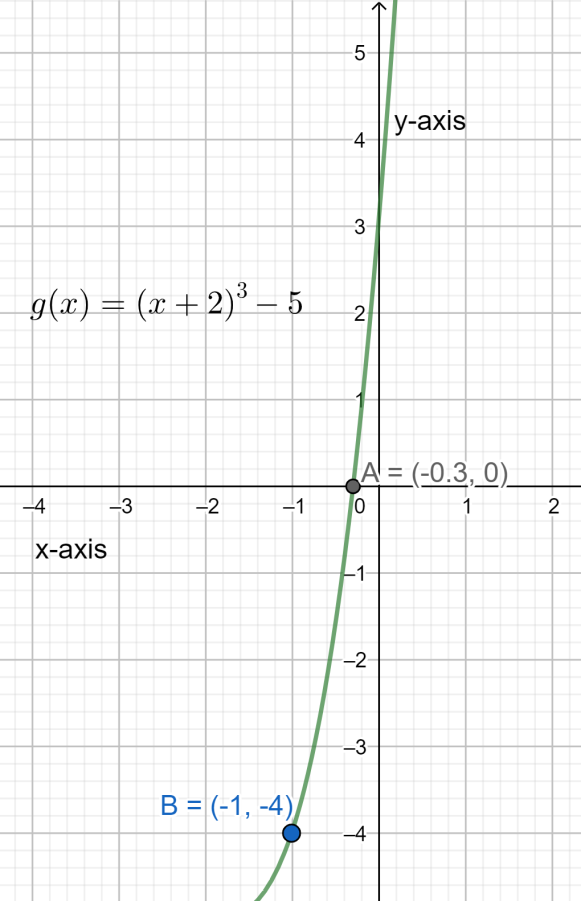
Therefore we can conclude that the function $g\left( x \right)$ has been formed by shifting the curve of the function $f\left( x \right)$ horizontally to the left by 2 and vertically down by 5.
Note: During the process of answering questions of this type we should be sure with the concepts that we are going to apply in between. This is a very simple and easy question and can be answered accurately in a short span of time. Very few mistakes are possible in questions of this type. Someone can make a mistake unintentionally and consider the simplification as $g\left( x \right)=f\left( x \right)+5$ which will lead them to end up having a wrong conclusion.
Complete step by step solution:
Now considering from the question we have been asked to explain the relation between the graphs for $f\left( x \right)={{x}^{3}}$ and $g\left( x \right)={{\left( x+2 \right)}^{3}}-5$ .
For answering this question let us consider that the curve of the function $f\left( x \right)$ has the curve positioned at the origin.
The graph of $f\left( x \right)$ has been illustrated below:
Now $g\left( x \right)$ can be simple written as $g\left( x \right)=f\left( x+2 \right)-5$ since $f\left( x+2 \right)={{\left( x+2 \right)}^{3}}$ . By observing this we can say that $f\left( x \right)$ has been shifted by 2 horizontally left and 5 vertically down for obtaining the graph of $g\left( x \right)$ .
The graph of $g\left( x \right)$ has been illustrated below:
Therefore we can conclude that the function $g\left( x \right)$ has been formed by shifting the curve of the function $f\left( x \right)$ horizontally to the left by 2 and vertically down by 5.
Note: During the process of answering questions of this type we should be sure with the concepts that we are going to apply in between. This is a very simple and easy question and can be answered accurately in a short span of time. Very few mistakes are possible in questions of this type. Someone can make a mistake unintentionally and consider the simplification as $g\left( x \right)=f\left( x \right)+5$ which will lead them to end up having a wrong conclusion.
Recently Updated Pages
Which will be the least stable resonating structure class 11 chemistry CBSE

How many 5 digit telephone numbers can be construc-class-11-maths-CBSE
How do you find the angle of the resultant vector class 11 physics CBSE
Draw labelled diagram of the following i Gram seed class 11 biology CBSE
What is the need and importance of classification class 11 biology CBSE
The way in which the sparrows expressed their sorrow class 11 english CBSE
Trending doubts
One Metric ton is equal to kg A 10000 B 1000 C 100 class 11 physics CBSE
Find the value of the expression given below sin 30circ class 11 maths CBSE
1 Quintal is equal to a 110 kg b 10 kg c 100kg d 1000 class 11 physics CBSE
Draw a diagram of nephron and explain its structur class 11 biology CBSE
10 examples of friction in our daily life
Proton was discovered by A Thomson B Rutherford C Chadwick class 11 chemistry CBSE