




What are the four processes of a Rankin cycle?
Answer
 Verified
509.4k+ views
Hint : A Rankin cycle is a thermodynamic cycle very similar to the Carnot cycle in which a gas undergoes consecutive compressions and expansions at different conditions. In the Carnot cycle we deal with pressure-volume curves but in the Rankine cycle we deal with temperature-entropy curves.
Complete Step By Step Answer:
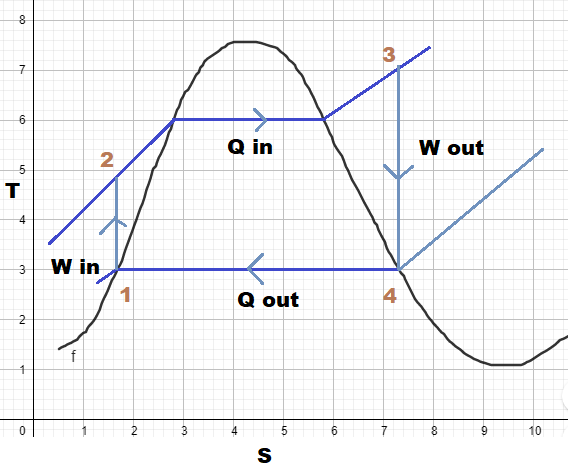
Rankin cycle is a thermodynamic cycle describing the processes being carried out in various heat engines and steam turbines where the working fluid is reused and follows a closed loop. The ability of steam engines to transform thermal energies derived from fuels into electrical energy can be explained on the basis of four important cyclic processes that can be written as follows:
An isentropic compression (entropy constant): which involves pumping the working fluid (which is a liquid) from a low to high pressure by the aid of a little energy input.
An isobaric heat addition (pressure constant): which involves heating the high-pressure liquid inside the boiler at a constant pressure. This results in the formation of dry-saturated vapour
An isentropic expansion (entropy constant): which involves reducing the temperature and pressure of the dry-saturated vapour and allowing it to expand with the help of turbines. This process is accompanied by some condensation.
An isobaric heat release (pressure constant): which involves the condensation process that converts wet vapour into a saturated liquid with simultaneous heat rejection.
The $ T - S $ diagram can be represented as follows:
Note :
The limited efficiency of the Rankin cycle is attributed to the high heat of vaporization associated with the working fluid. The working temperature range of this cycle can be widened only under drastic conditions like super critical levels.
Complete Step By Step Answer:
Rankin cycle is a thermodynamic cycle describing the processes being carried out in various heat engines and steam turbines where the working fluid is reused and follows a closed loop. The ability of steam engines to transform thermal energies derived from fuels into electrical energy can be explained on the basis of four important cyclic processes that can be written as follows:
An isentropic compression (entropy constant): which involves pumping the working fluid (which is a liquid) from a low to high pressure by the aid of a little energy input.
An isobaric heat addition (pressure constant): which involves heating the high-pressure liquid inside the boiler at a constant pressure. This results in the formation of dry-saturated vapour
An isentropic expansion (entropy constant): which involves reducing the temperature and pressure of the dry-saturated vapour and allowing it to expand with the help of turbines. This process is accompanied by some condensation.
An isobaric heat release (pressure constant): which involves the condensation process that converts wet vapour into a saturated liquid with simultaneous heat rejection.
The $ T - S $ diagram can be represented as follows:
Note :
The limited efficiency of the Rankin cycle is attributed to the high heat of vaporization associated with the working fluid. The working temperature range of this cycle can be widened only under drastic conditions like super critical levels.
Recently Updated Pages
Master Class 11 Computer Science: Engaging Questions & Answers for Success

Master Class 11 Business Studies: Engaging Questions & Answers for Success
Master Class 11 Economics: Engaging Questions & Answers for Success
Master Class 11 English: Engaging Questions & Answers for Success
Master Class 11 Maths: Engaging Questions & Answers for Success
Master Class 11 Biology: Engaging Questions & Answers for Success
Trending doubts
One Metric ton is equal to kg A 10000 B 1000 C 100 class 11 physics CBSE
There are 720 permutations of the digits 1 2 3 4 5 class 11 maths CBSE
Discuss the various forms of bacteria class 11 biology CBSE
Draw a diagram of a plant cell and label at least eight class 11 biology CBSE
State the laws of reflection of light
Explain zero factorial class 11 maths CBSE