




What are the five regions of the vertebral column?
Answer
 Verified
591.9k+ views
Hint: The vertebral column is popularly known as the backbone by a layman. Moreover, the vertebral column consists of cervical, thoracic, lumbar, sacral, and coccyx vertebrae. Based on the type of vertebrae, the vertebral column is divided into several regions.
Complete answer: The vertebral column is made up of 26 serially arranged units that are called the vertebrae. Due to this reason, it is called the vertebral column. Based on these vertebrae, the vertebral column is divided into five regions.
These five regions are known as –
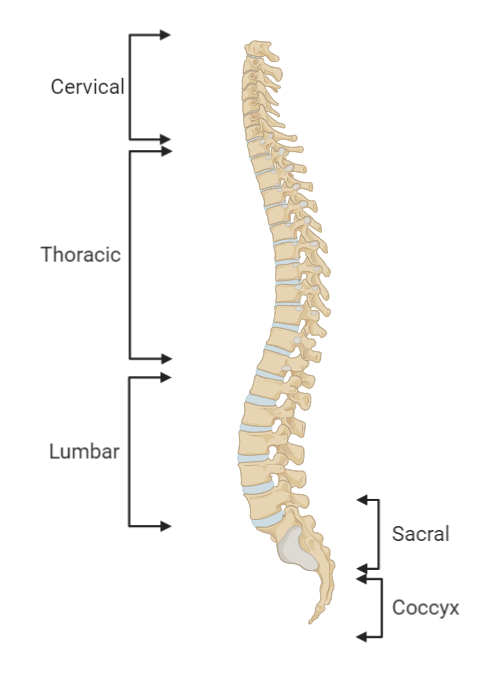
i. Cervical region – It is made up of cervical vertebrae. They are the first seven vertebrates of the vertebral column. They are small-sized and present in the neck region. The first vertebra is called the atlas and the second vertebra is called the axis.
ii. Thoracic region – It is made up of thoracic vertebrae. These are larger than the cervical vertebrae. They are twelve in number. These vertebrae are located in the chest. These provide the site for the attachment of the ribs. The thoracic vertebrae protect the heart and the lungs.
iii. Lumbar region – It is made up of lumbar vertebrae. They are five in number. They are the strongest, thickest, and the largest vertebrae present in the backbone. They are present in the abdominal region and these vertebrae bear the weight of the trunk.
iv. Sacral region – It is made up of sacral vertebrae. The sacral vertebra is a single vertebra in the vertebral column of the adults. However, in the embryonic stage, they are five, but they fuse later to form one structure. They form a triangular bony complex known as the sacrum.
v. Coccyx region – It is made up of the coccyx vertebrae. Coccyx vertebrae is a single vertebra in the vertebral column of the adults. However, in the embryonic stage, they are five coccygeal bones, but they fuse later to form one vestigial tail bone called the coccyx. The coccyx is found attached to the base of the sacrum.
Note: The vertebral column lies in the mid-dorsal region of the neck and the trunk. It extends from the base of the skull to the lowermost part of the back. Two adjacent vertebrae have a disc or pad of fibrous cartilage in between them. These are known as the intervertebral discs. They provide flexibility to the vertebral column.
Complete answer: The vertebral column is made up of 26 serially arranged units that are called the vertebrae. Due to this reason, it is called the vertebral column. Based on these vertebrae, the vertebral column is divided into five regions.
These five regions are known as –
i. Cervical region – It is made up of cervical vertebrae. They are the first seven vertebrates of the vertebral column. They are small-sized and present in the neck region. The first vertebra is called the atlas and the second vertebra is called the axis.
ii. Thoracic region – It is made up of thoracic vertebrae. These are larger than the cervical vertebrae. They are twelve in number. These vertebrae are located in the chest. These provide the site for the attachment of the ribs. The thoracic vertebrae protect the heart and the lungs.
iii. Lumbar region – It is made up of lumbar vertebrae. They are five in number. They are the strongest, thickest, and the largest vertebrae present in the backbone. They are present in the abdominal region and these vertebrae bear the weight of the trunk.
iv. Sacral region – It is made up of sacral vertebrae. The sacral vertebra is a single vertebra in the vertebral column of the adults. However, in the embryonic stage, they are five, but they fuse later to form one structure. They form a triangular bony complex known as the sacrum.
v. Coccyx region – It is made up of the coccyx vertebrae. Coccyx vertebrae is a single vertebra in the vertebral column of the adults. However, in the embryonic stage, they are five coccygeal bones, but they fuse later to form one vestigial tail bone called the coccyx. The coccyx is found attached to the base of the sacrum.
Note: The vertebral column lies in the mid-dorsal region of the neck and the trunk. It extends from the base of the skull to the lowermost part of the back. Two adjacent vertebrae have a disc or pad of fibrous cartilage in between them. These are known as the intervertebral discs. They provide flexibility to the vertebral column.
Recently Updated Pages
Master Class 11 English: Engaging Questions & Answers for Success

Master Class 11 Maths: Engaging Questions & Answers for Success
Class 11 Question and Answer - Your Ultimate Solutions Guide
Master Class 11 Biology: Engaging Questions & Answers for Success
Master Class 11 Physics: Engaging Questions & Answers for Success
Master Class 11 Accountancy: Engaging Questions & Answers for Success
Trending doubts
Differentiate between an exothermic and an endothermic class 11 chemistry CBSE
One Metric ton is equal to kg A 10000 B 1000 C 100 class 11 physics CBSE
Difference Between Prokaryotic Cells and Eukaryotic Cells
There are 720 permutations of the digits 1 2 3 4 5 class 11 maths CBSE
Draw a diagram of a plant cell and label at least eight class 11 biology CBSE
1 Quintal is equal to a 110 kg b 10 kg c 100kg d 1000 class 11 physics CBSE