




What are the diseases caused by nematodes?
Answer
 Verified
489.6k+ views
Hint: Nematodes are the multicellular microorganisms which are numerous in number and found in handfuls of soil and in many parasites of insects and animals. There are more than $20,000$ described species in the phylum nematoda. They are simple organisms by structure. Some are free living and abundant which feed on bacteria, fungi and other nematodes.
Complete answer-
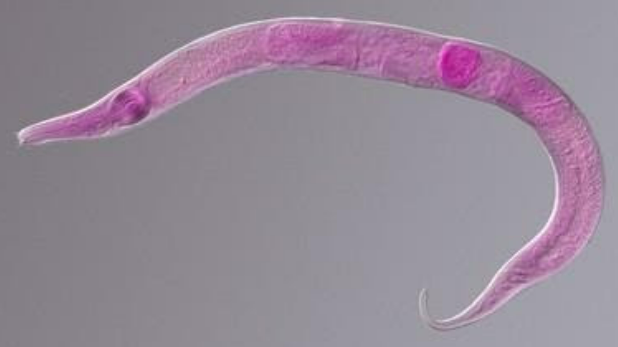
They are structurally simple organisms and are composed of approximately $1000$ somatic cells. They have potentially hundreds of cells associated with the reproductive system. They have a long alimentary canal which extends from mouth to anus near the tail.
They have digestive systems, nervous and reproductive systems. They range from $0.3mm$ to $8$ meters. The bilateral symmetry in nematodes is a lengthwise inline which can be divided into two equal halves and mirror images. Heads are different as they possess radial symmetry and produce mirror images.
Sexes are dimorphic and the cavity is present, possess tissue level organization and have cylindrical shape. The pseudocoelom is lined with mesoderm and endoderm on the other side.
The life cycle of nematodes is plant parasitic and have six stages- egg, adult and four juvenile stages. Male and females are separate. Some females have male features called hermaphrodites. They can produce both eggs and sperm. The egg production completes the sexual life cycle.
Note:
Nematode infections or diseases are- hookworm, trichiniasis, filariasis and rat lungworm disease. The diseases in plants are-root knot, Root lesion bulb and stem and leaf reniform. The filariasis worms have symptoms like-swollen legs and pubic areas where the worms accumulate and feed on the cells of the patient causing inflammation.
Complete answer-
They are structurally simple organisms and are composed of approximately $1000$ somatic cells. They have potentially hundreds of cells associated with the reproductive system. They have a long alimentary canal which extends from mouth to anus near the tail.
They have digestive systems, nervous and reproductive systems. They range from $0.3mm$ to $8$ meters. The bilateral symmetry in nematodes is a lengthwise inline which can be divided into two equal halves and mirror images. Heads are different as they possess radial symmetry and produce mirror images.
Sexes are dimorphic and the cavity is present, possess tissue level organization and have cylindrical shape. The pseudocoelom is lined with mesoderm and endoderm on the other side.
The life cycle of nematodes is plant parasitic and have six stages- egg, adult and four juvenile stages. Male and females are separate. Some females have male features called hermaphrodites. They can produce both eggs and sperm. The egg production completes the sexual life cycle.
Note:
Nematode infections or diseases are- hookworm, trichiniasis, filariasis and rat lungworm disease. The diseases in plants are-root knot, Root lesion bulb and stem and leaf reniform. The filariasis worms have symptoms like-swollen legs and pubic areas where the worms accumulate and feed on the cells of the patient causing inflammation.
Recently Updated Pages
Master Class 11 Computer Science: Engaging Questions & Answers for Success

Master Class 11 Business Studies: Engaging Questions & Answers for Success
Master Class 11 Economics: Engaging Questions & Answers for Success
Master Class 11 English: Engaging Questions & Answers for Success
Master Class 11 Maths: Engaging Questions & Answers for Success
Master Class 11 Biology: Engaging Questions & Answers for Success
Trending doubts
One Metric ton is equal to kg A 10000 B 1000 C 100 class 11 physics CBSE
There are 720 permutations of the digits 1 2 3 4 5 class 11 maths CBSE
Discuss the various forms of bacteria class 11 biology CBSE
Draw a diagram of a plant cell and label at least eight class 11 biology CBSE
State the laws of reflection of light
Explain zero factorial class 11 maths CBSE