




What are the different shapes found in bacteria? Give examples.
Answer
 Verified
546.3k+ views
Hint: Bacteria are one and only members of the kingdom Monera. Bacteria are the only organism that is widely found everywhere, also in very extreme cases like deserts, snow, deep oceans, hot springs, extreme salty areas and many more places.
Complete answer:
According to R.H. Whittaker classification, bacteria are one and the only members of the kingdom of Monera. They are found in widely everywhere and also in extreme cases like deserts, snow, extreme salty areas (these bacteria are known as halophiles), hot springs (these bacteria are known as thermoacidophiles), marshy areas( the one which found in marshy areas are known as methanogens) and many more places. The Important characteristics of bacteria or we can say that of kingdom Monera are that they are prokaryotic cell type, they have non-cellulosic cell wall this is an important characteristic and the nuclear membrane is absent so that the hereditary material is not confined within a nucleus. Bacteria either make their autotrophic food or depend on someone that is heterotrophic. It is of two types in autotrophic that are either photosynthetic or chemosynthetic. Similarly in the heterotrophic either they are saprophytic or parasitic.
So, bacteria are classified according to their shapes as follows:
1. Coccus (cocci in plural): These are oval or spherical. Examples are Staphylococci., Staphylococci.
2. Bacillus (bacilli in plural): These are rod-shaped. Examples are Streptobacillus, Corynebacterium.
3. Vibrium (Vibrio in plural): These have a comma-shaped appearance. Examples are Vibrio species, Asiatic cholera.
4. Spirillum (spirilla in plural): These are rigid spirals in appearance. Examples are Spirillum species, Campylobacter jejuni
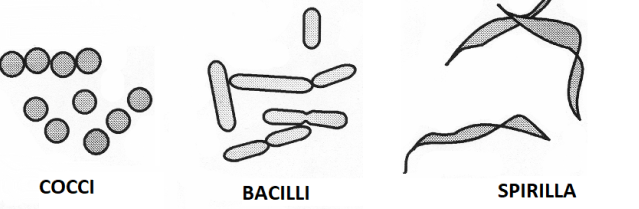
Note:
Mycoplasma is the only bacteria that do not possess a cell wall so no definite shape is found. They are the smallest cell found in the living world and also it can survive without oxygen. So, it is mostly parasitic.
Complete answer:
According to R.H. Whittaker classification, bacteria are one and the only members of the kingdom of Monera. They are found in widely everywhere and also in extreme cases like deserts, snow, extreme salty areas (these bacteria are known as halophiles), hot springs (these bacteria are known as thermoacidophiles), marshy areas( the one which found in marshy areas are known as methanogens) and many more places. The Important characteristics of bacteria or we can say that of kingdom Monera are that they are prokaryotic cell type, they have non-cellulosic cell wall this is an important characteristic and the nuclear membrane is absent so that the hereditary material is not confined within a nucleus. Bacteria either make their autotrophic food or depend on someone that is heterotrophic. It is of two types in autotrophic that are either photosynthetic or chemosynthetic. Similarly in the heterotrophic either they are saprophytic or parasitic.
So, bacteria are classified according to their shapes as follows:
1. Coccus (cocci in plural): These are oval or spherical. Examples are Staphylococci., Staphylococci.
2. Bacillus (bacilli in plural): These are rod-shaped. Examples are Streptobacillus, Corynebacterium.
3. Vibrium (Vibrio in plural): These have a comma-shaped appearance. Examples are Vibrio species, Asiatic cholera.
4. Spirillum (spirilla in plural): These are rigid spirals in appearance. Examples are Spirillum species, Campylobacter jejuni
Note:
Mycoplasma is the only bacteria that do not possess a cell wall so no definite shape is found. They are the smallest cell found in the living world and also it can survive without oxygen. So, it is mostly parasitic.
Recently Updated Pages
Master Class 11 English: Engaging Questions & Answers for Success

Master Class 11 Social Science: Engaging Questions & Answers for Success
Master Class 11 Maths: Engaging Questions & Answers for Success
Master Class 11 Biology: Engaging Questions & Answers for Success
Master Class 11 Physics: Engaging Questions & Answers for Success
Master Class 11 Chemistry: Engaging Questions & Answers for Success
Trending doubts
One Metric ton is equal to kg A 10000 B 1000 C 100 class 11 physics CBSE
Difference Between Prokaryotic Cells and Eukaryotic Cells
Difference between physical and chemical change class 11 chemistry CBSE
Find the value of the expression given below sin 30circ class 11 maths CBSE
Two of the body parts which do not appear in MRI are class 11 biology CBSE
Draw a diagram of a plant cell and label at least eight class 11 biology CBSE