




What are the conditions for hyperconjugation?
Answer
 Verified
597.3k+ views
Hint: There are two main conditions for hyperconjugation. One of them involves the presence of a hydrogen atom in a specific position while the other one involves the presence of a lone pair of electrons at a particular position.
Complete answer:
Hyperconjugation is also known as $\sigma -$conjugation or no bond resonance. It refers to the delocalization of the electrons which takes place in the presence of mainly $\sigma -$character bonds. Hyperconjugation increases the stability of the system.
Another type of hyperconjugation may occur by the parallel overlap of the p – orbitals including the hybrid orbitals which are actually involved in $\sigma -$bonds. We can say that in resonance pi – pi delocalization takes place while in hyperconjugation sigma pi delocalization takes place. In this case, a sigma bond is severed.
The hyperconjugation is shown below:
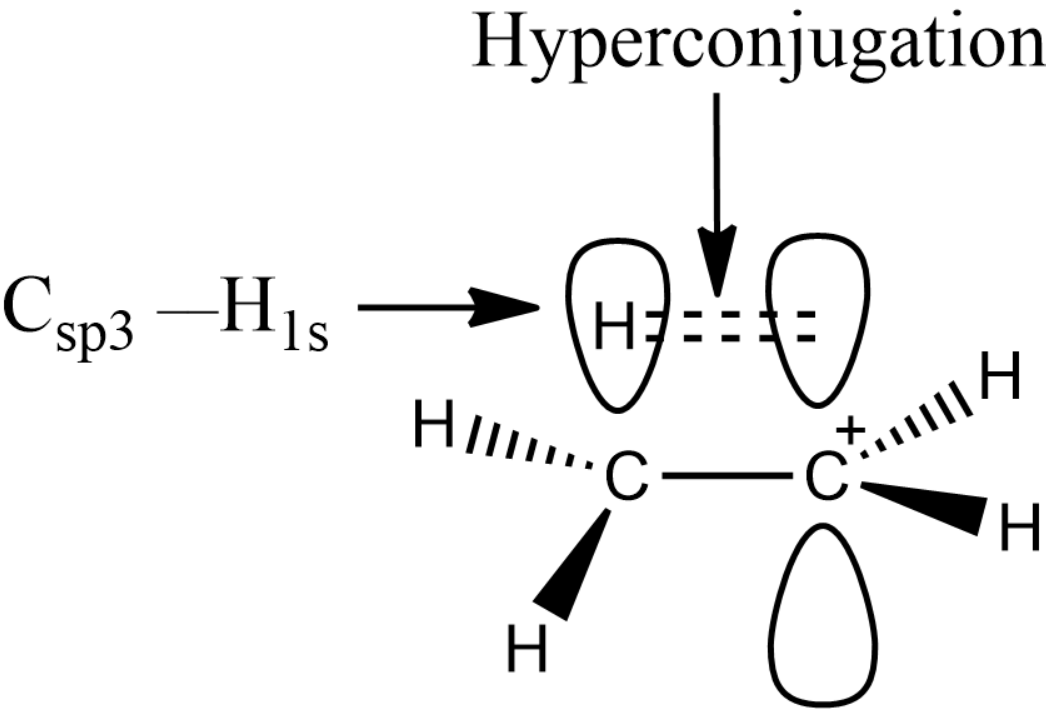
The alpha hydrogen present in the carbon will form the hyperconjugation with the empty p-orbital and hence there will be a sigma pi overlap. Thus, one of the conditions for the hyperconjugation to take place will be the presence of alpha hydrogen.
Similarly, if there is a lone pair of electrons present which is adjacent to a $s{{p}^{2}}$ hybrid carbon or atoms like oxygen, nitrogen etc., hyperconjugation will take place.
Hence, these are the two main conditions for hyperconjugation.
Note:
Resonance and hyperconjugation are similar, but there are some differences which separate them. Resonance involves bond formation during delocalization of electrons but hyperconjugation doesn’t form any bonds for the delocalization of the electrons.
Complete answer:
Hyperconjugation is also known as $\sigma -$conjugation or no bond resonance. It refers to the delocalization of the electrons which takes place in the presence of mainly $\sigma -$character bonds. Hyperconjugation increases the stability of the system.
Another type of hyperconjugation may occur by the parallel overlap of the p – orbitals including the hybrid orbitals which are actually involved in $\sigma -$bonds. We can say that in resonance pi – pi delocalization takes place while in hyperconjugation sigma pi delocalization takes place. In this case, a sigma bond is severed.
The hyperconjugation is shown below:
The alpha hydrogen present in the carbon will form the hyperconjugation with the empty p-orbital and hence there will be a sigma pi overlap. Thus, one of the conditions for the hyperconjugation to take place will be the presence of alpha hydrogen.
Similarly, if there is a lone pair of electrons present which is adjacent to a $s{{p}^{2}}$ hybrid carbon or atoms like oxygen, nitrogen etc., hyperconjugation will take place.
Hence, these are the two main conditions for hyperconjugation.
Note:
Resonance and hyperconjugation are similar, but there are some differences which separate them. Resonance involves bond formation during delocalization of electrons but hyperconjugation doesn’t form any bonds for the delocalization of the electrons.
Recently Updated Pages
Master Class 11 English: Engaging Questions & Answers for Success

Master Class 11 Physics: Engaging Questions & Answers for Success
Master Class 11 Computer Science: Engaging Questions & Answers for Success
Master Class 11 Chemistry: Engaging Questions & Answers for Success
Master Class 11 Social Science: Engaging Questions & Answers for Success
Master Class 11 Accountancy: Engaging Questions & Answers for Success
Trending doubts
Difference Between Prokaryotic Cells and Eukaryotic Cells
One Metric ton is equal to kg A 10000 B 1000 C 100 class 11 physics CBSE
Draw a diagram of nephron and explain its structur class 11 biology CBSE
Proton was discovered by A Thomson B Rutherford C Chadwick class 11 chemistry CBSE
10 examples of diffusion in everyday life
1L of CO2 is passed red hot coke The volume becomes class 11 chemistry CBSE