




Why are the cartilage rings in the trachea c-shaped?
Answer
 Verified
537.6k+ views
Hint: The trachea is a windpipe, which is a passage reaching from the primary bronchi of the lungs to the larynx or voice box. It allows air to travel from and to the lungs. In human adults, the trachea is roughly 1.5 to 2 centimeters in diameter and 4 inches in length. The trachea is classified into two smaller tubes known as bronchi. One bronchus is present in each lung. The trachea moistens and warms the air, as it passes through the lungs.
Complete answer
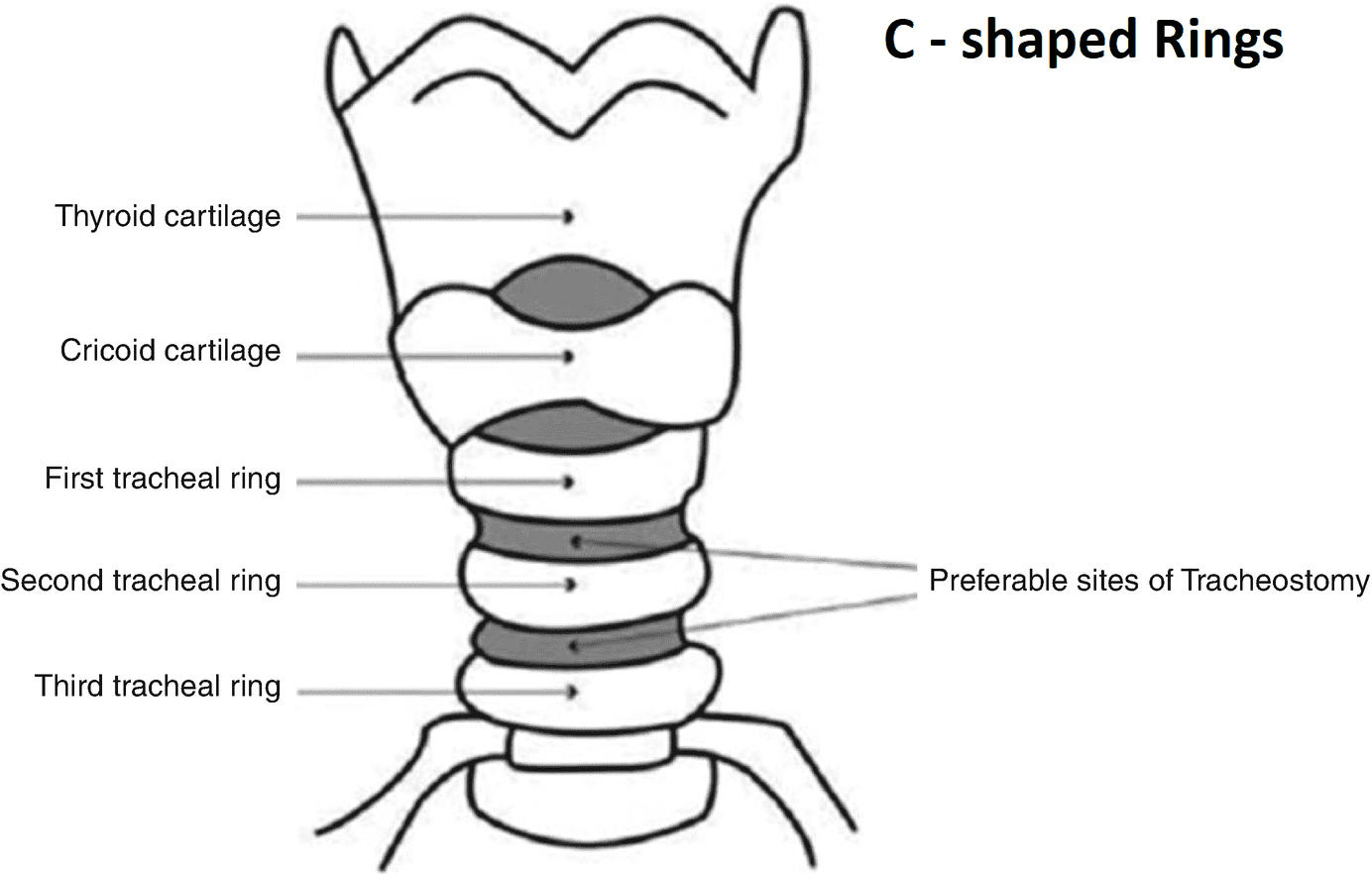
Fig: Trachea and Cartilage Rings
The trachea contains ciliated pseudostratified columnar epithelium-lined tubular structures supported by rings of hyaline cartilage. The cartilage rings present in the trachea are c-shaped because the trachea passes through the esophagus. The rings prevent collapsing in the absence of air. There are 15 to 20 incomplete c-shaped cartilaginous rings present in humans. The rings prevent the trachea from collapse. They are incomplete because this permits the trachea to collapse slightly to allow food to pass down the esophagus. They reinforce the lateral and anterior sides of the trachea for protecting and maintaining the airway. They are not O-shaped due to the trachea’s proximity to the esophagus, which runs behind the trachea. The open part of the cartilage rings faces the esophagus, permitting the trachea to be compressed slightly when the esophagus bulges outward when the food is swallowed.
Note:
Hyaline cartilage offers structural support to the trachea, bronchi, and larynx in the respiratory system. It holds the airway of the trachea open through cartilage rings. The perichondrium is a layer of dense irregular connective tissue, surrounding the cartilage. Two or more cartilage rings are united, partially or completely bifurcated. When food or liquid passes through the esophagus, the rings allow the expansion of the esophagus.
Complete answer
Fig: Trachea and Cartilage Rings
The trachea contains ciliated pseudostratified columnar epithelium-lined tubular structures supported by rings of hyaline cartilage. The cartilage rings present in the trachea are c-shaped because the trachea passes through the esophagus. The rings prevent collapsing in the absence of air. There are 15 to 20 incomplete c-shaped cartilaginous rings present in humans. The rings prevent the trachea from collapse. They are incomplete because this permits the trachea to collapse slightly to allow food to pass down the esophagus. They reinforce the lateral and anterior sides of the trachea for protecting and maintaining the airway. They are not O-shaped due to the trachea’s proximity to the esophagus, which runs behind the trachea. The open part of the cartilage rings faces the esophagus, permitting the trachea to be compressed slightly when the esophagus bulges outward when the food is swallowed.
Note:
Hyaline cartilage offers structural support to the trachea, bronchi, and larynx in the respiratory system. It holds the airway of the trachea open through cartilage rings. The perichondrium is a layer of dense irregular connective tissue, surrounding the cartilage. Two or more cartilage rings are united, partially or completely bifurcated. When food or liquid passes through the esophagus, the rings allow the expansion of the esophagus.
Recently Updated Pages
Which will be the least stable resonating structure class 11 chemistry CBSE

How many 5 digit telephone numbers can be construc-class-11-maths-CBSE
How do you find the angle of the resultant vector class 11 physics CBSE
Draw labelled diagram of the following i Gram seed class 11 biology CBSE
What is the need and importance of classification class 11 biology CBSE
The way in which the sparrows expressed their sorrow class 11 english CBSE
Trending doubts
One Metric ton is equal to kg A 10000 B 1000 C 100 class 11 physics CBSE
Find the value of the expression given below sin 30circ class 11 maths CBSE
1 Quintal is equal to a 110 kg b 10 kg c 100kg d 1000 class 11 physics CBSE
Draw a diagram of nephron and explain its structur class 11 biology CBSE
10 examples of friction in our daily life
Proton was discovered by A Thomson B Rutherford C Chadwick class 11 chemistry CBSE