




What are the 6 basic trigonometric functions?
Answer
 Verified
561k+ views
Hint: The 6 basic trigonometric functions are derived from a right-angled triangle. Firstly we mark the Hypotenuse Base and perpendicular of the triangle then using them we derive the 3 basic trigonometric functions. Then by using these 3 trigonometric functions we derive the rest three of them.
Complete step by step answer:
The all 6 trigonometric functions are derived from a right-angled triangle.
Let the triangle be as below with each side labeled.
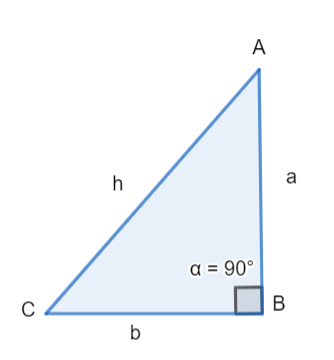
Where,
$a=$ Opposite side
$b=$ Adjacent side
$h=$ Hypotenuse
Now let us take $\angle C$ with respect to which we will find the value of all the basic trigonometric functions.
So starting with 3 Basic trigonometric function which one can find in the most calculators are below:
Sine:
$\sin C=$ Opposite/ Hypotenuse
$\sin C=\dfrac{a}{h}$…….$\left( 1 \right)$
Cosine:
$\cos C=$ Adjacent/Hypotenuse
$\cos C=\dfrac{b}{h}$…..$\left( 2 \right)$
Tangent:
$\tan C=$ Opposite/Adjacent
$\tan C=\dfrac{a}{b}$……$\left( 3 \right)$
Now we can find the rest 3 trigonometric function by the above 3 trigonometric function as:
Cosecant:
$\csc C=\dfrac{1}{\sin C}$
From equation (1) put the value in above equation,
$\Rightarrow \csc C=\dfrac{1}{\dfrac{a}{h}}$
$\therefore \csc C=\dfrac{h}{a}$…..$\left( 4 \right)$
Secant:
$\sec C=\dfrac{1}{\cos C}$
From equation (2) put the value in above equation,
$\Rightarrow \sec C=\dfrac{1}{\dfrac{b}{h}}$
$\therefore \sec C=\dfrac{h}{b}$…..$\left( 5 \right)$
Cotangent:
$\cot C=\dfrac{1}{\tan C}$
From equation (3) put the value in above equation,
$\Rightarrow \cot C=\dfrac{1}{\dfrac{a}{b}}$
$\therefore \cot C=\dfrac{b}{a}$…..$\left( 6 \right)$
So from equation (1)-(6) we get the basic trigonometric functions.
Hence 6 Basic trigonometric functions are sine, cosine, tangent, cosecant, secant and cotangent.
Note: Trigonometry is that branch of mathematics that studies the relation between the sides and the angle of triangles. Trigonometric function which is sine, cosine, tangent, cosecant, secant and cotangent helps in finding the missing side or missing angle of a triangle. There are various trigonometric identities used for calculation purposes.
Complete step by step answer:
The all 6 trigonometric functions are derived from a right-angled triangle.
Let the triangle be as below with each side labeled.
Where,
$a=$ Opposite side
$b=$ Adjacent side
$h=$ Hypotenuse
Now let us take $\angle C$ with respect to which we will find the value of all the basic trigonometric functions.
So starting with 3 Basic trigonometric function which one can find in the most calculators are below:
Sine:
$\sin C=$ Opposite/ Hypotenuse
$\sin C=\dfrac{a}{h}$…….$\left( 1 \right)$
Cosine:
$\cos C=$ Adjacent/Hypotenuse
$\cos C=\dfrac{b}{h}$…..$\left( 2 \right)$
Tangent:
$\tan C=$ Opposite/Adjacent
$\tan C=\dfrac{a}{b}$……$\left( 3 \right)$
Now we can find the rest 3 trigonometric function by the above 3 trigonometric function as:
Cosecant:
$\csc C=\dfrac{1}{\sin C}$
From equation (1) put the value in above equation,
$\Rightarrow \csc C=\dfrac{1}{\dfrac{a}{h}}$
$\therefore \csc C=\dfrac{h}{a}$…..$\left( 4 \right)$
Secant:
$\sec C=\dfrac{1}{\cos C}$
From equation (2) put the value in above equation,
$\Rightarrow \sec C=\dfrac{1}{\dfrac{b}{h}}$
$\therefore \sec C=\dfrac{h}{b}$…..$\left( 5 \right)$
Cotangent:
$\cot C=\dfrac{1}{\tan C}$
From equation (3) put the value in above equation,
$\Rightarrow \cot C=\dfrac{1}{\dfrac{a}{b}}$
$\therefore \cot C=\dfrac{b}{a}$…..$\left( 6 \right)$
So from equation (1)-(6) we get the basic trigonometric functions.
Hence 6 Basic trigonometric functions are sine, cosine, tangent, cosecant, secant and cotangent.
Note: Trigonometry is that branch of mathematics that studies the relation between the sides and the angle of triangles. Trigonometric function which is sine, cosine, tangent, cosecant, secant and cotangent helps in finding the missing side or missing angle of a triangle. There are various trigonometric identities used for calculation purposes.
Recently Updated Pages
Master Class 12 Economics: Engaging Questions & Answers for Success

Master Class 12 English: Engaging Questions & Answers for Success
Master Class 12 Social Science: Engaging Questions & Answers for Success
Master Class 12 Maths: Engaging Questions & Answers for Success
Master Class 12 Physics: Engaging Questions & Answers for Success
Master Class 9 General Knowledge: Engaging Questions & Answers for Success
Trending doubts
One Metric ton is equal to kg A 10000 B 1000 C 100 class 11 physics CBSE
Difference Between Prokaryotic Cells and Eukaryotic Cells
Two of the body parts which do not appear in MRI are class 11 biology CBSE
1 ton equals to A 100 kg B 1000 kg C 10 kg D 10000 class 11 physics CBSE
Draw a diagram of nephron and explain its structur class 11 biology CBSE
10 examples of friction in our daily life