




Are ribosomes membrane-bound?
Answer
 Verified
564.9k+ views
Hint: These are cellular machines made up of specialized ribosomal RNA along with dozens of distinct proteins. These are sites for protein synthesis.
Complete answer:
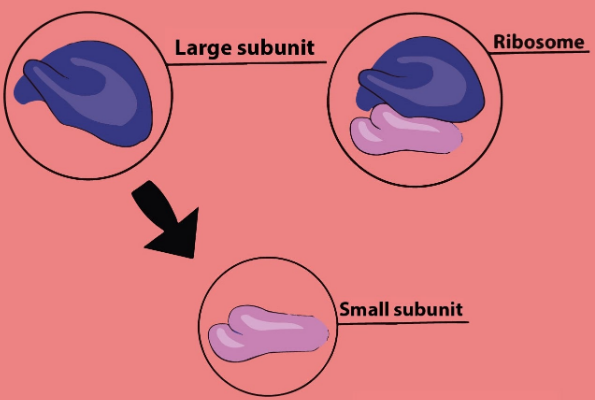
No, ribosomes are not membrane-bound. They are formed of specialized ribosomal RNA or rRNA along with various distinct proteins that function to synthesize proteins. The ribosomal proteins and rRNAs are arranged into two distinct ribosomal pieces of various sizes, known generally because of the large and little subunit of the ribosome. Ribosomes contain two subunits that fit together and work together to translate the mRNA into a polypeptide chain during protein synthesis. Because they are formed from two subunits of non-equal size, they are slightly longer within the axis than in diameter.
-Ribosomes are found floating within the cytoplasm or even attached to the endoplasmic reticulum.
-A ribosome translates encoded information from the cell nucleus that is provided by messenger ribonucleic acid or mRNA.
-It also links together amino acids that are selected and collected from the cytoplasm by the transfer of ribonucleic acid or tRNA.
-If the ribosome exists in a free or membrane-bound state, it solely depends on the presence of an ER-targeting signal sequence on the protein that is being synthesized.
-An individual ribosome could be membrane-bound when it's making one protein. However, it might be a free ribosome in the cytosol when it makes another protein.
-The ribosomes of the eukaryote are produced and assembled in the nucleolus.
-The ribosomal proteins enter the nucleolus and combine with four rRNA strands to create a small and a large ribosomal subunit that makes up the complete ribosome.
Note:
-Free and membrane-bound ribosomes differ from each other only in their spatial distribution. They are identical in structure.
-The ribosome may have first originated in the world of RNA.
-They would have appeared as self-replicating complex structures which only later evolved the ability to synthesize proteins when amino acids began to appear.
Complete answer:
No, ribosomes are not membrane-bound. They are formed of specialized ribosomal RNA or rRNA along with various distinct proteins that function to synthesize proteins. The ribosomal proteins and rRNAs are arranged into two distinct ribosomal pieces of various sizes, known generally because of the large and little subunit of the ribosome. Ribosomes contain two subunits that fit together and work together to translate the mRNA into a polypeptide chain during protein synthesis. Because they are formed from two subunits of non-equal size, they are slightly longer within the axis than in diameter.
-Ribosomes are found floating within the cytoplasm or even attached to the endoplasmic reticulum.
-A ribosome translates encoded information from the cell nucleus that is provided by messenger ribonucleic acid or mRNA.
-It also links together amino acids that are selected and collected from the cytoplasm by the transfer of ribonucleic acid or tRNA.
-If the ribosome exists in a free or membrane-bound state, it solely depends on the presence of an ER-targeting signal sequence on the protein that is being synthesized.
-An individual ribosome could be membrane-bound when it's making one protein. However, it might be a free ribosome in the cytosol when it makes another protein.
-The ribosomes of the eukaryote are produced and assembled in the nucleolus.
-The ribosomal proteins enter the nucleolus and combine with four rRNA strands to create a small and a large ribosomal subunit that makes up the complete ribosome.
Note:
-Free and membrane-bound ribosomes differ from each other only in their spatial distribution. They are identical in structure.
-The ribosome may have first originated in the world of RNA.
-They would have appeared as self-replicating complex structures which only later evolved the ability to synthesize proteins when amino acids began to appear.

Recently Updated Pages
Master Class 9 General Knowledge: Engaging Questions & Answers for Success

Master Class 9 Maths: Engaging Questions & Answers for Success
Master Class 9 Science: Engaging Questions & Answers for Success
Master Class 9 English: Engaging Questions & Answers for Success
Master Class 9 Social Science: Engaging Questions & Answers for Success
Class 9 Question and Answer - Your Ultimate Solutions Guide
Trending doubts
Find the sum of series 1 + 2 + 3 + 4 + 5 + + 100 class 9 maths CBSE
Difference Between Plant Cell and Animal Cell
Fill the blanks with the suitable prepositions 1 The class 9 english CBSE
What is pollution? How many types of pollution? Define it
What is the Full Form of ICSE / ISC ?
Name 10 Living and Non living things class 9 biology CBSE