




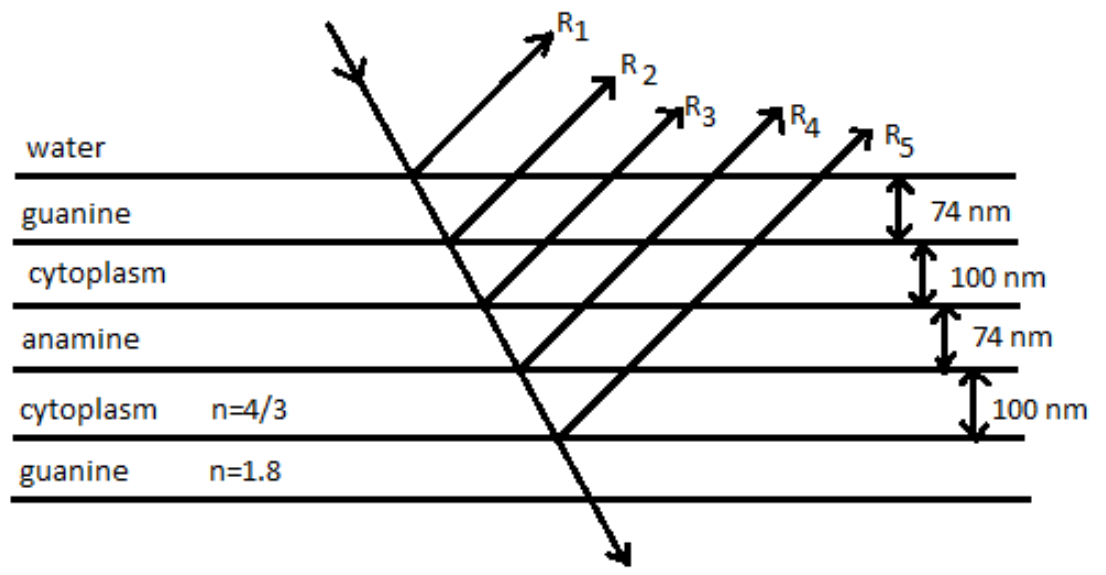
Are $${R_1}$$ , ${R_2}$ , ${R_3}$ , ${R_4}$ and ${R_5}$ in phase.
A. Yes
B. No
C. Maintain a constant phase
D. Insufficient data to reply
Answer
 Verified
570k+ views
Hint: This is the concept of Huygens’s wave theory. He proposed that in the case of reflection of light, the angle of incidence is equal to the angle of reflection of the light. Also, the angle of reflection and angle of incidence of the light lies at $90^\circ $ to the point of incidence of the light.
Complete step by step answer:
Here, let a light is incident to the denser medium as shown below
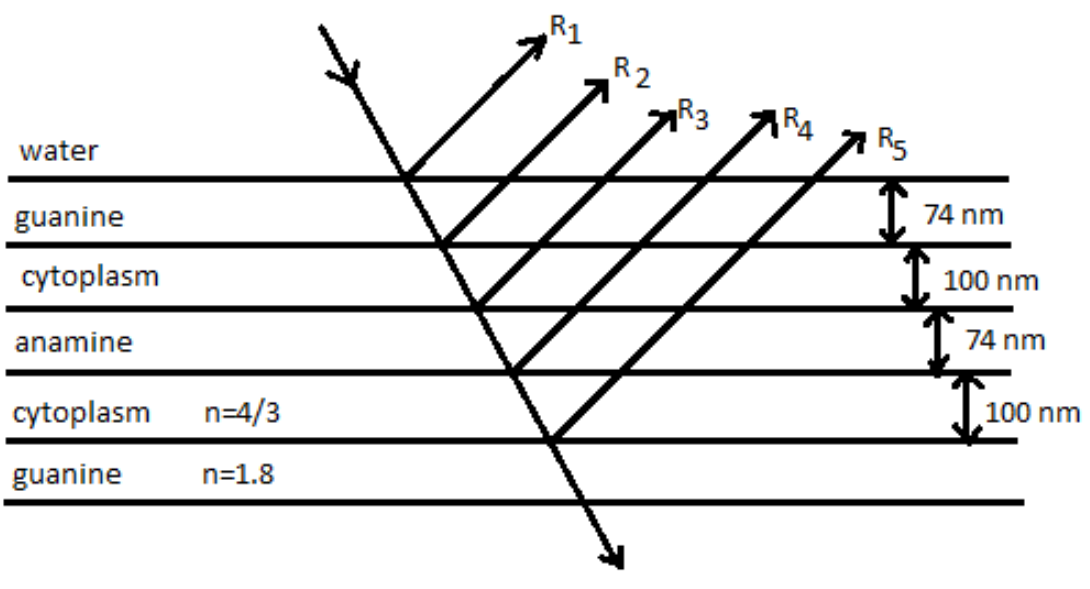
- Here, ${R_1}$ is the ray reflected from the water, ${R_2}$ is the ray reflected from guanine, ${R_3}$ is the ray reflected from the cytoplasm, ${R_4}$ is the ray reflected from an amine, and ${R_5}$ is the ray reflected from the cytoplasm having refractive index $\dfrac{4}{3}$.
- As we can say, there is a half-cycle phase shift from the water to the guanine interface. This half-cycle shift continues for all the interfaces up to the cytoplasm of refractive index $\dfrac{4}{3}$. But there is no half-cycle shift from the guanine ($n = 1.8$) interface.
- Therefore, we can say that due to reflections there is one half-cycle phase shift in the two neighboring reflected rays. Therefore, rays ${R_1}$ , ${R_2}$ , ${R_3}$ , ${R_4}$ and ${R_5}$ maintain a constant phase.
So, the correct answer is “Option C”.
Note:
Huygens principle states that when a light is incident on an arbitrary surface the wave front itself forms spherical wavelets and these wavelets are always directed in the forward direction. Therefore, every wave front acts as a source of secondary wavelets. Also, propagation of light waves is equal to the sum of wavelets formed spreading from each point of the wave front.
Complete step by step answer:
Here, let a light is incident to the denser medium as shown below
- Here, ${R_1}$ is the ray reflected from the water, ${R_2}$ is the ray reflected from guanine, ${R_3}$ is the ray reflected from the cytoplasm, ${R_4}$ is the ray reflected from an amine, and ${R_5}$ is the ray reflected from the cytoplasm having refractive index $\dfrac{4}{3}$.
- As we can say, there is a half-cycle phase shift from the water to the guanine interface. This half-cycle shift continues for all the interfaces up to the cytoplasm of refractive index $\dfrac{4}{3}$. But there is no half-cycle shift from the guanine ($n = 1.8$) interface.
- Therefore, we can say that due to reflections there is one half-cycle phase shift in the two neighboring reflected rays. Therefore, rays ${R_1}$ , ${R_2}$ , ${R_3}$ , ${R_4}$ and ${R_5}$ maintain a constant phase.
So, the correct answer is “Option C”.
Note:
Huygens principle states that when a light is incident on an arbitrary surface the wave front itself forms spherical wavelets and these wavelets are always directed in the forward direction. Therefore, every wave front acts as a source of secondary wavelets. Also, propagation of light waves is equal to the sum of wavelets formed spreading from each point of the wave front.
Recently Updated Pages
Master Class 11 Computer Science: Engaging Questions & Answers for Success

Master Class 11 Business Studies: Engaging Questions & Answers for Success
Master Class 11 Economics: Engaging Questions & Answers for Success
Master Class 11 English: Engaging Questions & Answers for Success
Master Class 11 Maths: Engaging Questions & Answers for Success
Master Class 11 Biology: Engaging Questions & Answers for Success
Trending doubts
One Metric ton is equal to kg A 10000 B 1000 C 100 class 11 physics CBSE
There are 720 permutations of the digits 1 2 3 4 5 class 11 maths CBSE
Discuss the various forms of bacteria class 11 biology CBSE
Draw a diagram of a plant cell and label at least eight class 11 biology CBSE
State the laws of reflection of light
10 examples of friction in our daily life